
This Space Available
By Emily Carney
A new video by the fantastic lunarmodule5 channel on YouTube recreates Skylab’s last moments and underscores how it held together surprisingly well during its 34,981st and final orbit, which saw it begin its end over the South Atlantic and Indian Oceans. The newly released video, pieced together from audio sourced from the National Archives, is a fascinating look at how the first U.S. space station’s reentry was monitored by tracking stations and NORAD. Skylab’s final “heartbeats” – its telemetry – remained robust until its final Ascension Island pass, when it was observed that the station was beginning to break up. But where is Ascension Island, and why is its role not appreciated as much as it should be in Skylab history?
In The Middle of Nowhere
The ever-reliable Wikipedia describes Ascension Island as “an isolated volcanic island.” This may be a tour de force in understatement, as the former location of one of NASA’s tracking stations looks close to NOTHING, NADA, and zip geographically if you zoom into it on Google Maps. Up until more recently, the South Atlantic island lived up to its “volcanic” and barren status, remaining relatively devoid of greenery and trees. If you live on the United States’ eastern coast, it’s five hours ahead of you; if you live in Florida, it’s a little warmer there this time of year in comparison, at roughly 70 degrees Fahrenheit. While it’s not a region renowned, say, for theme park rides or great shopping, its former inhabitants – many of whom were NASA employees or USAF airmen – have very warm memories of it and their time stationed there. Maybe its remoteness and strangeness are why it’s not as well-connected to the Skylab program as it should be.
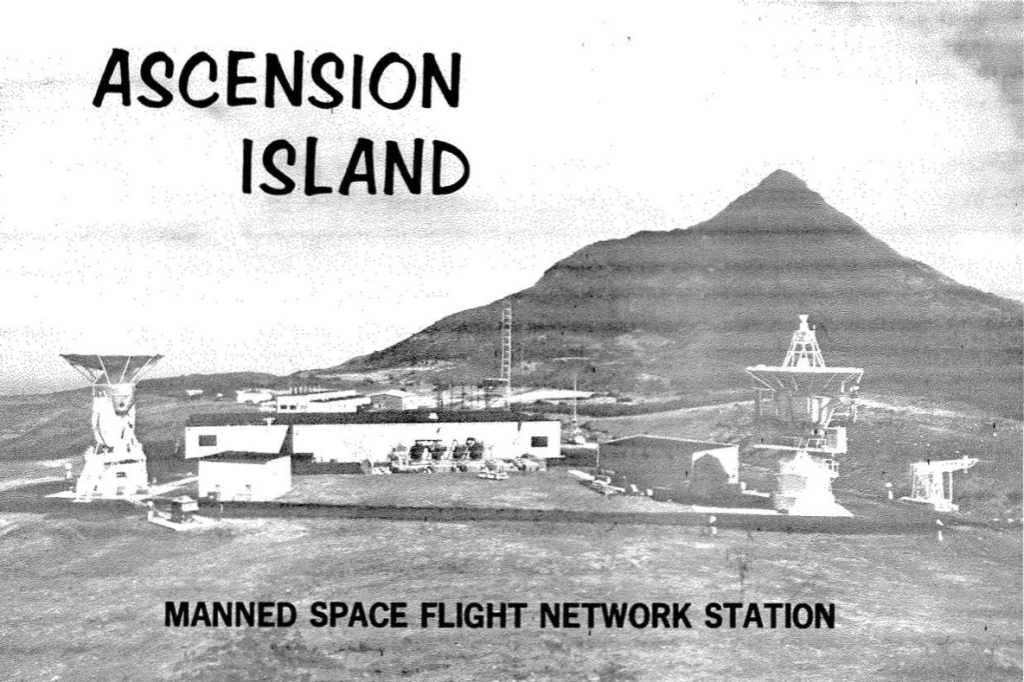
The Ascension Island tracking station operated from 1967, when the Apollo lunar landing program was heating up, to 1990, when the Shuttle-era Tracking and Data Relay Satellite System (TDRSS) largely superseded it. If you’re a space history buff, there’s very little left of the island’s golden era days of space tracking, and you can’t just hop on a plane and visit, as travel is highly restricted. According to its government website, “It is possible to travel to Ascension Island via St. Helena by a monthly charter service operated by AirLink.”
But we do have the memories of Dan Kovalchik, one of the controllers who kept the tracking station running. And he was on console when Skylab reentered.
It almost goes without saying that up until July 11, 1979, the sheer uncertainty of Skylab’s final moments was something of a worldwide joke. But there was real anxiety about its resting place, given that the space station was then the largest single piece of space debris slated for deorbit. Plus, memories of 1978’s Kosmos 954 incident, which saw contaminated space debris rain across parts of northern Canada, were still fresh in space watchers’ minds. So, personnel at several international tracking stations, particularly Bermuda and Ascension Island, were essential in giving Houston’s Johnson Space Center updates as Skylab entered its terminal orbit.
The View From The Island
In his book The Devil’s Ashpit and Other Tales of Ascension Island, Kovalchik describes the full-circle moment tracking Skylab for the last time, as he began his career during the first part of the program at the Corpus Christi tracking station (TEX). He wrote, “Even if we had remained oblivious to the media coverage, I still would have felt myself lucky to be working during the predicted reentry orbit. I’d tracked a few brand-new satellites in my short career (Skylab being the first) and I was on the Vanguard [tracking ship] for the manned Apollo-Soyuz capsule reentries, but I’d never tracked a satellite to its absolute end.” He was joined by an intern named Gene.
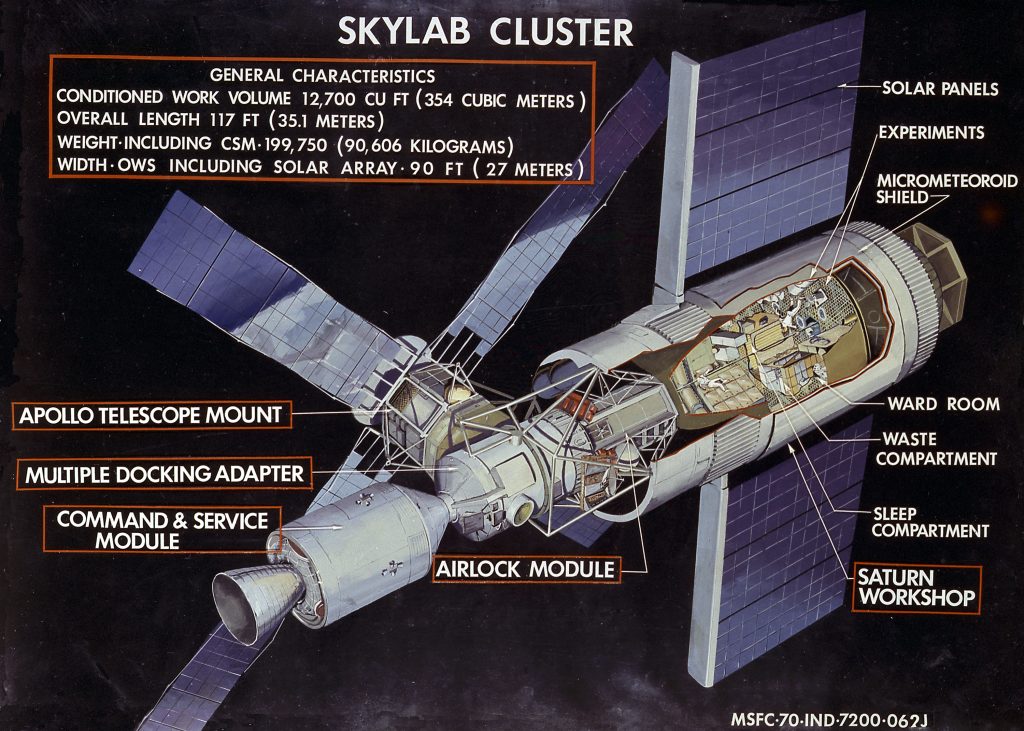
Twelve minutes into the lunarmodule5 video, Skylab began approaching its final Ascension Island pass; moments later, the EGIL, the flight controller in Houston responsible for monitoring Skylab’s electrical systems, reported that the Apollo Telescope Mount’s (ATM) batteries were beginning to heat up. The ATM was the space station’s large, distinctively “windmill”- shaped structure with four solar panels, and it was already believed that the solar panels would likely fail first during reentry. As Skylab ended its final Bermuda pass, NORAD confirmed with NASA’s flight controllers that Skylab was still in one piece, between 80 and 70 miles in altitude above the Earth. Three minutes from Ascension, the vehicle, remarkably, still remained in one piece.
It would not be intact much longer. At the video’s 21:30 mark, the command “Ascension SCE, load mark 0608” and the response (voiced by Gene, the intern) “Mark 0608 loaded” can be heard. This was the last command ever successfully sent to Skylab’s Apollo Telescope Mount Digital Computer (ATMDC), which controlled the space station’s orientation. Kovalchik added in The Devil’s Ashpit, “So just like I had done all week, I stood beside Gene while he prepped the computer, tested its link to S-band, and (correctly) announced, ‘OPS, SCE. We’re go for commanding.’ And I was standing beside him at 16:01:31 when he sent the very last command that Skylab would ever receive. The command turned on the doomed spacecraft’s Attitude and Pointing Control System so that the on-board computer would transmit rate-of-tumble information, helpful in predicting where on Earth the mission would come to an end. Attaboy, Gene!”
Right after this command was sent, Ascension reported the spacecraft was rapidly tumbling, but they still had telemetry. Moments later, the EGIL rather humorously reported, “We don’t have any indication [the solar panels are] off, but we don’t have any indication they’re on, either.” There’s an audible, nervous laugh in the background in Houston. Ascension then reported it was gradually losing telemetry. A couple of minutes later, the EGIL reported that a “cluster” of solar cells was still reporting voltage. It’s ironic that the space station, which arrived in orbit missing many essential pieces and parts, was still holding together this well. Then, there was a loss of signal. Johnson Space Center’s John Uri wrote in a NASA article regarding Skylab’s reentry, “Once the disintegrating station passed out of range of Ascension, it continued its reentry unmonitored.” And end scene.
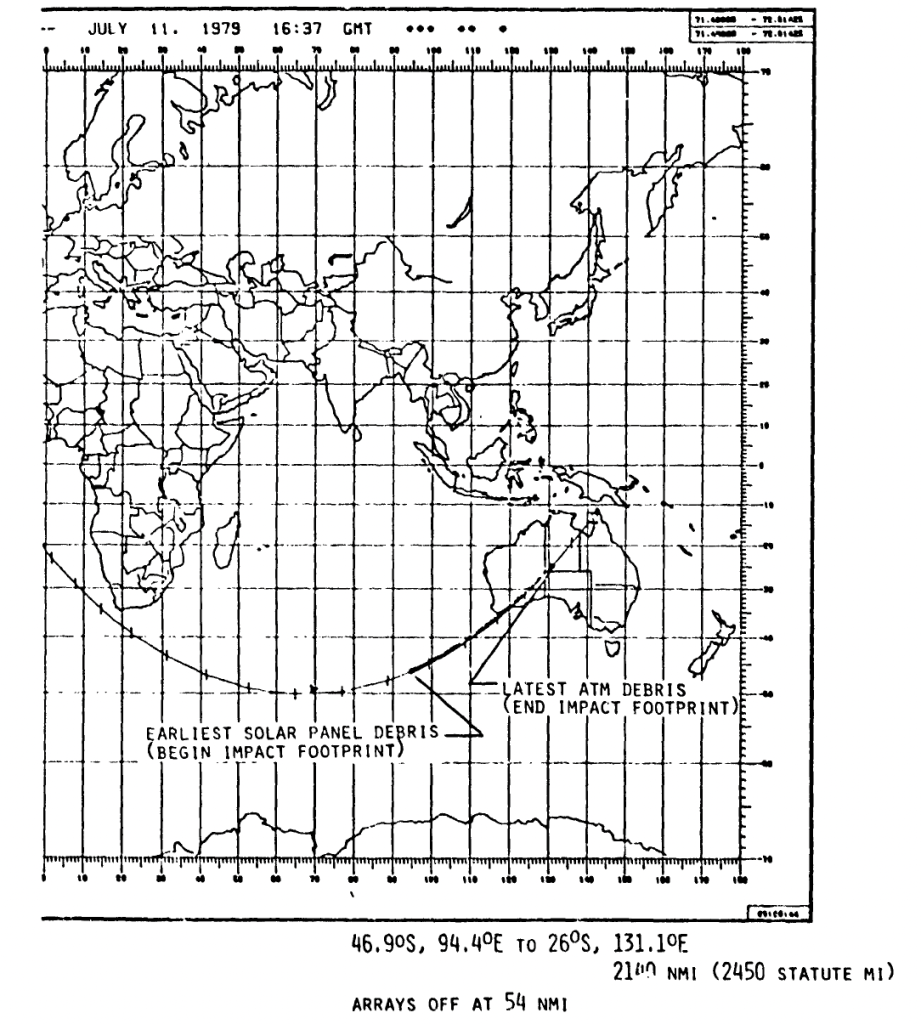
Kovalchik related in a conversation with this author that by this point, the monitoring controllers knew Skylab was coming apart: “The S-band techs confirmed that by the end of the pass, they were tracking two distinct pieces.” It’s elegant – and somehow fitting – that Skylab spent its final moments tracing one last quiet arc over a lonely volcanic island in the South Atlantic.
Featured image credit: “This illustration shows general characteristics of Skylab with callouts of its major components.” The Apollo Telescope Mount (ATM) was among the first of Skylab’s components to separate from the space station cluster during its July 11, 1979 reentry. 1970 NASA MSFC image
*****
Emily Carney is a writer, space enthusiast, and creator of the This Space Available space blog, published since 2010. In January 2019, Emily’s This Space Available blog was incorporated into the National Space Society’s blog. The content of Emily’s blog can be accessed via the This Space Available blog category.
Note: The views expressed in This Space Available are those of the author and should not be considered as representing the positions or views of the National Space Society.










2 thoughts on “Beginning the End: Skylab’s Last Glint Over Ascension Island”
Nice tribute to good old Skylab.
Thanks for the article Emily, makes the video really come alive.
Thanks for the link to my channel too…really appreciated