
| Keeping the International Space Station (ISS) supplied will become an increasing challenge with the retirement of the US Space Shuttle in 2011. This is the first in a series to look at how the ISS will be serviced for the next five or six years.
The Japanese were schedule to launch their second H-II Transfer Vehicle (HTV-2) resupply mission today, 20 January, but weather has caused the mission to be rescheduled for a possible launch on Saturday. |
The Russians fly their Progress spacecraft on resupply missions, and the next one is scheduled for 28 January.
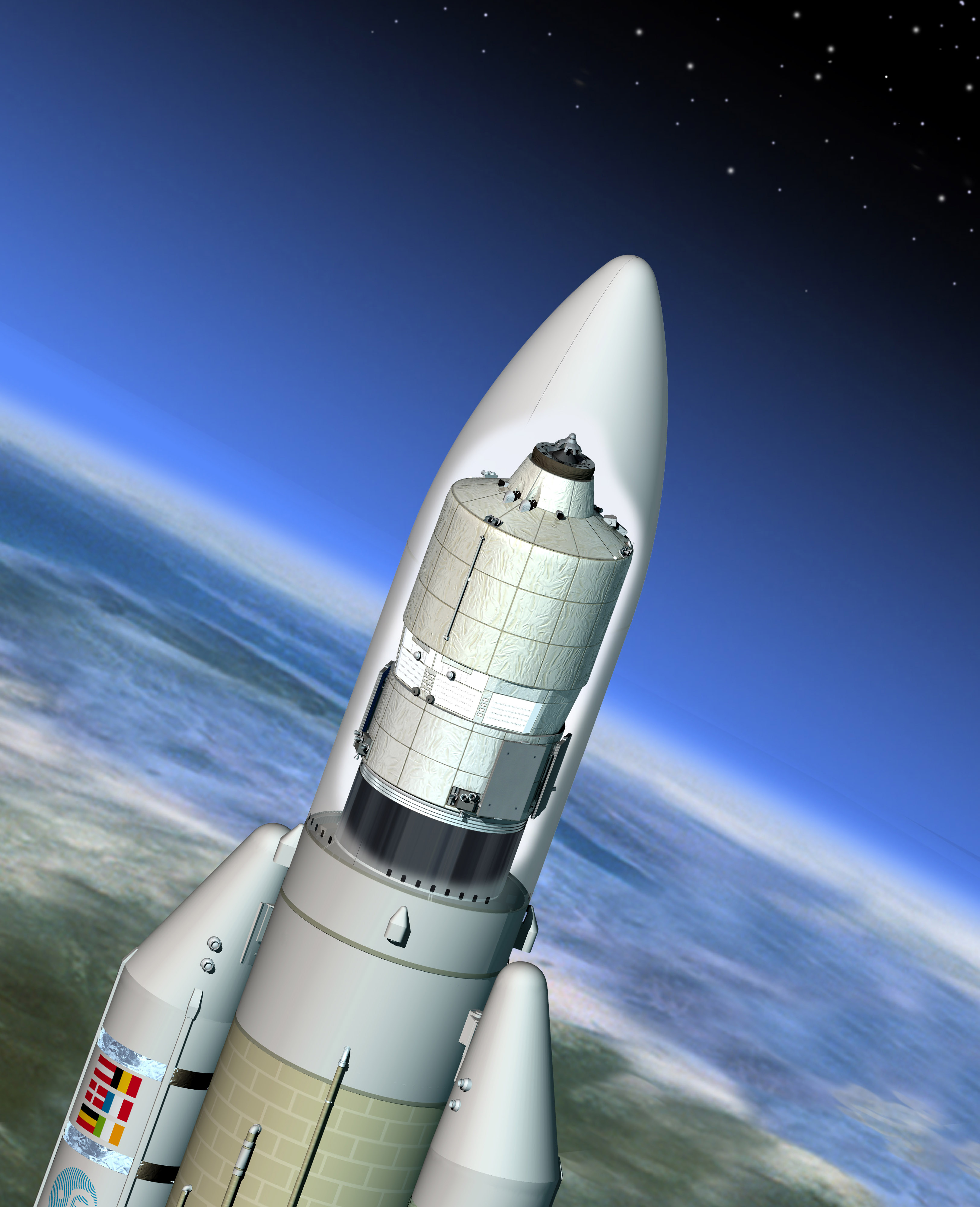 ATV-2 Johannes Kepler Image Credit: European Space Agency (ESA) |
The European Space Agency (ESA) has flown their Automated Transfer Vehicle (ATV-1 or Jules Verne) to the ISS once before on 9 March 2008, and their next launch is coming up on 15 February 2011.
On the commercial side, Space X has successfully orbited their Dragon spacecraft and returned to Earth. Their next test flight is penciled in for July and the first resupply mission is penciled in for December. And Orbital Sciences Corporation has their first cargo delivery test of its Cygnus spacecraft scheduled for December 2011. That summarizes the partners working to support the International Space Station. |
Here is a more detailed look at the European Space Agency’s ATV system.
The 20 ton Johannes Kepler ATV has a cargo capacity of up to 7 metric tons. The composition of this load can vary depending on the mission:
The spacecraft is compose of two main sections. The first is the ATV Service Module (below, left), which is not pressurized, includes propulsion systems, electrical power, computers, communications and most of the avionics. The ATV uses four main engines and 28 small thrusters to control the navigation of the spacecraft. Four solar panels are deployed after launch and supply 4800 Watts of power to the batteries and the electrical systems. The second component is the Integrated Cargo Carrier (below, right). The large section in the front is pressurized and comprises about 90% of the cargo volume. It handles all the dry cargo, including the racks on each side. The inhabitants of the International Space Station access this area through the hatch in the Russian docking system. |
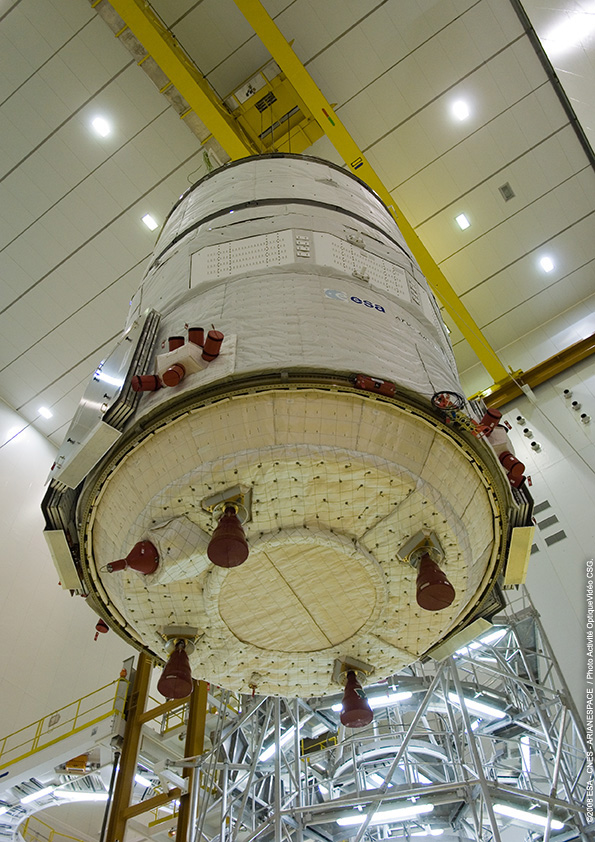 ATV Service Module & Four Main Engines Image Credit: ESA |
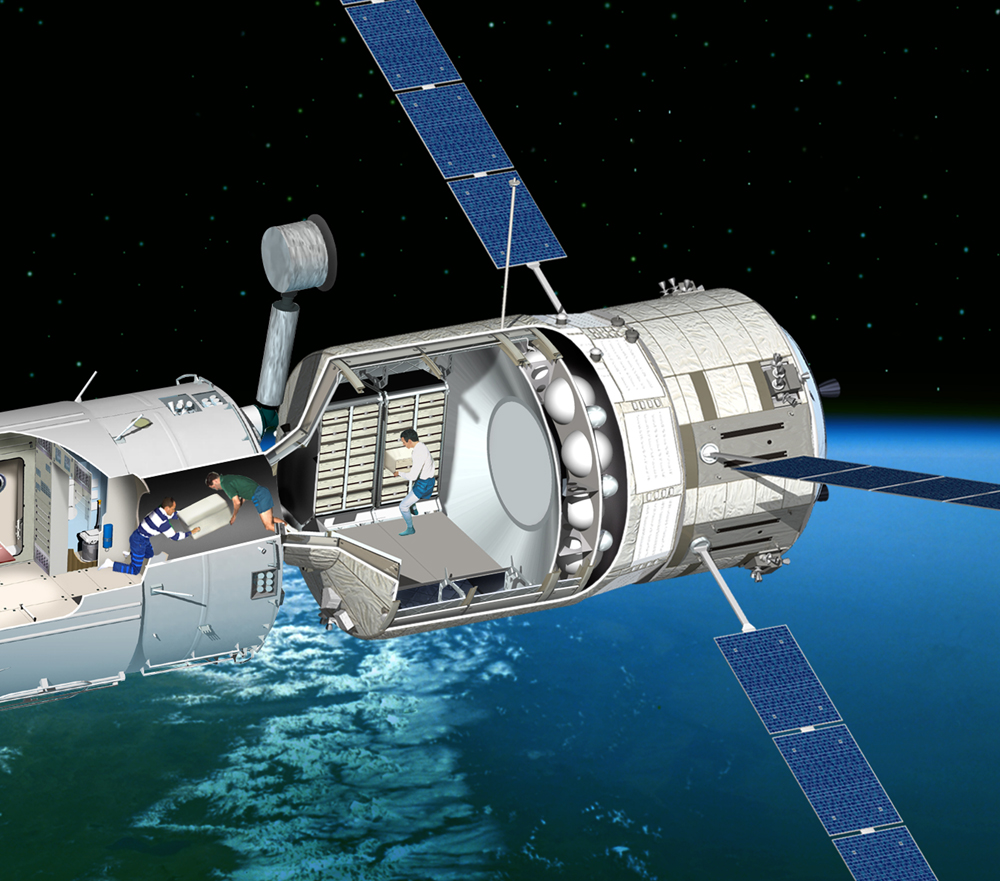 Cutaway of ATV Cargo Carrier Image Credit: ESA |
| The Equipped External Bay of the Integrated Cargo Carrier (ICC) holds 22 spherical tanks of different sizes and colors (below, left). These tanks are used to re-supply the Station with propellant for the International Space Station propulsion system, various gases (air, oxygen, and nitrogen) and water for the crew.
The contents of these tanks are delivered to the Station through dedicated connections, or through manually operated hoses. |
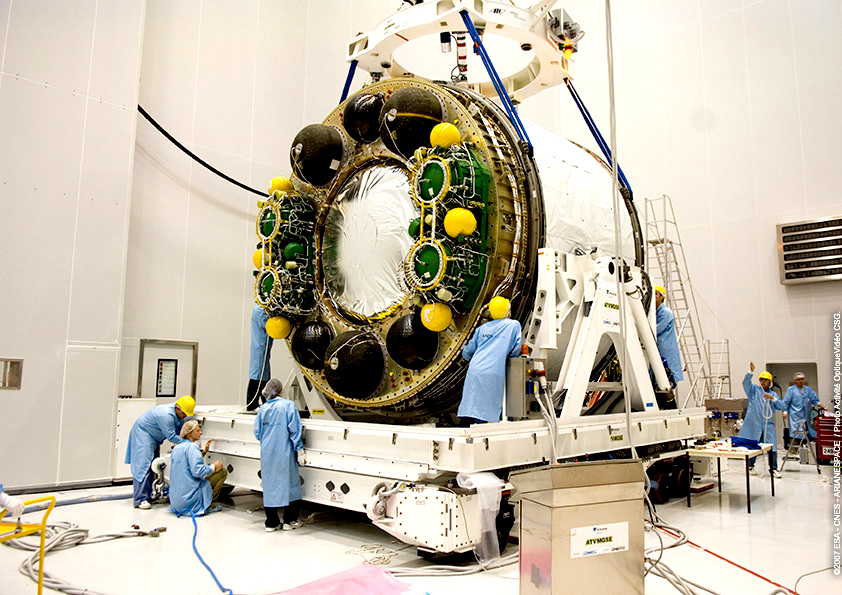 ATV Liquid Resupply Tanks Image Credit: ESA |
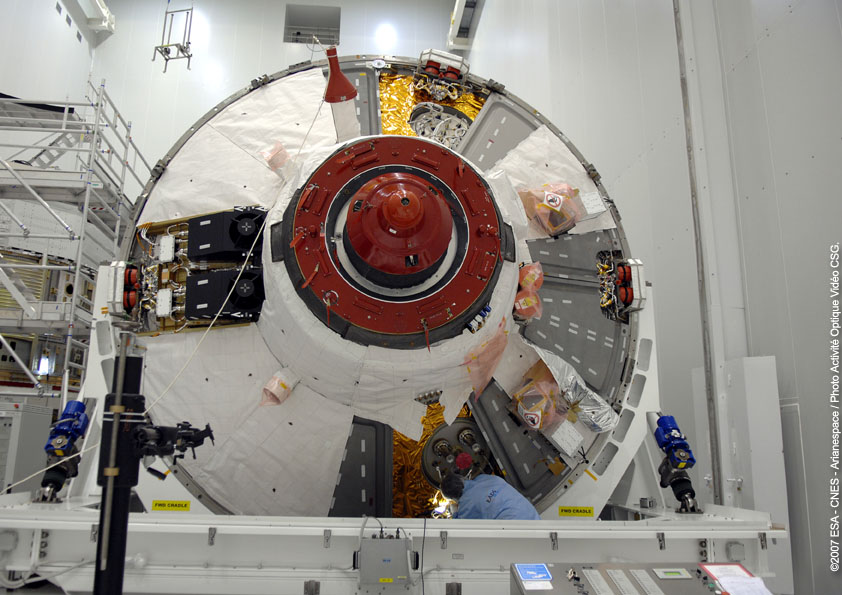 Russian Docking Module Image Credit: ESA |
| The ATV uses the Russian-made docking equipment sensors to perform the approach and docking sequence (above, right). The procedure is the same as with the Soyuz manned capsules and the Progress resupply spacecraft.
The Russian docking system enables physical, electrical and propellant connections with the Station. Access to the ICC is through the Russian hatch. Once the ATV is securely docked, the crew can enter the cargo section and remove the payload, which usually includes maintenance supplies, science hardware, parcels of fresh food, mail and family tapes or DVDs. |











4 thoughts on “ATV-2 Johannes Kepler”
On the 15th of Feb, cargo will be transported to the ISS by ATV-2. That’s 19 days away! Take a look at the ESA ATV blog. http://blogs.esa.int/atv/
Awesome pictures, I feel we’re entering a rather sad period in space exploration where government would rather spend millions on election campaigns than on expanding human reach.