By Burt Dicht
NSS Managing Director of Membership
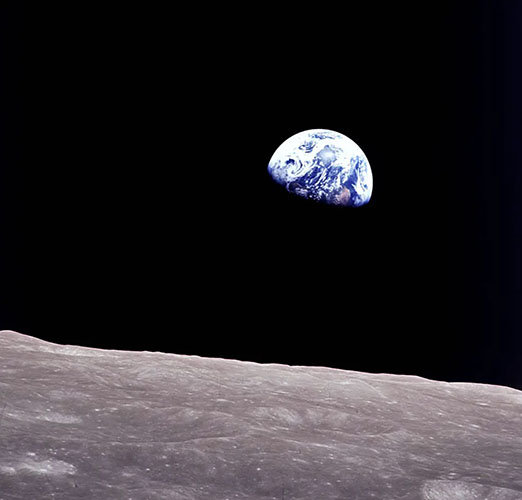
Image: Earthrise from Apollo 8, taken December 24, 1968. Courtesy NASA.
December occupies a unique place in the history of human spaceflight. It was today in 1968 that humans first ventured beyond low Earth orbit, and in December 1972 that we last walked on the surface of another world. More than five decades later, as NASA prepares for Artemis II, December once again invites reflection—on where we have been, what we learned, and why it still matters.
Apollo 8: When Humanity Left Home
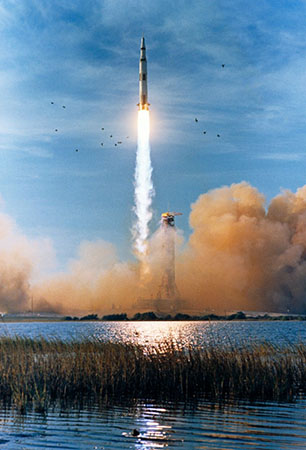
On December 21, 1968, Apollo 8 lifted off, carrying Frank Borman, Jim Lovell, and Bill Anders farther from Earth than any human had ever traveled. For the first time, humans left low Earth orbit, journeyed to the Moon, and entered lunar orbit. The mission was bold, risky, and absolutely essential. Apollo 8 proved that the Saturn V could perform as designed, that the Apollo spacecraft could sustain human life far from Earth, and that navigation and communications at lunar distances were achievable. Without Apollo 8, Apollo 11 would not have happened.
Yet Apollo 8’s legacy extends far beyond engineering validation. As the spacecraft orbited the Moon, Bill Anders captured one of the most influential photographs ever taken—Earthrise. Against the stark lunar foreground, Earth appears small, luminous, and alone. No borders. No nations. Just one fragile world suspended in space.
Reflecting on that moment years later, Anders famously observed:
“We came all this way to explore the Moon, and the most important thing is that we discovered the Earth.”
That insight captures the profound irony—and the enduring power—of Apollo 8. The mission fundamentally reshaped humanity’s self-perception. Earthrise helped catalyze the environmental movement, influenced global conversations about stewardship, and reminded us that everything we value exists on a single, finite planet.
For many of us, including me, Apollo 8 was transformative. I was nine years old at the time, and it is no exaggeration to say that I became an engineer because of Apollo 8—because it demonstrated what thoughtful engineering, driven by purpose, could achieve.
Apollo 17: The Last Footsteps, and an Unfinished Promise
Four years later, from December 7 to December 19, 1972, Apollo 17 unfolded over twelve remarkable days that would become humanity’s final journey to the Moon. Eugene Cernan, Harrison Schmitt, and Ronald Evans completed the most scientifically ambitious Apollo landing, spending three days in the Taurus-Littrow valley. With Schmitt—the first professional geologist to walk on the Moon—Apollo 17 represented the maturation of lunar exploration from demonstration to discovery.
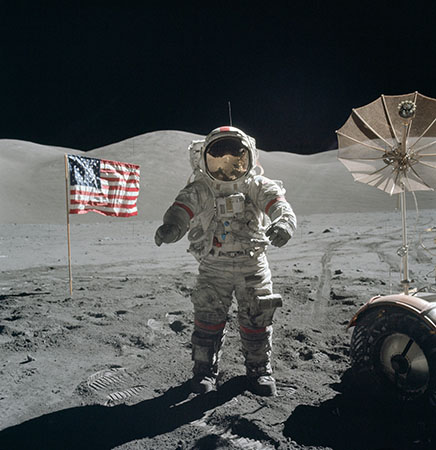
As Commander Gene Cernan prepared to leave the lunar surface for the final time, he paused before ascending the ladder and spoke words that still echo today:
“And, as we leave the Moon at Taurus-Littrow, we leave as we come and, God willing, as we shall return, with peace and hope for all mankind.”
Those words were not a conclusion—they were a promise. At the time, many believed the return would come quickly. Instead, decades passed. Apollo 17 marked an extraordinary ending—but not the end of the story.
Looking Ahead: Artemis II and the Next Chapter
Today, 53 years after Apollo 17, we find ourselves once again on the threshold of return. With Artemis II targeted for launch as early as February 2026, humans are preparing to leave low Earth orbit and journey toward the Moon. Like Apollo 8, Artemis II is not a landing mission—it is a proving mission, designed to validate systems, crews, and operations in deep space.
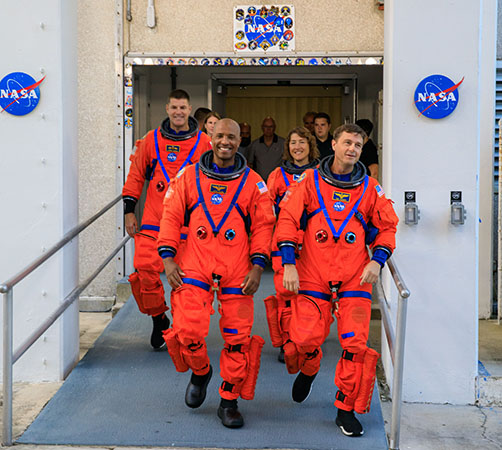
The parallels are striking. Apollo 8 showed us what was possible. Apollo 17 showed us what could be accomplished. Artemis represents an opportunity to build something lasting—sustained exploration, international partnership, and a future presence beyond Earth.
As we reflect this December, it is worth remembering that the true legacy of Apollo is not just where we went, but how those missions changed us. The courage to venture beyond our home world remind us that space exploration is ultimately about humanity’s quest for knowledge—and for understanding our place in a vast universe.
The next time humans see Earth rise above another horizon, we will carry those lessons with us—and continue a journey that began, fittingly, in December 1968.