By Burt Dicht
NSS Managing Director of Membership
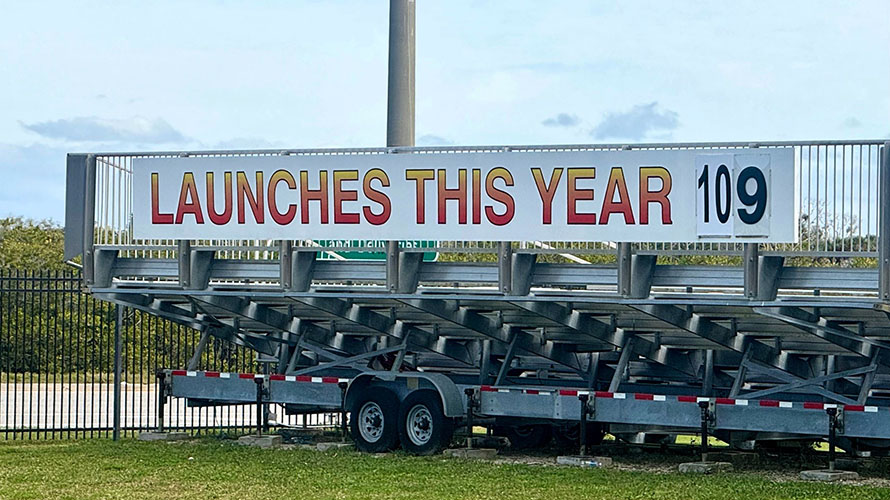
Every time I drive the NASA Causeway toward the National Space Society offices at the Kennedy Space Center Visitor Complex, I pass a sign that tells a quiet but revealing story [photo above by Burt Dicht]. It displays the number of launches from Florida’s Space Coast so far this year. In 2025, that number became hard to ignore.
As flight operations for the year ended, the counter reached 109 launches, a new all-time record that far surpassed the previous high of 93 set just one year earlier. The sign itself struggled to keep up, its mismatched digits reflecting how quickly the pace had accelerated. What was once a rare, carefully scheduled event has become routine. Rockets now rise from the Space Coast several times a week, and sometimes several times in a single day.
That sign is more than a statistic. It reflects a fundamental shift in how spaceflight now operates. By the end of 2025, access to orbit was no longer defined by how often rockets could fly, but by how effectively they could be reused. The space community’s focus moved from proving launch systems to leveraging them—driving down cost, increasing reliability, and enabling sustained activity beyond Earth. Reusability has moved beyond demonstration and is becoming the foundation for expanded opportunity in space.
This 2025 Year in Space review looks back on a year when that shift became unmistakably visible. Rather than cataloging missions month by month, it focuses on how flight testing matured into usable operational capacity—and how that capacity sets the stage for what comes next.
Heavy-Lift Validation
The most consequential technical development of 2025 was the continued maturation of next-generation heavy-lift launch vehicles. For decades, payload mass and launch availability constrained exploration architectures. Those constraints did not disappear overnight, but they began to ease in measurable ways.
For SpaceX, 2025 was defined by demanding flight-test realities. Several Starship missions early in the year ended in catastrophic failures, underscoring the difficulty of scaling fully reusable launch systems to unprecedented size. These outcomes reflected fundamental challenges involving propulsion, thermal protection, vehicle dynamics, and integrated operations—challenges that can only be resolved through flight.
Progress came later in the year. Flight 11, launched in October, marked the most complete Starship mission to date.

The upper stage reached its intended trajectory, and the Super Heavy booster executed a controlled descent, completing a soft ocean landing. While the booster was not recovered by the launch tower’s chopsticks, the mission demonstrated stable ascent, stage separation, reentry control, and recovery sequencing within a single flight profile. It closed critical performance gaps and provided a clearer path toward operational refinement in 2026. And the booster was successfully captured by the chopsticks for the second time on the seventh Starship test flight on January 16, 2025.
Blue Origin followed a different development path. After years of ground testing and system qualification, New Glenn entered service with a successful maiden flight in January, deploying the Blue Ring Pathfinder (test bed for a multipurpose orbital transfer vehicle). In November, the vehicle launched NASA’s twin ESCAPADE probes toward Mars and successfully recovered its booster on the Jacklyn landing platform vessel. Within a single year, New Glenn transitioned from long-anticipated to operationally relevant, positioning it for a more active manifest ahead.

Completing the launch picture was United Launch Alliance’s Vulcan rocket. Vulcan flew again in 2025, continuing its transition into operational service and supporting national security launch requirements as Atlas V is retired. Vulcan does not pursue full reusability, but it plays a critical role in sustaining assured access to space. Its steady progress reinforces the reliability needed for missions that depend on continuity rather than rapid iteration.
Elsewhere, Europe continued restoring independent access to space as Ariane 6 completed four successful flights, including operational Galileo satellite deployments. China maintained a high launch cadence while advancing tests of reusable Long March variants intended to be reusable, reinforcing its long-term heavy-lift development strategy.
Taken together, these developments show that heavy lift is moving beyond development and into usable capacity—capacity that will shape mission planning in 2026 and beyond.
Robotic Exploration
As launch capability expanded, robotic missions demonstrated what that capacity now enables, particularly on the Moon.
In March, Firefly Aerospace achieved the first fully successful commercial lunar soft landing. Blue Ghost Mission 1 touched down in Mare Crisium, operated for a full lunar day, returned data from all ten NASA payloads, and briefly survived into the lunar night. For NASA’s Commercial Lunar Payload Services (CLPS) program, this mission marked an important step toward routine lunar delivery, providing confidence that commercial landers can support sustained surface operations.

Intuitive Machines followed with its Athena (IM-2) mission near the lunar south pole. Like its predecessor, the lander tipped over during touchdown, limiting surface operations. Even so, the mission returned valuable data, and lessons learned are being incorporated into future designs. This iterative process—learning directly from flight—is shaping more capable landers for upcoming missions.
Beyond the Moon, deep-space missions advanced steadily. China launched Tianwen-2, beginning a decade-long mission to retrieve samples from a near-Earth asteroid before continuing on to a comet. NASA’s ESCAPADE probes, launched aboard New Glenn, began their journey to Mars to study the planet’s magnetosphere, demonstrating how increased launch capacity enabled lower-cost focused planetary science missions.
Human Spaceflight
Human spaceflight in 2025 was defined by reassessment, resilience, and expanded operational experience.
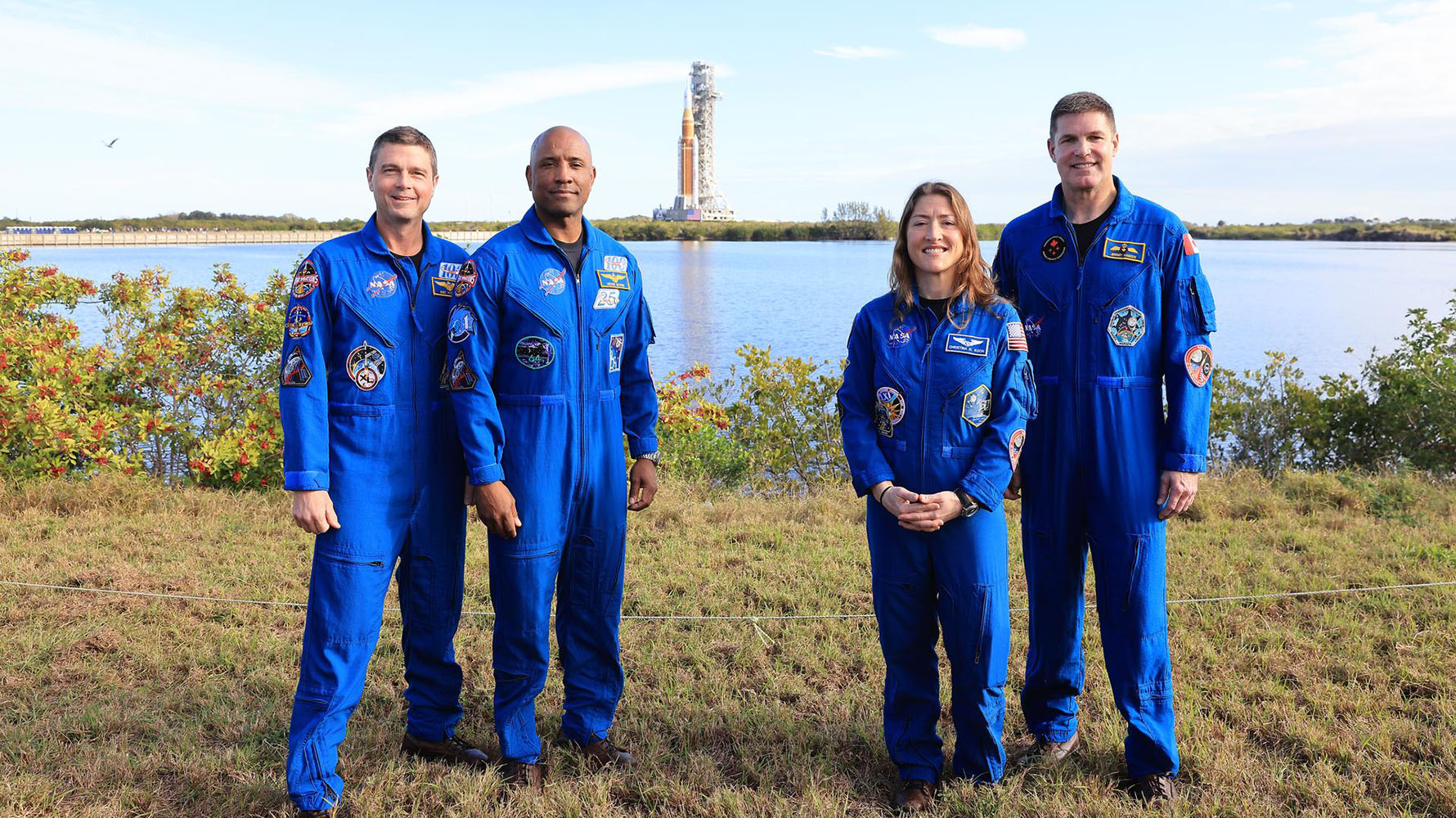
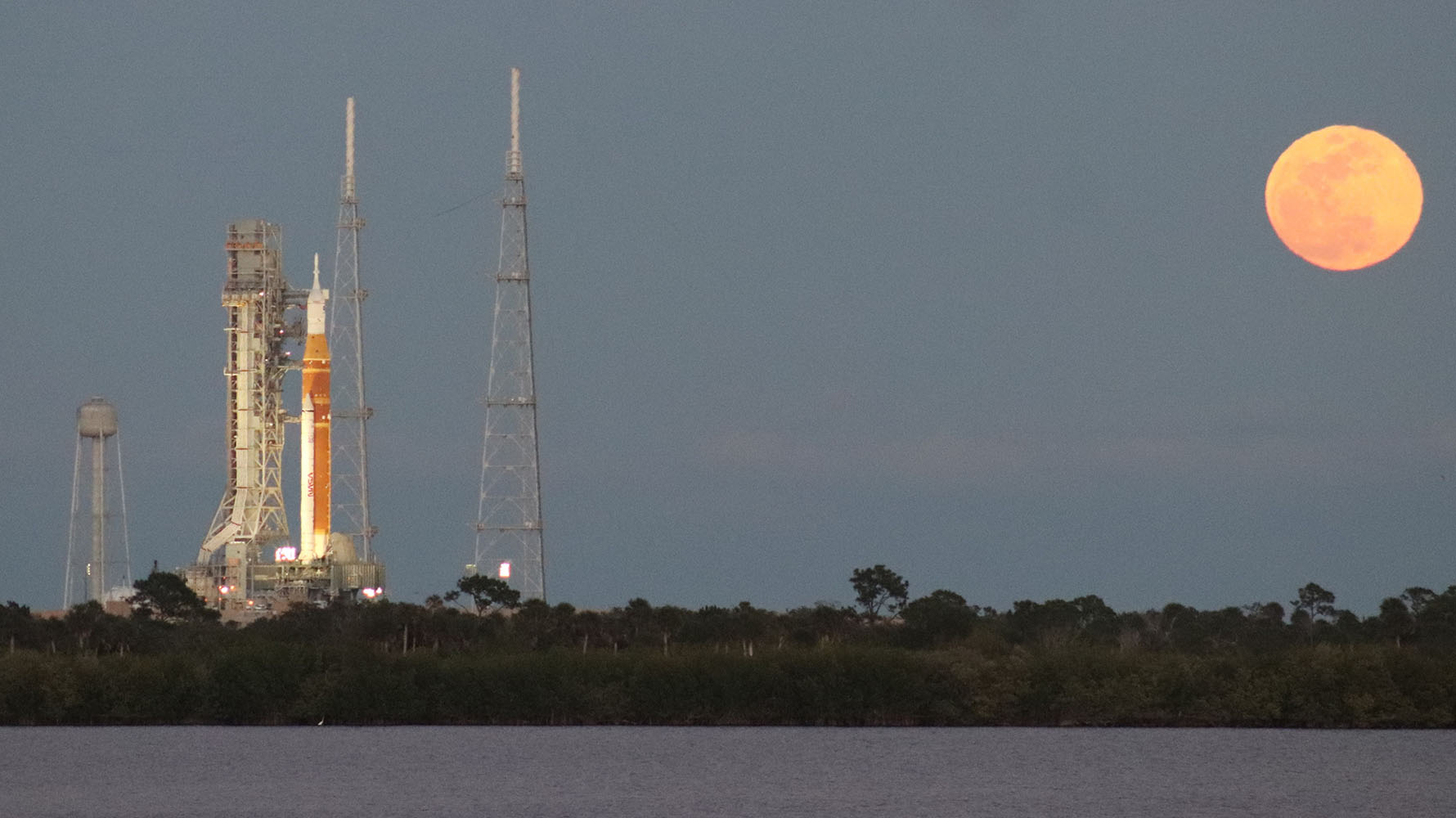
NASA formally delayed the Artemis II mission around the Moon to early 2026 (currently targeted no earlier than February 5), citing the need for additional work on life-support systems and continued heat-shield analysis. With the SLS and Orion vehicle fully stacked, the focus shifted toward verification and mission assurance—work that directly supports a more confident crewed flight in 2026.

That emphasis on operational resilience was underscored by the safe return in March of astronauts Butch Wilmore and Suni Williams, who came home after an unplanned nine-month stay aboard the International Space Station. Their extended mission highlighted the flexibility built into ISS operations and the professionalism required when programs encounter unexpected challenges.
In November, NASA and Boeing announced that the next Starliner mission would fly cargo only, clarifying the near-term landscape for U.S. crew transportation while allowing work to continue toward future crewed flights.
At the same time, the operational envelope for human spaceflight expanded. SpaceX’s Fram2 mission (March 31 – April 4) became the first crewed flight to a true polar orbit, carrying humans over Earth’s poles and opening new orbital regimes for research and future missions.

Commercial missions continued to broaden participation. Axiom Space’s fourth private astronaut mission flew in June with a notably international crew, including astronauts from India, Poland, and Hungary alongside retired NASA astronaut Peggy Whitson. China continued routine crew rotations aboard their Tiangong space station, expanding scientific output and signaling plans to host international astronauts in future missions.
Preparing for the Next Phase in Low Earth Orbit
Progress toward the next generation of space stations continued throughout the year.
Vast launched its Haven Demo pathfinder in November, validating life-support and structural systems needed for the planned Haven-1 commercial station. Orbital Reef and Starlab advanced through key design reviews, moving closer to hardware development and integration. These efforts collectively point toward a more diverse low Earth orbit ecosystem as the ISS approaches the latter part of its operational life.
Science Continues to Lead
Space science remained one of 2025’s most consistent sources of progress.
The James Webb Space Telescope continued delivering transformative results, refining our understanding of early galaxy formation and probing the atmospheres of distant worlds with increasing precision.

Closer to home, the Parker Solar Probe returned unprecedented data from within the Sun’s outer atmosphere, directly sampling the solar corona and improving understanding of how the solar wind is generated and accelerated—knowledge with direct relevance to space weather forecasting and future human exploration.
In October, NASA launched the Interstellar Mapping and Acceleration Probe (IMAP) to study the boundary of the heliosphere and how the solar wind interacts with interstellar space. Together, Parker and IMAP strengthen our understanding of the space environment that spacecraft and crews will navigate in the years ahead.
Looking Ahead
2025 did not hinge on a single defining moment. Instead, it delivered something just as important: evidence that spaceflight systems are increasingly capable of sustained, repeatable performance.
Launch vehicles flew more often. Commercial landers delivered on the Moon. Astronauts adapted to extended missions and new orbital regimes. Scientific missions pushed closer to the Sun and farther toward interstellar space.
These were building blocks—quiet, cumulative, and essential. As 2026 approaches, they form a stronger foundation for the next phase of exploration, when capacity demonstrated in 2025 is put to use in more ambitious ways. In that sense, 2025 paved the way for what comes next. We can hardly wait to see how that foundation is put to work in 2026.