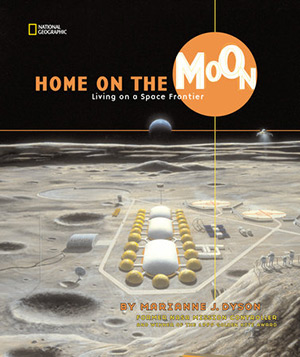
Category: Children’s Book
Reviewed by: Gina Hagler
Title: Home on the Moon: Living on a Space Frontier
Author: Marianne J. Dyson
Reading Level: Ages 8-12
NSS Amazon link for this book
Format: Hardcover
Pages: 64
Publisher: National Geographic Children’s Books
Date: 2003
Retail Price: $18.95
ISBN: 0439802032
Home on the Moon: Living on a Space Frontier opens with the Apollo 8 mission orbiting the Moon in 1968, describes the resources discovered on the Moon in subsequent missions, and explores the practicalities of space settlement while inviting the reader to imagine living on the Moon. The book also walks students through what it would take to establish a lunar settlement. A former NASA mission controller, Marianne Dyson is adept at giving readers the technical information required in real-life terms they can understand. In this book, Saturn V rockets don’t just burn liquid oxygen in their first stage; they burn “54 railroad cars’ worth.” The Apollo 14 crew didn’t just get 1 rem of radiation exposure; they got the equivalent of “about 10 chest x-rays, or the amount an airline pilot gets in one year.”
This book describes the natural resources available on the Moon, along with the current thinking on the ways in which these resources became part of the Moon. Dyson then explains how these resources can be used to meet the human need for food, water, and shelter. Dyson also explains why knowing about the factors likely in the creation of the Moon helps us to know where on the Moon to seek the materials we need.
Each chapter includes a hands-on activity to go along with the material covered. The final chapter describes the way a space settlement may one day be built – with robots doing the preliminary work to establish a place where humans can live. There are many wonderful quotes from astronauts and the people at NASA, as well as artist’s renderings of a settlement on the Moon, a glossary, Moon and mission facts, and listings of additional reference materials and resources.
My favorite illustration is the one showing the phases of the Moon and the Earth, with the shadow and light moving across the face of each of them in opposite directions. I also found the description of the underground living environments fascinating. The reader will learn how underground living is desirable because the average temperatures on the Moon’s surface range from 225° F during the day to -243° F at night.
Dyson’s book is engaging and informative. It really made me think about what it would be like to live on the Moon. It also gave me a lot of new information about the resources available to make it happen.
I’d heartily recommend Home on the Moon: Living on a Space Frontier for the intrepid space settlers in your family!
© 2007 Gina Hagler
Please use the NSS Amazon Link for all your book and other purchases. It helps NSS and does not cost you a cent! Bookmark this link for ALL your Amazon shopping!