
This Space Available
By Emily Carney
“You know who I am,” he said
The speaker was an angel
He coughed and shook his crumpled wings
Closed his eyes and moved his lips
“It’s time we should be going”
– David Bowie, “Look Back in Anger,” from the Lodger album (1979)
2026 marks 15 years since Falling to Earth, Al Worden’s autobiography/cultural reset co-written with Francis French, was published by Smithsonian Books. Its text remains just as impactful now as it was in 2011, largely because it reveals the raw truth of Worden’s career and reputation within 1970s NASA. No other astronaut memoir in history contains a paragraph as unvarnished as:
We were now next in line to fly. We’d made it through the long training grind. NASA’s attention really turned in our direction, and I felt an intense focus on preparing our mission to launch. It was getting so close, I could almost taste it. And yet, in the spring of 1971, right as we neared the peak of our abilities and readiness to fly, I made a decision that f–ked up my life completely, utterly, and irreversibly.
For those of you who haven’t yet read Falling to Earth, I will try to spare any massive spoilers. Yes, Apollo 15 launched in July 1971. Worden performed what remains the furthest trans-Earth EVA in spaceflight history and returned safely (minus one parachute). The flight itself, as most space enthusiasts know, was risky but hugely successful – it was Apollo’s first dedicated, complex “J” science mission. But most notably, Falling to Earth revealed, for the first time, the details of the Apollo 15 postal covers incident, which tarnished the crew’s reputation for decades.
The truth remains as infuriating as when I first opened the book, not long after its publication. I was so upset by what actually happened to Worden that, upon first read, I threw my copy (which has since been inscribed by Worden, French, and Dee O’Hara) against a wall in my apartment and had to take a long drive to clear my head. Later readings are just as unsettling. This was a man who sacrificed his marriage and much of his personal life for his career – but by the end of his time at NASA, he was exiled to Ames Research Center in California, out of sight and out of mind, like so much dust beneath a couch. And he had flown to the Moon. It was, and remains, devastating.
Why did Worden wait 40 years to reclaim his narrative? I often found myself wishing that he’d written a version of Falling to Earth circa 1980 and had gotten the details out earlier to clear his name. I never asked Worden, a close friend whom I interviewed numerous times, why he chose to wait so long to write his memoirs. It seemed too personal a question to even ask.
Reflecting on this question now, nearly six years after his passing, I believe I have found the answer: the passing of time changes one’s perspective on events.
If Worden had written the book in 1980, the story may have been very different. Only five years had passed since he resigned from NASA, following a very public disgrace by the very agency that had made him famous. During those early years, Worden may have been preoccupied with recovery rather than reflection. Gradually, the shame imposed upon him lingered and evolved. I believe his initial self-questioning – “Why did I do this?” – eventually shifted to a more reflective stance: “What really happened to me and why?” This evolution is evident when reading Falling to Earth.
Plus, Worden found an excellent co-author in French, who was already a space literature veteran by the time the book began being sketched out. It’s possible that a Worden autobiography written without French wouldn’t have had the same focus and tone. The most skillful thing about Falling to Earth, in my estimation, is how Worden is critical but compassionate toward the flawed, younger version of himself – not an emotionally easy task to undertake in a memoir. He’s aware that his younger self was imperfect and could seem remote and foolish, and writes as much. This kind of self-awareness is not seen in all Apollo astronaut autobiographies.
Together, Worden and French shifted the focus from the “astronaut gone wrong” narrative, ensuring that Worden’s difficult 1970s period no longer defined him. The worst thing that happened to Worden was hardly the most interesting thing about him. This transformation also helps explain why it took 40 years for Falling to Earth to happen. Later, Worden was welcomed back by the astronaut community and NASA, and in his third act, he became a highly sought-after and beloved Apollo astronaut.
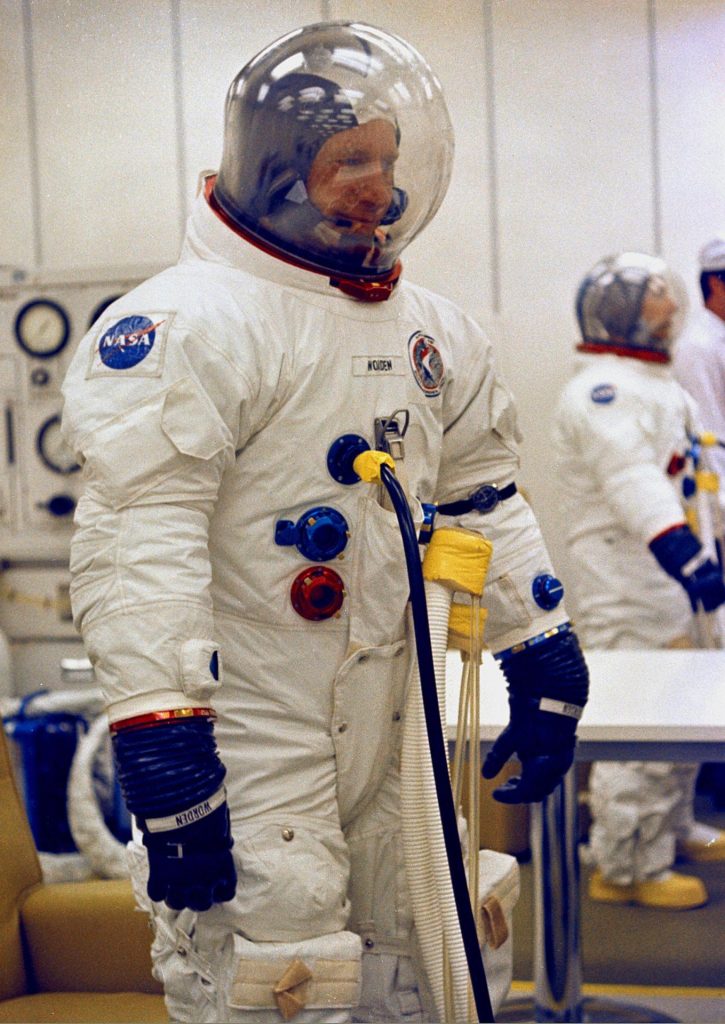
With this, Worden embraced a newfound confidence that was evident during the last decade of his life. The last two chapters of Falling to Earth discuss this happier time, and are appropriately called “Redemption” and “A New Tranquility.” His second set of memoirs, written with French, The Light of Earth: Reflections on a Life in Space, was published posthumously in 2021 and also touches on this period of his life.
Worden may also have felt uncomfortable telling the story earlier, as he likely did not want it to seem as if he were weaponizing it against any specific people or NASA in general. You get the sense that while Worden was very understandably hurt and angry, he wanted to, above all, remain a class act. And he did. If you missed Falling to Earth the first time around, you need to check it out now, because all of these reasons and more are why it’s one of the top astronaut memoirs ever committed to paper.
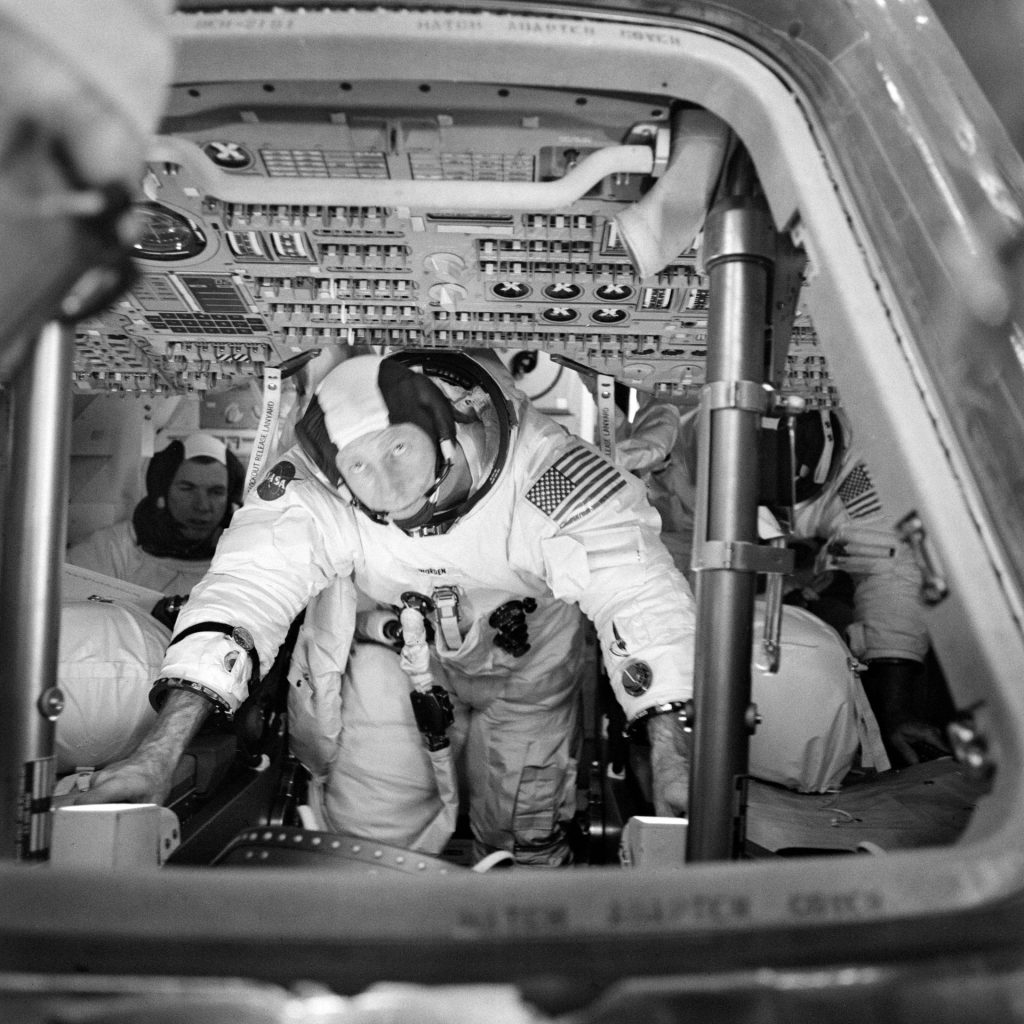
Featured image credit: “The three Apollo 15 prime crew members can be seen inside the Apollo 15 Command Module (CM) during simulation training at the Kennedy Space Center (KSC). Astronaut David R. Scott, commander, is in the background to the left. Astronaut Alfred M. Worden, center foreground, is the command module pilot. Out of view, to the right background, is astronaut James B. Irwin, lunar module pilot.” March 1971 NASA photo.
*****
Emily Carney is a writer, space enthusiast, and creator of the This Space Available space blog, published since 2010. In January 2019, Emily’s This Space Available blog was incorporated into the National Space Society’s blog. The content of Emily’s blog can be accessed via the This Space Available blog category.
Note: The views expressed in This Space Available are those of the author and should not be considered as representing the positions or views of the National Space Society.






1 thought on “Look Back in Anger: 15 Years Since Falling to Earth”
While Mike Collins wrote the BEST astronaut bio, Worden in many ways wrote the most unique one. His story, with the highest of highs and the lowest of lows, had more pathos and suffering that the others. He pulled back the curtain on some of the darker aspects of NASA and showed some of the astronauts and NASA administrators in a very negative light that we do not get elsewhere.