By Robin Scott
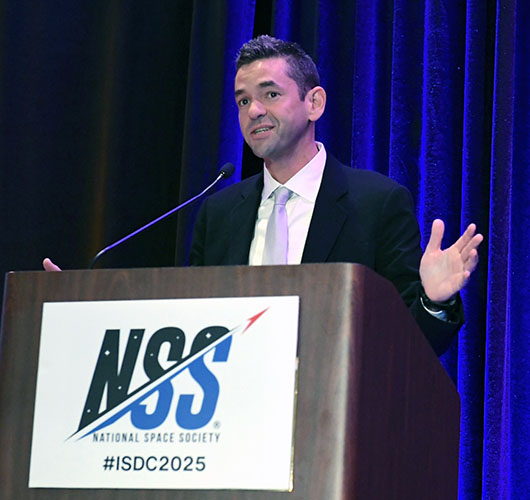
The NSS North Houston Chapter hosted Houston Air Traffic Controllers Holly Cron and Jesse Strickland who spoke on “How Air Traffic Control (ATC) Operations are affected by Space Travel.” Their talk was timely because of the increase of space launches.
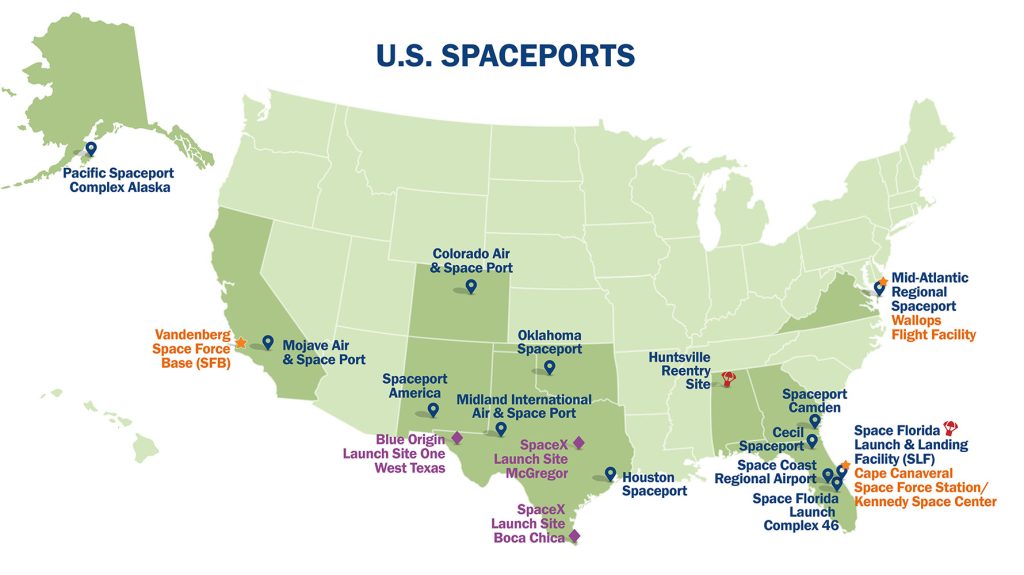
The U.S. has 14 space launch and re-entry ports, i.e., spaceports. Air Traffic Controllers have three types of facility positions: Tower, Terminal Radar Approach Control Facilities, and Center. There are six-ATC areas that coordinate space flights in Boca Chica. Air Traffic Controllers utilize communication skills and computers to track flights and weather and change flight plans. However, in oceanic areas, they use pen and paper instead of computers. Air Traffic Controllers do annual training on space launches, re-entry, and airspace sterilization (establishing safety focus zones).
The Federal Aviation Administration (FAA) Office of Commercial Space Transportation (known by the acronym AST) licenses launch and re-entry operations and spaceports. At least 10 days before every launch, the FAA ATC System Command Center in Warrington, Virginia does the following:
- Ensures that the space launch and reentry operations are safely and efficiently integrated in the National Airspace System, which includes a hotline for Air Traffic Controllers to communicate issues.
- Sends a Notice to Air Missions (NOTAM) and a notice to mariners. Airlines use NOTAMs to plan flight routes. For space launches, certain routes cannot be taken and flights may be delayed. Pilots use NOTAMS as a brief for the route of their flight. For unforeseen changes that were not on the NOTAM, Air Traffic Controllers can use a frequency to contact pilots.
On launch days, Air Traffic Controllers are given a Temporary Flight Restriction for the altitude, area, and time that aircraft cannot enter Aircraft Hazard Areas (AHAs). AHAs cover vehicle launch and ascent, jettison items, and stage re-entries. Debris Response Areas are similar to AHAs but can only be applied in radar-controlled airspace. No radar exists in the Gulf of Mexico.
Spaceport map courtesy FAA.