
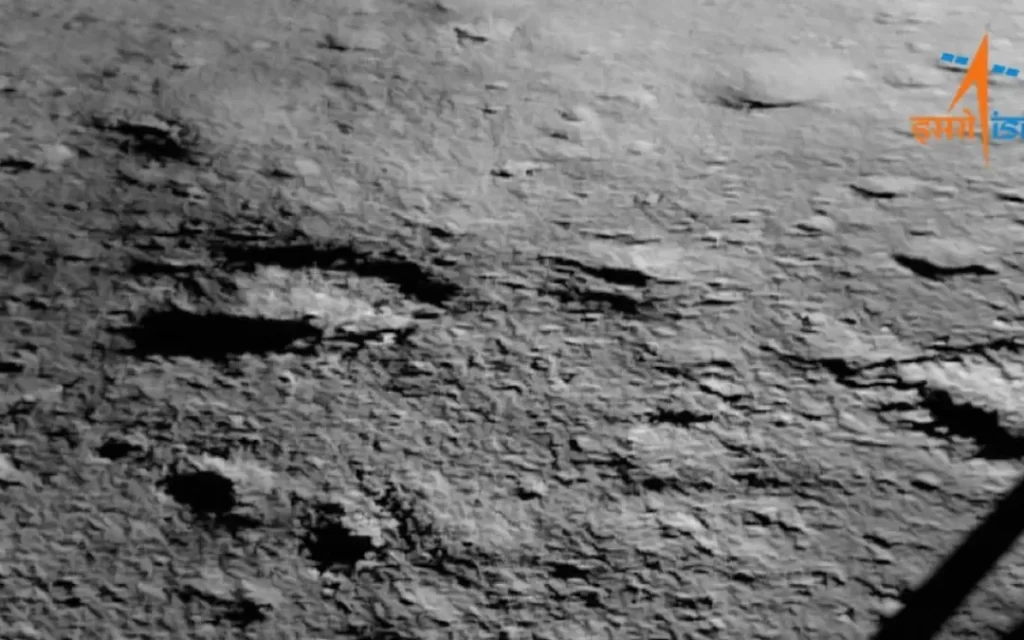
Image: The Moon’s surface from Chandrayaan-3. Credit: ISRO.
NSS Indian Chapters Jubilant Over Successful Touchdown
Just a few days after Russia’s Luna 26 lander apparently impacted the lunar surface, India’s Chandrayaan 3 lander successfully touched down near the lunar south pole on August 23. It is the first lander and rover to reach the polar area, and India is just the fourth nation to successfully land a spacecraft anywhere on the Moon, after the Soviet Union/Russia, the United States, and more recently, China.
“NSS joins the people of India in cheering this signal achievement, marking the ascension of India to the first rank of spacefaring nations,” said Dale Skran, NSS COO. “We look forward to India being joined by Japan and numerous private U.S. companies over the next few months and years as humanity at long last returns to the Moon in force, this time to stay.”
Touchdown occurred at 8:33 am Eastern Time (1233 GMT or 6:03 p.m. India Standard Time), said the Indian Space Research Organization (ISRO). ISRO chairman, Sreedhara Somanath, declared, “We have achieved soft landing on the Moon! India is on the Moon!”
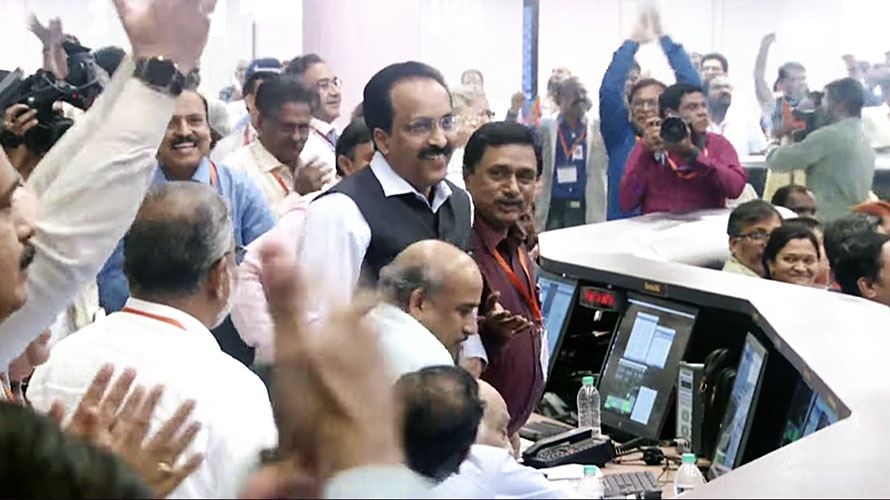 Jubilation at Chandrayaan mission control. Credit: ISRO.
Just hours after touchdown, images from the lander were posted to social media. The landing site appeared to be relatively flat and should offer a smooth drive to the small rover, called Pragyan, once it departs the lander, called Vikram.
Madhu Thangavelu, a lecturer at the University of Southern California, Vice President of NSS-India Relationships, and member of the NSS Board of Directors, said, “Lunar touchdown is hard, as we have seen from past missions. Polar landing is harder because of highland topography. India has nailed the first lunar polar touchdown. We’re excited to see how the rover mission proceeds. There is a lot to learn and much hard data to glean in support of upcoming missions.”
Chandrayaan 3 follows the first two Chandrayaan missions. Chandrayaan 1, an orbiter, was successful. The orbiter portion of Chandrayaan 2 was also successful but the lander/rover element of that mission lost contact shortly before impacting the lunar surface. The successful landing of Chandrayaan 3 shows significant growth in India’s robotic exploration progam.
The Chandrayaan mission duration is expected to be one lunar day, or 14 Earth days.








4 thoughts on “NSS Applauds India’s Chandrayaan 3 Landing on Lunar South Pole”
I am Avinash Shirode past member of Board of directors of NSS and also president of Nasik India chapter. I have worked in ISRO in the early stages of development of the organization. It is indeed a proud moment for all Indians and particularly to people like me who were a part of this organization. India is the first country in the world to land on the South Pole of the Moon. I had made a presentation about Indian space agency at the ISDC at Frisco, Texas, in May 2023. The audience was very curious to know about the future missions of ISRO.
Congratulations to India on your achievement
Latest research of ISRO is really helpful. They provided information about Moon surface temperatures at different depth.
If Moon south pole surface temperature is 70 degree C and temperature below 80mm is minus 10 degree C, it is really a perfect temperature gradient to develop electricity generator. As per Seebeck effect, if there is a temperature gradient between two plates you will get electrons flow between the two plates. In future this electricity generator will help to provide enough electric power to a small basement houses. It will also help to power all mission’s equipment more efficiently than solar panels.
Latest research of ISRO is really helpful.
They provided information about moon surface temperatures at different depth.
If moon south pole surface temperature is 70 degree C and temperature below 80mm is minus 10 degree C, it is really a perfect temperature gradient to develop electricity generator. As per Seebeck effect, if there is a temperature gradient between two plates you will get electrons flow between the two plates. In future this electricity generator will help to provide enough electric power to a small basement houses. It will also help to power all mission’s equipment more efficiently than solar panels.