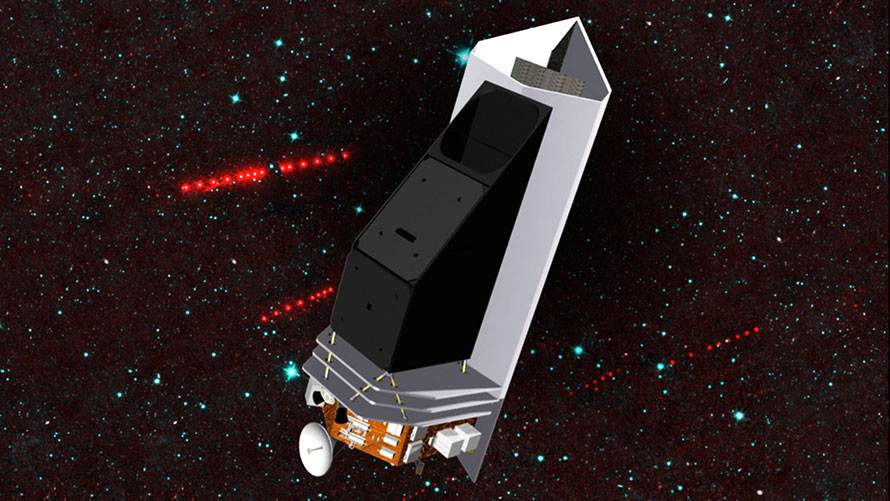
The National Space Society (NSS) applauds NASA Administrator Jim Bridenstine’s April 29th endorsement of building and operating an orbiting infrared telescope, NEOCam, to detect and track Near Earth Objects (NEOs). NEOs are objects that approach or cross the Earth’s orbit and are best detected outside of the Earth’s atmosphere using the infrared electromagnetic spectrum. His endorsement came during the Planetary Defense Conference in College Park, Maryland organized by the International Academy of Astronautics.
NEOs are a significant threat. In 2013 a 20-meter object disintegrated over Chelyabinsk, Russia. The shock wave sent 1,500 people to seek medical treatment and damaged or destroyed many buildings. A NEO exploded over Tunguska, Siberia in 1908, leveling trees throughout an area the size of Washington, D.C. Around 66 million years ago, an asteroid about 10 km across struck the edge of the Yucatan Peninsula causing a massive extinction event that wiped out the dinosaurs.
NSS, the Planetary Society, and other organizations have been actively urging full funding for the NEOCam mission to substantially reduce the threat. Addressing space advocacy concerns, Arizona Senator Kyrsten Sinema raised the issue of funding NEOCam with Administrator Bridenstine during a March 13 hearing, The New Space Race: Ensuring U.S. Global Leadership on the Final Frontier.
Chair of the NSS Executive Committee Dale Skran recently explained: “NEOs that cross Earth’s orbit are particularly dangerous, and we have long campaigned for a mission capable of spotting and tracking them before they hit Earth. In fact, our Policy Committee issued a position paper in 2014 recommending that NEOCam be fully funded for that purpose.” (See https://nss.org/wp-content/uploads/2017/07/NSS-Position-Paper-Planetary-Defense-2014.pdf)
In 1998 Congress directed NASA to detect and track 90% of the NEOs 1 km or more in diameter. That goal has been reached. Subsequently, Congress directed NASA to detect and track 90% of the more difficult to find NEOs 140 meters in diameter or greater. This has yet to be accomplished. Amy Mainzer at NASA’s Jet Propulsion Laboratory (JPL) has estimated that NEOCam could carry out that latter congressional mandate within ten years.
NSS Senior VP and Operating Officer Bruce Pittman further explained that “Currently, NEOCam has been funded for an extended Phase A study, which means that initial work is progressing, but it has not been approved for development.” Mainzer and NASA’s Planetary Defense Officer Lindley Johnson estimate the life-cycle cost of the NEOCam mission to be $500-600 million. NSS Executive Vice President Alfred Anzaldua commented, “That’s a substantial cost but lives are at stake. A 140-meter diameter asteroid or comet could kill millions of people. We need to find all the potentially hazardous NEOs so that we can deflect them away from Earth’s orbit.”





3 thoughts on “NASA Administrator Bridenstine Endorses the NEOCam Mission”
I certainly hope NEOCam is fully funded. NEOs must be found, there _are_ PHAs, and eventually there will be another asteroid on the way to being a major impactor. We “might” be able to do something about it, but only if we know about it well in advance of an impact. The count of NEAs follows a logarithmic scale – there are many in the Tunguska Event class, and many, many more in the Chelyabinsk Event class. The discovery rate of one kilometer and larger NEAs is down to a trickle but the discovery rate of “small” NEAs is quite high – see https://cneos.jpl.nasa.gov/stats/totals.html and note the slopes for the 140+ class and for the ones smaller than 140 meters. The ones in the smaller class are discovered by Earth based telescopes only when they pass by closely, when they are near “full moon” phase and the short distance increases their intensity. There are many recent discoveries in the “monthly” list of flybys posted at http://www.spaceweather.com/ (the discovery date is coded in the temporary name).
Close approaching asteroids are listed at
https://cneos.jpl.nasa.gov/ca/
and
https://minorplanetcenter.net/iau/TheIndex.html ==>
https://minorplanetcenter.net/iau/lists/PHACloseApp.html
So far, we’ve been “lucky”.
One more important note – NEAs are typically at Earth’s distance from the Sun and are quite warm, easily detectable with a space based IR telescope. NEOCam is based around a 16 megapixel IR sensor that Dr. Mainzer and her team have developed. That sensor can operate at 35 Kelvin, a temperature achievable with passive systems – no exotic refrigeration with consumable cryogenics required. NEOCam should be able to search for ten year. Details at Planetary Defense Conference 2013 Amy Mainzer
https://www.youtube.com/watch?v=VqJwqiGXJv8 @ 1:40, especially 3:16 and 4:47
What if they find an asteroid/comet that has an impact trajectory toward earth…then what? see NASA Letters.