Category: Nonfiction
Review of Chapter “Putting Space to Work” by Dale Skran
Title: 2025: Scenarios of US and Global Society Reshaped by Science and Technology
Authors: Joseph F. Coates, John B. Mahaffie, and Andy Hines
Format: Hardcover/PDF
Pages: 515
Publisher: Oakhill Press
Date: September, 1996
ISBN 978-1886939097
Free online PDF copy
I love to cheat on predicting the future. My cheat is a simple one – I live forward in time from the point where the prediction was made, and then when the date comes around, I write a review and poke holes in the efforts of the prognosticators. The book 2025 was written in 1996, and here I sit at year end 2025, all revved up and ready to review a book with certain knowledge of what actually happened. Hardly seems fair, eh? Yet I submit that the process of looking at how predictions go wrong – and right – is a valuable one that can inform our own efforts to anticipate the future yet to be.
This is a big book chock full of predictions, so I will limit my review to the area I know the second most about – space – the first being telecommunications, my field of professional expertise. As it turns out, there is quite a bit of overlap between these two areas in terms of what happened.
The authors start out with what they think are 83 very likely-to-be-true statements about 2025. This is followed by 23 possible but less likely statements about 2025. None of the first 83 statements directly relates to space, although it is mentioned that fiber optics wins out over satellite communications. In the 23 less likely statements we see one about an asteroid watch existing, and another about Moon/asteroid mining. The authors get significant although not total credit on the asteroid watch idea, and certainly there have been some feeble efforts toward asteroid mining missions, but the authors are broadly correct in putting these ideas in the “less likely” category.
The authors’ big error lies in an assumption that international institutions will become stronger, and especially the United Nations, and that this international warmth will influence how space develops. As it turns out, virtually the opposite has occurred. Soon after the book was written, the world was engulfed in what amounted to a world war between Western nations and an Islamic insurgency with global ambitions. Just as this seemed to be receding as a front burner issue, Russia embarked on a slow-motion world war to rebuild their empire by conquering the Ukraine, while the middle east exploded in endless rounds of increasingly bloody violence. Through all this the U.N. has proven to be remarkably ineffective at peace keeping, peace-making, and resolving issues like climate change.
Having said all that, the authors can be forgiven for not realizing that they were writing the book at an unusually hopeful time after the fall of the Soviet Union when things really did seem to be getting better, right up to 9/11/2001 when an attack on the U.S. similar in scope to Pearl Harbor opened the 21st century with vast bloodshed.
Any attempt to predict the future is held prisoner to initial assumptions like this one, but they must be made. A common one is “assume there is no nuclear war” because this is such a major fork in the road that normal extrapolation no longer works. The authors do scenario-based futurism, and this approach will invariably generate a lot of untrue statements because a scenario is usually fairly specific, and specifics are hard to get right 25 years in the future. Thus, I will try to focus on the general trend of the authors’ predictions, and not on details that don’t really matter.
The authors open their space chapter, “Putting Space to Work,” with a list of dates and major space events:
- 2013 – International Space Station
- 2017 – Space Plane
- 2020 – Moon Base
- 2024 – Human Expedition to Phobos
- 2030 – Human Expedition to Mars
The ISS was actually completed in 2011, so we see here a rare instance of a scenario prediction that is more pessimistic than reality. But after that, like other futurists that rely on extrapolation of current trends, they fall off the wagon. No space plane has been or is likely to be developed in the near to medium term, since the major lesson of the space shuttle seems to be that space planes are not so workable. We may have a Moon Base by 2030 or 2035, but certainly none was built by 2020. And the first Mars date was clearly not met. The ISS may be the last large all-government space project, and it is increasingly apparent that big things in space will be done mostly by commercial enterprises. The authors made the same mistake as many other space futurists – extrapolate forward a major program like Apollo or the ISS, and just assume budgets keep rising and new things keep getting done, when the reality seems to be institutional exhaustion and declining budgets.
The authors place the formation of an International Space Agency as part of the U.N. in 2002, something that now seems unlikely to ever happen, and further to be viewed by many as undesirable. The authors envisioned a strong commercial space sector, positing many milestones that have yet to be achieved in 2025, but directionally they were certainly correct. However, their error was in assuming rapid growth in the 00s, followed by a leveling off, while what really happened was more like an exponential curve, with very slow growth in the 00s, and much more rapid growth recently. On page 242 they provide a graph of world space launches from 1995 to 2025. The curve starts at about 100 per year and grows to about 250 in 2025.
Although the authors anticipated strong progress in robotics and expert systems, they might or might not be impressed by our current capabilities. I asked ChatGPT 5.2 to produce a graph of world space launches which I have included below:
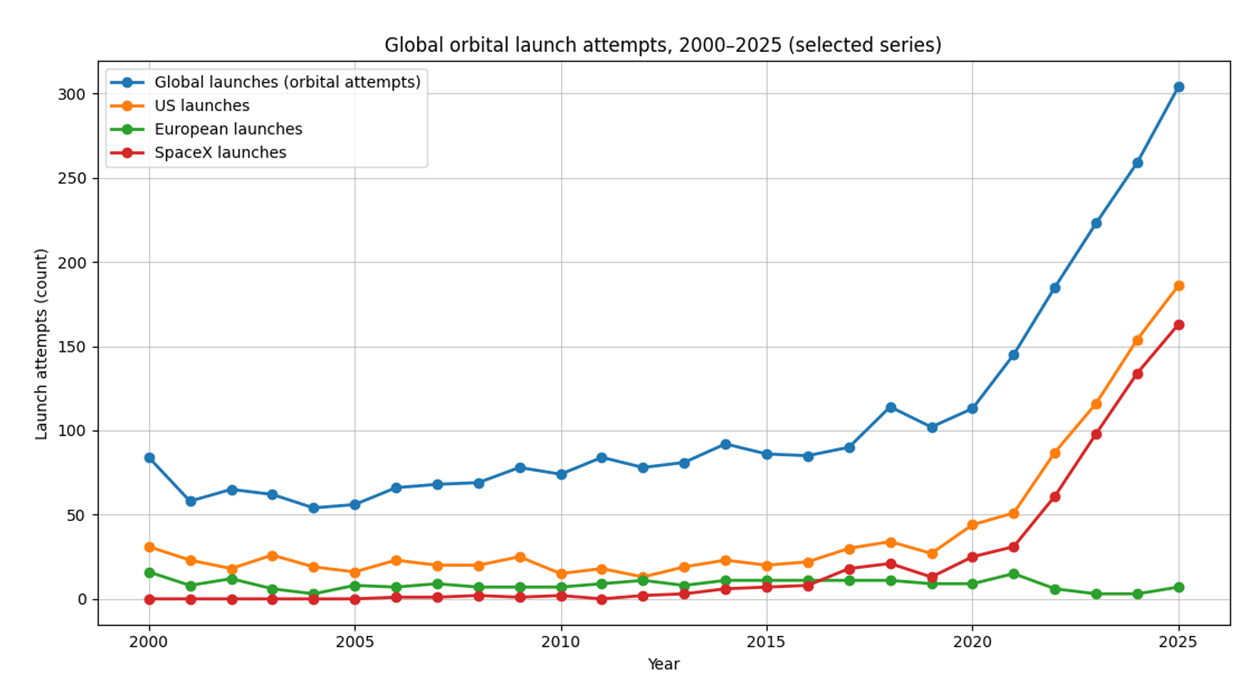
The starting point in 2000 is a bit lower than 100, and the total in 2025 at 300 is a bit more than predicted by the authors, but overall, they came pretty close to the real numbers – except in the middle. They projected rapid growth in the 00s, and then a leveling off, but in reality, launches were basically flat all the way to 2020, with very rapid growth driven by SpaceX and the Chinese after that.
I’m not going to spend much more time on the authors’ projections of international cooperation. They have the Chinese as part of the ISS construction team, and it goes more wrong from there, diverging from reality with each step. The writers theorize that the high cost of space activities will drive increased international cooperation, and this has been true, but mainly with regard to the ISS, but otherwise remains in the margins. The real story has been a rapid decline in the costs of doing things in space, widening access to all kinds of space projects while decreasing the need for international cooperation.
Page 243 sports a table titled “Profile of World Leaders in Space.” The U.S. description is shockingly accurate: “Reputation, large, trained space workforce, thriving commercial section” as a strength, and “Deciding on priorities, reluctant and demanding international player” as a weakness. For Russia, as a weakness I would add “conducting a slow-motion world war and stealing your space partners satellites” as an additional weakness. The European weakness listed is “Getting consensus,” which is surely still true, but Europe no longer leads in “Launch vehicles.” In fact, Europe today ranks well behind the U.S., China, and India in launch vehicles, and is barely competitive with a much-diminished Russia. The Japan description rings more or less true, but the Chinese have done far more than the authors expected, becoming the true #2 space power in 2025. And the authors do not even list India, a considerable blind spot. Aside from the base assumption that the U.S. would still be a space leader in 2025, for the most part the authors ranking of space powers missed the target.
The section on “Military Applications” falls wide of the mark, with a focus on spy satellite data supporting U.N. peacekeeping, and a 2007 Lima Space Weapons Treaty outlawing weapons in space. In reality, the following destructive tests of anti-satellite weapons were conducted between 1997 and 2025:
- 2007 – 01–11: China – created debris
- 2008 – 02-20: U.S. – created debris
- 2019 – 03-27: India – created debris
The U.S. Space Force was created on December 20, 2019. Service members are called “Guardians.” The status of things can be illustrated by the December 11, 2025, rollout by the U.S.S.F of their naming conventions for space weapons. For example, orbital weapons will be named from the Norse Pantheon, electromagnetic warfare weapons after serpents, and missile warning systems “sentinel.” See the image below, credit U.S. Space Force.

Another feature of the current landscape not anticipated by the authors lies in the growing military significance of civilian space infrastructure, notably the SpaceX Starlink system, which has become widely used to guide weapons in the Russia-Ukraine war. This in turn has led to Russia making threats that it may attack the Starlink system.
Finally, the authors wrote at a time in which it appeared that the SDI and missile defense lacked credibility and would never be widely deployed. Several Middle Eastern “missile duels” later, and with a daily light show over Ukraine, it has become crushingly obvious that missile defense works, and we need more of it. The U.S. has embarked on a massive partially space-based missile shield “Golden Dome” (a play on Israel’s “Iron Dome”) which promises to have vast impact on space development in the future.
The authors drop a lot of ink on scenarios of future commercial space activities, and allowing for the limitations of the scenario method, they called this one right. Space has been increasingly dominated by commercial players, and their definition of “commercial” is the correct one.
What did they miss from a commercial perspective? I suspect they would be surprised at the degree to which the traditional aerospace majors – Boeing, Lockheed, and Aerojet – have been shouldered aside by SpaceX, Blue Origin, Rocket Lab, and others. Nobody – me included – anticipated how badly Boeing would bungle Starliner. The other elephant in the room is SpaceX. Nobody, and especially not Boeing or ULA, anticipated that this oddball dude who founded PayPal would create the behemoth that SpaceX is today – the world’s leading rocket launch company by a lightyear, the world’s largest satellite operator, and very probably soon the world’s largest telecom company. Along with a little car company he founded (Tesla) these businesses have made Elon Musk the world’s richest man with somewhere between $600B and $700B in his pockets, more than 2x his nearest rival, Google co-founder Larry Page. This is the stuff of science fiction – a real-life D.D. Harriman from Heinlein’s The Man who Sold the Moon. Love him or hate him – and many do hate him – Musk is a phenomenon.
The authors did not anticipate the dominance of LEO communications satellites, the need for commercial space companies to be vertically integrated, or the rise of cubesat technology. They did correctly call out the importance of laser inter-satellite links. But in many ways, they were overly optimistic about the commercial milestones that would be achieved by 2025. The things they talk about are being pursued by startups, or are in early states of testing, but it is safe to say that aside from the launch business, the real future of space commerce lies ahead of us.
When it comes to space science, they opine “A critical management strategy was the shift from custom-design space structures and vehicles to standard models.” Although the cubesat revolution might be claimed to fulfill this vision, in 2025 the usage of standard space probes for space science lies in the future, with the good work done between 1996 and 2025 almost exclusively the product of expensive bespoke robots.
The authors projection of “Interspace Travel” falls far from realty. They suggest “Single-stage-to-orbit rockets have predominated since 2000,” while in the real-world 2025 SSTO has been abandoned as impractical after the expenditure of many billions of R&D dollars. Although correct that neither fission nor fusion rockets are in use in 2025, the authors have Earth-based mass drivers in operation in 2025, while more or less completely missing the importance of ion rockets for both transport to GEO and for deep space probes. This essentially complete failure of extrapolation for vehicle technology is typical of books on the future of space travel written in the 80s and 90s. A widespread obsession with space planes and SSTO blinded two generations of engineers to the solutions sitting right in front of them. One wonders what the authors would think of the growing success of reusable two-stage VTVL methlox rockets.
The description of the ISS on page 266-7 is shockingly accurate. Aside from including China as a station partner – it wasn’t – and projecting the ISS to have a crew of 8 – it is 7 most of the time – 90% of what they say came to pass. Of course, they missed the Chinese having their own space station with a crew of three due to their assumption of growing international cooperation.
The description of a 2020 Moon base is similar to current plans for a base in the 2030s, but there was no anticipation of the Chinese Alliance vs the Artemis Accords nations rivalry in lunar exploration and development. The authors’ descriptions of Mars plans are technically sound but politically far off the mark. Most notably, the role of SpaceX as the leading advocate of Mars settlement was not anticipated. A final section “Prospects for colonies” can only be described as overly optimistic.
One odd milestone the authors throw out is Japan joining the international space station in 2005, which is way off since Japan was a full partner starting in 1985. It is almost as though the person doing the final table confused Japan and China. Another interesting milestone has China becoming the leading launching power in 2013. This turned out to be wrong in two ways: (1) China has become the #2 launching power, and without the advent of SpaceX would lead the world, and (2) the authors didn’t see the tension between saying the Chinese were the leading launching power, but then not discussing anything they might be doing in space.
What might we learn from 2025’s space predictions? First, taking a current trend like the rise of SpaceX and extrapolating it forward may or may not create a useful guide to the future. Second, beware commonplace assumptions, like the idea that spaceplanes will dominate. Third, keep in mind that history is not over, and geopolitics will continue to matter.