Opinion by Dale Skran
I’ve been writing columns on the prospects for the Space Launch System (SLS) for several years now, and one of the challenges with this effort has been deciding when to write the next column. Clearly, a column should only appear when there is some significant news, but what might that news be? For this go-round the following events loomed, some in the recent past, and some expected in the near future. These events include:
- August 12, 2025: Third Vulcan flight
- October 13, 2025: Starship’s 11th flight test
- November 13, 2025: Second New Glenn flight
- Q4 2025: Fourth Vulcan flight/Amazon Kuiper satellites
- April 2026: Artemis 2/Crewed Orion around the Moon in an Apollo 8 redo
- 1H 2026: Fifth Vulcan flight/USSF-111
- 1H 2026: Third flight of New Glenn/Blue Moon Mark 1 uncrewed lunar lander
- 1H 2026: 12th Starship flight test/first flight of Starship V3
- 2026: 12th Falcon Heavy flight/Astrobotic Griffin Lunar Lander
Looking forward to these prospective events, events 6-9 are nebulous as to when they will occur, so it does not seem like a good idea to wait for them before doing another column, and events 4 & 6 won’t add that much to the third Vulcan flight (event 1). I was planning to wait until April 2026 after the Artemis 2 flight and hoping to include another Starship and/or Vulcan flight. But then Blue made a big announcement.
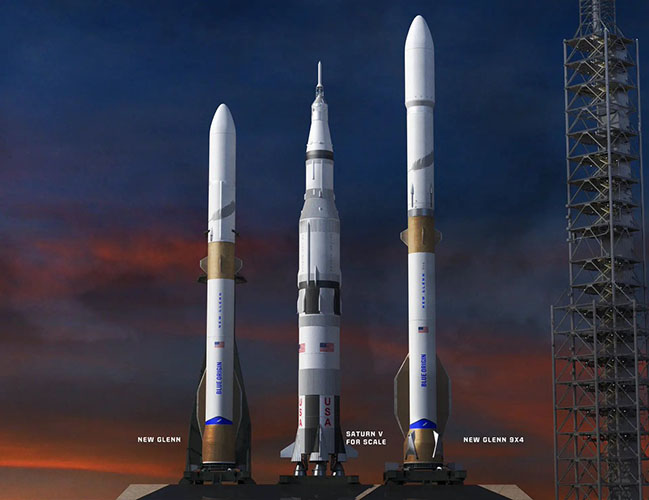
So, the sweet spot seems to be right now – with three Vulcan flights, 11 Starship tests, one SLS flight, and two New Glenn Flights to consider, including the amazing recovery of the New Glenn first stage on only the 2nd flight. And let’s not forget that Falcon Heavy achieved full operational status with ten successful consecutive flights. But what really makes this the right time is the announcement by Blue Origin of a new version of New Glenn “New Glenn Heavy” called the 9×4. This announcement is game-changing, and with the solid success of the 2nd New Glenn flight, their credibility is on an upward trajectory.
Now that we have put a stake in the ground for when to review the situation, I am also going to abandon the structure used in the previous columns. There have been a lot of changes, and the political environment related to SLS has dramatically shifted. For the first time we have seen an administration propose stopping SLS after Artemis 3, and while Senator Ted Cruz rode to the rescue to add funds back for Artemis 4 and 5, the longer-term future of the SLS remains more clouded than ever before.
Although all of the competitors are well behind earlier schedules, we have reached a point where Vulcan, New Glenn, Falcon Heavy, and SLS can make claims to varying levels of operational capability, and Starship may have set a record for the most test flights of a heavy lift vehicle without actually putting anything into orbit. Let’s start with a chart comparing the candidates to replace the SLS. Note that Vulcan can fly with zero, two, four, or six solid rocket boosters (SRBs).
| Rocket | LEO capacity | TLI capacity | TMI capacity | Reusability |
| SLS Block 1 | 95 MT | 27 MT | 20-22 MT | None |
| Vulcan/6 SRBs | 27 MT | 11-12 MT | 7.6 MT | Future/engines only |
| Falcon Heavy | 63.8 MT | About 21 MT | 16.8 MT | None/fully expended |
| Falcon Heavy | 57 MT | About 19 MT | 15 MT | Side boosters reused |
| New Glenn 7×2 | 45 MT | 7 MT | 5-6 MT est. | Booster only |
| New Glenn 9×4 | 70 MT | 20 MT | 10-15 MT est. | Booster only |
| Starship V3 | 100+ | Varies with refueling | Varies with refueling | Both stages |
LEO=Low Earth Orbit, TLI=Trans Lunar Injection, TMI=Trans Mars Injection
All of these numbers must be taken with a grain of salt, although the Falcon Heavy numbers are probably the most reliable. As our base assumption, let’s treat SLS Block 1, Vulcan, Falcon Heavy, and New Glenn as having achieved a degree of operational success. The Falcon Heavy leads by quite a bit in terms of flights, but eventually Vulcan and New Glenn will catch up, even if both encounter more problems as they ramp up. Considering the shuttle flight heritage – and the reused engines – SLS Block 1 should be treated as more reliable than you would expect for something that has only flown once. Starship V3 has yet to fly, and most importantly, has yet to demonstrate orbital refueling, so impressive as its achievements to date are, some skepticism is justified.
This brings us to the question of the moment – how does the introduction of the New Glenn 9×4 alter the competitive landscape? Given the engine maturity for both stages, it seems reasonable to credit that the New Glenn 9×4 will grace the launch pad sooner rather than later. It’s a new rocket, but a new rocket that is a straightforward extrapolation of a flying rocket.
New Glenn 9×4 looms as a strong competitor to Falcon Heavy with similar stats and reusability characteristics. This means that NASA mission planners can reasonably count on being able to rely on having access to two commercial heavy lift vehicles that can put about 20 MT into TLI. This is not quite the 27 MT of SLS Block 1, but it comes at a much-reduced price tag – perhaps as little as 1/10 the fully loaded cost of an SLS Block 1. And New Glenn 9×4 in fully expendable mode may well have more lift capacity than SLS Block 1. Based on these facts, it is hard to see the SLS as having a future beyond the already committed Artemis 5.
And Artemis 5 lies well in the future. The current plan calls for:
- Artemis 2: No Earlier Than (NET) April 2026
- Artemis 3: NET mid-2027
- Artemis 4: NET September 2028
- Artemis 5: NET 2030
2026/2027 will see an increasing flight cadence for Vulcan and New Glenn. During 2027-28 we can expect the first flight of New Glenn 9×4. And who knows how far Starship V3 will get with three years of development? The first full-stack Starship flew (unsuccessfully) on April 20, 2023, and for the 11th time (successfully) on October 13, 2025. That’s three years. Starship may well fail to support the current Artemis Moon landing schedule but come 2029 there will be three commercial heavy lift vehicles – Falcon Heavy, New Glenn, and Starship – fully operational and comparable to SLS. Vulcan, even with 6 SRBs, is not in the same class as the other vehicles.
That bell is tolling pretty loudly these days.
© 2025 Dale Skran
Image credit Blue Origin