
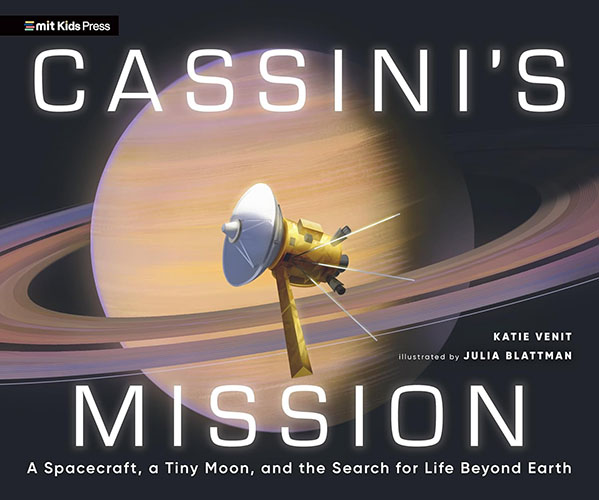
Category: Children’s Books
Reviewed by: Casey Suire
Title: Cassini’s Mission: A Spacecraft, a Tiny Moon, and the Search for Life Beyond Earth
Author: Katie Venit
Illustrator: Julia Blattman
Ages: 4-8
Format: Hardcover/Kindle
Pages: 40
Publisher: MIT Kids Press
Date: August 2025
Retail price: $18.99/$9.99
ISBN: 978-1536232325
Find this book
For curious young minds, Cassini’s Mission is a well-illustrated, captivating, and out-of-this-world bedtime story.
After Cassini’s final plunge into Saturn’s atmosphere, there were lots of tears, hugs, and handshakes among the scientists that had kept her alive for twenty years. Cassini was a machine. Just a collection of science instruments, electronics, and plutonium-238 that circled Saturn 294 times. She didn’t breathe, have feelings, or have a heartbeat. Why was she so special? Why did she have to die? Why was there an overwhelming flood of emotions that day at the Jet Propulsion Laboratory?
For parents and educators, Cassini’s Mission will provide answers to science-minded youth. The combined spacecraft, named Cassini-Huygens, was a joint effort between NASA, the European Space Agency (ESA), and Italy’s Agenzia Spaziale Italiana (ASI) space agency. While Cassini orbited Saturn, the Huygens lander was dispatched to Titan, the gas giant’s largest moon. Cassini-Huygens was an entry in NASA’s Flagship-class of planetary science missions, which are more capable and expensive than medium-level New Frontiers and lower-level Discovery science missions. The spacecraft, launched by a Titan IVB/Centaur booster, departed Earth in October 1997.
Just getting Cassini-Huygens off the pad proved controversial, as the spacecraft employed three RTGs (radioisotope thermoelectric generators) with 72 pounds of plutonium-238 to generate power for scientific instruments. RTGs offer an advantage over conventional solar panels, as solar panels lose their effectiveness as a spacecraft gets farther away from the Sun. For a trip to Saturn, solar panels are impractical. The use of plutonium prompted protests over the mission due to fears of what would happen in the event of either a launch failure of the Titan booster or a mistake in a planned Earth flyby gravity-assist maneuver. In response, NASA tried to assure the public that the launch was safe. Ultimately, the launch was approved by then-President Clinton, and Cassini-Huygens was able to meet the desired launch window.
The trek to the solar system’s sixth planet took seven years. Rather than go straight to Saturn, Cassini-Huygens used a trajectory dubbed the Venus-Venus-Earth-Jupiter Gravity-Assist (VVEJGA). The gravity of each celestial body changed the speed and direction of the spacecraft. Cassini-Huygens finally reached Saturn in July 2004. The mission was originally meant to last only four years. Instead, the brilliant scientists and engineers of the Jet Propulsion Laboratory (JPL) stretched her life for another thirteen years. In January 2005, Huygens landed on Titan. At the time of this writing, this is still the most distant landing on another celestial body. Meanwhile, Cassini studied Saturn and several of her moons. One notable event was a flyby of the moon Iapetus. For this accomplishment, the Cassini team at JPL received a taped message from Arthur C. Clarke. On another occasion, the mission received congratulations from Neil Armstrong.
While the spacecraft explored several worlds in the Saturnian system, the book’s main focus is to educate young readers about the icy moon Enceladus. In particular, the mission studied water vapor and ice erupting from geysers on the south pole of the tiny world. This discovery suggests that an underground ocean of liquid water lies under the surface of Enceladus. As the book notes to kids, the recipe for life is water, chemicals, and energy. The water geysers on Enceladus made astrobiologists take notice of the small moon. Unfortunately, it also sealed the fate of Cassini. If the spacecraft crashed on Enceladus, it might contaminate any potential life living in the subsurface ocean. In 2017, the JPL team intentionally destroyed Cassini by reentering the spacecraft into Saturn’s atmosphere.
So, what’s next for the exploration of Saturn and her moons? Earlier this year, it was confirmed that a staggering 274 moons orbit the massive gas giant. There’s the proposed New Frontier class Dragonfly mission, which aims to send a flying rotorcraft to Titan. Despite proposals to sharply reduce NASA’s science funding, Dragonfly is, so far, safe from budget cuts. In any case, for those lucky individuals that worked on Cassini-Huygens, the mission created memories they will always cherish.
© 2025 Casey Suire






2 thoughts on “Children’s Book Review: Cassini’s Mission”
Why were there hugs & tears at the end of Cassini’s mission? It might have something to do with referring to the vehicle as ‘she’ & ‘her.’ Just saying. PS It sounds like something I might want to read.
Your review was better written and more interesting than the book! Thank you for the details.