Category: Nonfiction
Reviewed by: Mark Lardas
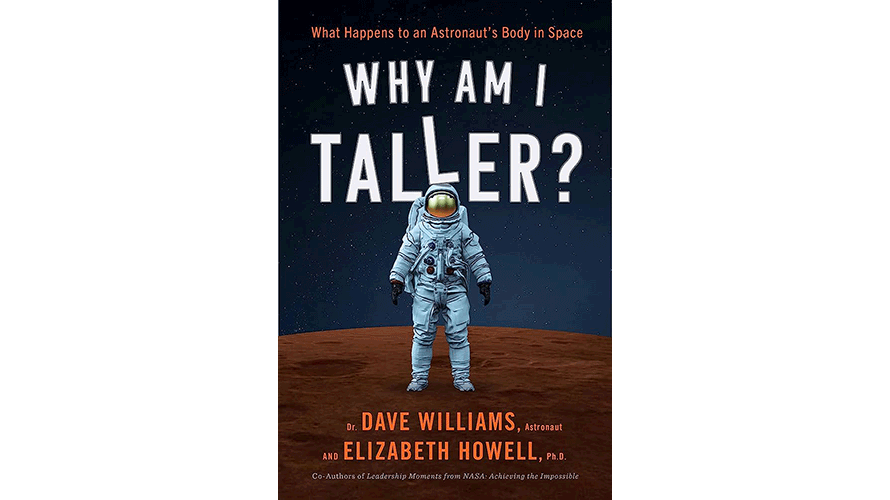
Title: Why Am I Taller? What Happens to an Astronaut’s Body in Space
Author: Dr. Dave Williams and Elizabeth Howell, PhD
NSS Amazon link for this book
Format: Paperback/Kindle/Audiobook
Pages: 240
Publisher: ECW Press
Date: November 2022
Retail Price: $17.95/$9.99/$15.30
ISBN: 978-1770415966
In 1940s and 1950s science fiction, life in space was almost like life on Earth. Living in zero gravity was portrayed as not much different than living in a gravity field. Space had risks, cosmic radiation and an inevitable meteor hit, but otherwise life on a space ship was little different than life on a submarine. Today, after nearly fifty years of humans living for long periods in space, we know better.
Why Am I Taller? What Happens to an Astronaut’s Body in Space, by astronaut Dr. Dave Williams and Elizabeth Howell, PhD, explores and explains what we know about what happens to the human body when it spends time in space.
In the first chapters Williams and Howell relate changes free-fall creates on a human body. Space travelers get taller as their spines expand. Our bodies’ mechanisms designed to keep blood from pooling in the legs in Earth gravity redistribute fluids from legs to the upper torso, yielding spindly legs and puffy faces. Different muscles are used. The tops of the feet, used to hook onto footholds, get callused while soles become soft.
These are some of the fascinating discoveries in the book. Williams and Howell look at virtually all aspects of life in space, physical, physiological, and psychological. Space sickness, the effects of radiation exposure, bone demineralization, and the effects of confinement and isolation are all examined. So too, are the challenges of working in space. Diet and digestion in space merit a look, as do the effects of living in partial gravity, such as experienced living on the Moon and Mars.
Not only does living in space offer challenges, readapting to life on Earth after returning from space has challenges too. Some, as the authors show, are as trivial as the returning traveler forgetting they are no longer in microgravity. Readapting to driving on Earth occurs quickly. Yet effects on muscle and bone can linger for months or longer.
The book is more than just a compilation of the hazards that accompany spaceflight. It also examines what is done to overcome those hazards. The authors present the research that had been done to understand the changes microgravity creates on the human body, and to overcome the detrimental effects of living in space. It also shows the methods used to counteract those effects, including rigorous exercise routines.
The authors show how understanding the effects of living in space have more general applications. Changes space travelers experience are similar to aging. A chapter is spent showing how the study of aging is used to maintain health in space, and how space medicine can be used to better understand the aging process, and improve the quality of life for the elderly.
For Williams, this book is personal. He spent nearly a month in space on two Shuttle missions, including conducting three EVAs. He is one of fewer than fifty physicians that have flown in space. He has experienced much of what he presents in this book.
“Why Am I Taller?” is a fascinating look at living in space, the challenges it offers, and the methods used to keep space travelers healthy in space and after they return to Earth. It is absorbing and informative.
© 2023 Mark Lardas
Please use the NSS Amazon Link for all your book and other purchases. It helps NSS and does not cost you a cent! Bookmark this link for ALL your Amazon shopping!