Category: Non-Fiction
Reviewed by: Peter Spasov
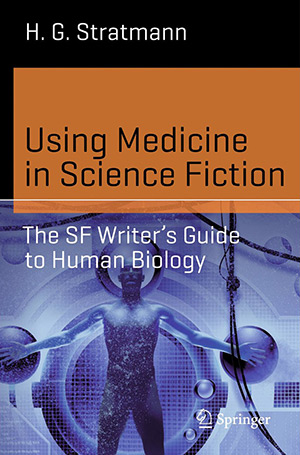
Title: Using Medicine in Science Fiction: The SF Writer’s Guide to Human Biology
Author: Henry G. Stratmann, MD
NSS Amazon link for this book
Format: Paperback and ebook
Pages: 556
Publisher: Springer International Publishing
Date: October 2015
Retail Price: $29.99
ISBN: 978-3319160153
It takes years of study and practical experience to know medicine. This book is a resource for those of us who are not medical doctors. And if we consider space travel, how do we know what it can be like to zip from Earth to—well, anywhere else? Throughout the book, the author gives examples from selected works of science fiction and how things are either correctly or incorrectly portrayed. At points, one can see his sense of humor and passion for the genre. The author is a cardiologist who has published science fiction stories as well as articles in medical journals.
The book begins with a summary of human biology from the chemistry of cells (the stuff of life as Stratmann puts it) to organs and human anatomy. With the basics covered, the book then addresses how people can be healed or hurt, the dangers of space, microgravity effects, and how astronauts handle medical care. He devotes a whole chapter to radiation effects.
A standard trope of science fiction is putting people in deep sleep for interstellar travel. The chapter on suspended animation knocks some reality about the actual complications of putting a person in this state, while also portraying how other animals do it and discussing modern medical use of limited cryopreservation and therapeutic hypothermia. The latter is a procedure used to cool a person’s body to a temperature that is lower than normal. The author explains some of the challenges to scale these procedures to interstellar suspended animation. After laying out these realities, Stratmann then offers some entertaining advice as to how an author might include such a technique.
A science fiction medical book wouldn’t be complete without chapters on telepathy, immortality, and alien sex. The author also speculates about microgravity astronaut-to-astronaut coitus. As a physician, Stratmann treats telepathy with a hearty dose of scepticism. Regarding immortality, he douses our eternal plans with frank discussions of gene therapy and the Hayflick limit, a theory that ultimately our cells can only divide so often before reaching “the end of the line.” The sex chapter covers experiments in space with animal reproduction as well as the possibilities and challenges for pregnancy in space. If you have wondered if you could mate with an extraterrestrial alien, you’ll have to read this book!
Other chapters cover medical nanotechnology, stem cells, organ transplants (or why to avoid that in space), and bionics. In the latter, he touches on daunting nitty gritty issues of merging humans and computers, but doesn’t address the speculative technological singularity when artificial intelligence exceeds that of human.
Some hard science authors extensively research medical topics for the sake of a paragraph or a few pages at best. An example Stratmann cites is the novel Energized by Edward M. Lerner. An astronaut murders another on an asteroid by removing his battery pack. Stratmann describes in detail the processes of freezing and numerous factors including the breathing of chilled oxygen and more. Presumably Lerner consulted with Stratmann in the writing of this scene.
The final chapter offers general suggestions for writers, such as showing the reader something instead of telling him about it. He also stresses that, especially when it comes to medical or technical issues, less is more: writers should avoid getting into too many details that can lead readers to question plausibility, hence detracting from the story.
Although hitting his readers with dollops of the real world, Stratmann gives writers permission to remove constraints and run wild with imagination in order to tell compelling stories. In his closing remarks, he gives some practical tips to balance the speculative with the plausible.
All writers and readers of science fiction will find Using Medicine in Science Fiction a valuable reference and an entertaining education on the effects of spaceflight on humans.
© 2016 Peter Spasov
Please use the NSS Amazon Link for all your book and other purchases. It helps NSS and does not cost you a cent! Bookmark this link for ALL your Amazon shopping!