Category: Fiction
Reviewed by Clifford R. McMurray
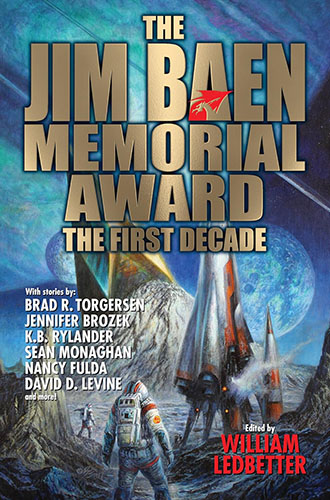
Title: The Jim Baen Memorial Award: The First Decade
Editor: William Ledbetter
NSS Amazon link for this book
Format: Paperback, Kindle
Pages: 320
Publisher: Baen
Date: November 2017
Retail Price: $16.00/$8.99
ISBN: 978-1481482813
The Jim Baen Memorial Award is a science fiction contest jointly administered by the National Space Society and Baen books, presented annually at the International Space Development Conference. The contest rules limit entries to short stories dealing with human space exploration in the next half-century or so. In this volume we have 16 winners and runners-up from the first decade of the award, all of them looking at various aspects of what living and working in space will be like for the pioneering generations.
The creators of this award hope the tales told here will inspire the next generation of scientists and engineers, as science fiction has always done. But no story can inspire unless it first captivates the readers’ imaginations and emotions. Adventure stories like these have to work on two levels. The foreground of the story is the hardware and the alien terrain of new worlds; the heart of the story is how the human characters’ emotions are caught up in their struggles to use technology to endure and prevail in new environments. So, for example in “Letting Go” we have a really Big Idea: a tunnel bored straight through the Moon, right through the core, acting as an elevator shaft from one side to the other. Drop a capsule in one side, and gravity will carry it to the core, and momentum will carry it up to the opposite hemisphere, where it will come to rest for an instant at the surface. This would never work on a planet with a molten core like Earth, but the Moon’s core cooled to solid rock eons ago, so it’s possible there—but only if there’s no friction in the system. Friction would cause the capsule to stop short of the opposite surface, and yo-yo back and forth in ever decreasing periods until it comes to rest at the core. And of course every mechanical system has friction…. That’s the setup. The story is about a father’s inner thoughts and emotions as he tries to rescue his daughter from a capsule that was dropped before the system was completed, and learning to let her make her own life choices.
The frontier is a dangerous place, and survival there demands competence, resourcefulness and courage. “Scramble” follows a day in the life of a lunar rescue team member, responding to the crash of a passenger spacecraft. They’re able to rescue almost everybody, but it’s the one they couldn’t save that has him looking for a drink before he goes home. “Low Arc” is also set on the Moon, but in this story the stranded astronaut must repair his damaged spacecraft enough to make a controlled crash close to base before his air runs out. In “Taking the High Road” we are introduced to a crew of explorers on the way to Mars who discover that their base camp has had an accident which destroyed their provisions and fuel for the return trip. They don’t have enough water and air to get back to Earth, but they have enough fuel to rendezvous with a short-period comet. Comets have lots of water, which can also yield oxygen via electrolysis. That’s all they need to stay alive, however long it takes to circle back to the inner solar system. They make it back to Earth 25 years later—and don’t want to get off their new home. “Citizen Astronaut” finds a blogger sent to Mars for public relations purposes trying to integrate himself with the professional crew, and working with them to survive a meteor strike on the base.
Other stories deal with artificial intelligence and what it means to be human. In “We Fly” a woman whose intelligence and personality was downloaded into the software of an interstellar probe finds that there’s a stowaway in the software with her. “Cylinders” is told from the point of view of a prototype artificial intelligence on an L5 colony assigned to protect the daughter of his creator while he learns to be more like a biological human. The young boy in “Balance” learns what a tragedy a fully balanced ecology on a generations-long interstellar voyage can be.
It must have been a coincidence, but the stories are almost perfectly balanced in terms of setting, with three stories each about explorers/settlers on the Moon, Mars, asteroids or comets, and at space stations, and four stories about interstellar flights (a couple of them fall in more than one of these categories). The authors deal with everything from rescues and self-rescues to the quest for artificial intelligence to piracy in space. All the stories are competently executed, some are excellent, and with so many different styles and points of view that it will be a rare science fiction reader who finds nothing to enjoy here.
© 2020 Clifford R. McMurray
Please use the NSS Amazon Link for all your book and other purchases. It helps NSS and does not cost you a cent! Bookmark this link for ALL your Amazon shopping!