
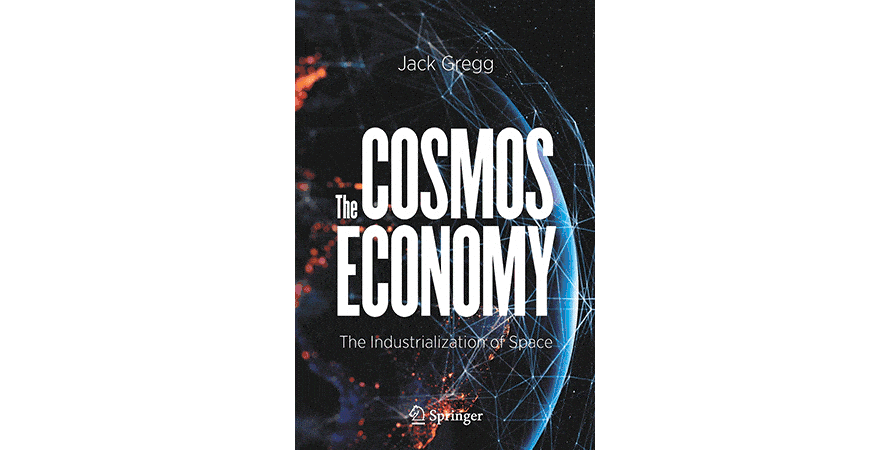
Category: Nonfiction
Reviewed by: Casey Suire
Title: The Cosmos Economy: The Industrialization of Space
Author: Jack Gregg
NSS Amazon link for this book
Format: Paperback/Kindle
Pages: 340
Publisher: Copernicus
Date: May 2021
Retail price: $27.99/$22.52
ISBN: 978-3030625689
It’s no secret that the space industry is currently booming. Private investment in space reached an all-time high in 2021. The number of companies planning new launch vehicles, space stations, satellites, etc. has never been higher. Things are really exciting.
Dr. Jack Gregg’s book, The Cosmos Economy, will help readers understand what is going on in the space business and why it is happening. The book will also explain how the industry could be valued at $3 trillion by mid-century. Gregg formerly served as Executive Director of the California Space Authority. During this period he began to question what the future space economy would be like, which led to the creation of the book. He also interviewed several prominent individuals in the space industry. A few of these important figures belong to the National Space Society.
In his book, Gregg often uses business terminology and concepts to describe the upcoming cosmic economy. Examples include “blue oceans” (getting involved in a new market before the competition arrives) and “greenfields” (untapped and undeveloped areas like the region beyond low Earth orbit). He also details how the space economy will grow through five phases of adoption: frontier, early adopters, early mainstream, late mainstream, and lagging adopters. Despite the potential for strong growth, not everything will be easy. One problem Gregg mentions multiple times is the down-mass problem: How to move thousands of tons of cargo from space to the surface of Earth? He mentions that technologies like space elevators could solve this problem, but no one has built one yet.
Gregg writes in a way that isn’t dry or mundane. Often he adds humor. For instance, he notes that SpaceX’s Mars mission “is a solution ready-made to ensure the human species doesn’t end up extinct like the dinosaurs or the 8-track tape deck.” Another example is a section he titled “Is there Really Gold in Them Thar Asteroids?”
One aspect of The Cosmos Economy that will cause some strong debate is the role of humans in space: Gregg makes the suggestion that the first space settlers will be robots and not humans. Reasons include the numerous dangers of spaceflight to humans, the fact that robots and automation are cheaper than people, and that robots can work non-stop without food or life support.
While these arguments are normally used by those against human spaceflight, this is not totally the case in the book. Early on, Gregg states that “human settlement in space is a sure thing and will happen in the twenty-first century.” He also believes “it certainly would simplify things and reduce the start-up costs if the foundational work were to be accomplished by robots to clear a path so that people can come later.” In The Cosmos Economy, humans will settle space only after robots do it first. Interestingly, Gregg came to this conclusion based on a survey he conducted on the subject.
Another part of the book likely to grab one’s attention is a very brief discussion on human bioengineering. Can humans be modified to better withstand the harsh conditions of outer space? One suggestion is to combine human DNA with tardigrade DNA. Tardigrades, also known as water bears, are microscopic creatures known to survive tough conditions such as extreme temperatures and radiation. There is also the prospect of 3D printing body parts that have been damaged by long periods of spaceflight. It is noted that many fictional stories involving altered body parts, such as Frankenstein, usually don’t end well. On the other hand, it is reasoned that procedures like heart transplants and prosthetic limbs have helped improve lives. It is also claimed that there could be some spin-off value to this idea. Technologies used for building new body parts for “frankenauts” would have applications on Earth.
As far as what activities will create a multi-trillion dollar space economy, Gregg mentions industries such as space-based energy generation, agriculture and food production, mining, and manufacturing. These are all things NSS members will recognize, but it is worth repeating for those unaware of what might one day be possible in space.
One interesting statistic in the book is how commercial space ventures are financed. According to a recent report, 77.1% came from private funding sources; the other 22.9% was from the government. Space is not another government program funded by taxpayers. Space is a place that can create economic opportunities for those willing to take the risk. It is out there waiting.
© 2022 Casey Suire
Please use the NSS Amazon Link for all your book and other purchases. It helps NSS and does not cost you a cent! Bookmark this link for ALL your Amazon shopping!






1 thought on “Book Review: The Cosmos Economy”
The Space Elevator concept is very expensive and requires futuristic Nanotube-cable materials. However,there is a possible lower cost more feasible alternative : ” The LUNAR SPACE TOWER” The L.S.T would be an elevated spaceport located at Moon’s South Polar Region. The L.S.T could be linked to a lunar oxygen pipeline and transport rocket propellant to low mass space ferry vehicles while avoiding lunar dust clouds generally produced by surface landings. The design engineering of the L.S.T would be based on the iconic Seattle Space Needle and Tokyo Sky Tower coupled with carbon fiber composites,3-D printing techniques,refined lunar regolith and advanced robotic construction technologies. An international consortium of private companies working with several governmental agencies i.e. the ISS could erect the first L.S.T in the year 2040. “Someday……There will be-Elevators-on the-Moon! S.T.E.M./ L.S.T-2040