Category: Nonfiction
Reviewed by: Susan Raizer
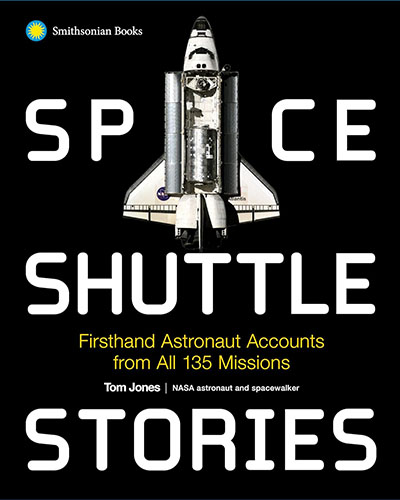
Title: Space Shuttle Stories: Firsthand Astronaut Accounts from All 135 Missions
Author: Tom Jones
Format: Hardcover/Kindle
Pages: 320 pages
Publisher: Smithsonian Books
Date: October 2023
Retail Price: $35.00/$21.99
ISBN: 978-1588347541
Find this book
Space Shuttle Stories is composed of at least one astronaut’s impressions of each of the 135 space shuttle missions, from the test flights of Enterprise in 1977 to Columbia in 1981 and to the last flight of Atlantis in July 2011. Astronauts from each of the six orbiters, Enterprise, Columbia, Challenger, Discovery, Atlantis and Endeavour provided their narratives. The astronauts had various roles on the missions, from payload specialists to commanders. For the lost crews of both Challenger and Columbia, there were touching tributes to them by their astronaut colleagues. More than 130 astronauts provided their insights to their missions, with the author filling in information where necessary. The pandemic and the widespread use of Zoom and other platforms allowed the author to begin the interview process with the astronauts, all of whom were eager to provide their insights.
The author, Tom Jones, is a former astronaut who flew on four space shuttle missions between 1994 and 2001 (STS 59 in 1994, STS 68 in 1994, STS 80 in 1996 and STS 98 in 2001) and performed three space walks to further the building of the International Space Station. He is a published author of six books including Sky Walking: An Astronaut’s Memoir, and Ask the Astronaut. In addition, he has written articles for Air & Space/Smithsonian, Aerospace America, National Geographic and the Planetary Report. He is a senior research scientist of the Institute for Human and Machine Cognition and has been on television news programs as an expert commentator on space exploration and science.
Space Shuttle Stories is a visually beautiful coffee table sized book. Each narrative includes the mission number, orbiter name, duration of the mission, photographs and listing of the crew, and mission objectives, and is accompanied by full color one page photographs of mission performance. The book is divided into several sections: 1) ‘Testing the Space Shuttle’ covering 1981-1986; 2) ‘Returning to Flight’ and the ‘Space Shuttle as Science Platform’: 1986-1998; 3) ‘Building the International Space Station’ and ‘Losing Columbia’: 1998-2011; 4) ‘The Space Shuttle in Perspective’. The book also includes references, a bibliography for further study, and an index.
Whether each astronaut contributor was a commander, pilot, mission or payload specialist, each one was candid in their narrative as they offered their personal insights into their assigned (or spontaneous) tasks, their feelings about their crew mates and their shared experiences on the mission. The first time voyagers, almost universally, spoke of their trepidations regarding the launch and their abilities to perform their duties optimally, which morphed into awe and astonishment at first sight of Earth from space. Both rookies and veterans spoke of their team’s inventiveness and cohesiveness in solving problems, both on their own when contacting Mission Control was not viable, and when working with their colleagues on the ground to come up with workarounds for unplanned glitches.
This reviewer found the narratives very informative and a refresher in what was accomplished on the missions and which astronauts participated. Some of these stand out: There were 10 flights between 1994 and 1998 to assist the Russians in building, repairing and equipping the Mir Space Station, as well as transporting astronauts for long duration stays on Mir. There were numerous critical missions performed for the Department of Defense, most of which remained classified. There were the Hubble Space Telescope repair missions that prolonged the life of and enhanced the capabilities of this great orbital telescope. There was one mission, STS 83, which because of equipment malfunctions, was cut short after three days; its crew was launched the following year to complete the mission.
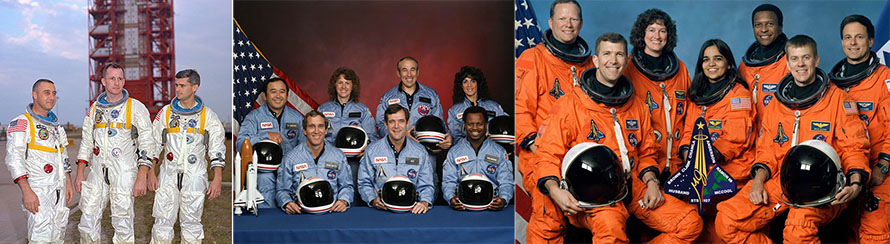
I also found that all crews meshed successfully to achieve mission objectives even if rookies sometimes needed additional encouragement and support! Among the most poignant was the author’s discussion of the Challenger tragedy, as well as the expression by Rick Hauck (commander on Discovery’s Return to Flight after Challenger) that the Shuttle program had to continue to honor the sacrifice of his colleagues. I also found the same sentiment after Columbia. The author included an onboard upbeat narrative by Laurel Clark, Mission Specialist on that ill-fated flight. We learn that even before Columbia was lost, the foam issue occurred on several flights but was deemed not to be a problem by Mission Control.
This reviewer recommends Space Shuttle Stories to National Space Society members for several reasons. First, the book is a testament to the accomplishments that were achieved over the thirty year span of the program. Second, the book is a beautiful addition to any space enthusiast’s library and a clear and concise history of a craft that allowed so much science, engineering and other disciplines to have a platform to further our understanding of life off planet Earth. Third, the reader gets an insight into the thought processes of the astronauts from the rookies who were nervous about first-time flying and performing their assigned duties optimally to the more experienced astronauts who felt their crews worked well to accomplish their duties.
© 2024 Susan Raizer