
Category: Nonfiction?
Reviewed by: Dale Skran
Title: Space Forces: A Critical History of Life in Outer Space
Author: Fred Scharmen
Format: Hardcover/Kindle
Pages: 272
Publisher: Verso
Date: November 2021
Retail price: $23.99/$9.99
ISBN: 978-1786637352
Find this book
In Space Forces: A Critical History of Life in Space, Fred Scharmen, a teacher of architecture and urban design at Morgan State University, embarks on an intellectual project to fit advocates of space settlement into either round holes or square holes. They are either like Gerard O’Neill and Wernher Von Braun, described as Western colonialists bent on exporting exploitation and militarism to space, or good-hearted socialists in the mold of J. D. Bernal, seeking to impose some alternative to private property and free markets on the solar system. A problem with anyone who seeks to mold facts to support a thesis arises from an inevitable rise of confirmation bias. Scharmen’s re-invention of Arthur C. Clarke, one of the best and most level-headed hard science fiction writers of the 20th century, as a meandering mystic agog over fake crystal skulls left me shaking my head.
Though Space Forces is a poor introduction to the history of different visions of space settlement, this is not to say that Scharmen’s work has a complete lack of merit. If you’ve already read The World, the Flesh and the Devil (Bernal), The High Frontier (O’Neill), The Mars Project (Von Braun), and Profiles of the Future (Clarke), you’ll be equipped to separate the wheat from the chaff left by Scharmen’s project. The chapter on NASA holds special interest for space advocates who might wonder what holds NASA back from building a human future in space. You may not agree with everything Scharmen has to say about NASA, but I found much of value here. On the other hand, the chapter on Clarke appears to have been written about a different author than the one we all know and love. Scharmen focuses on the quasi-scientific television show Arthur C. Clarke’s Mysterious World rather than classic works such as The Promise of Space and The Exploration of Space.
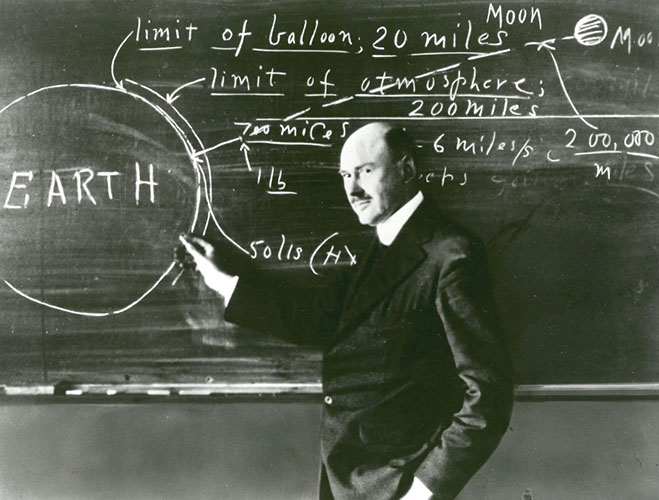
Scharmen’s admittedly fluid and often entertaining prose spins a variety of anecdotes and historical footnotes that many space advocates will find interesting. Unfortunately, he spends too much time with science fiction writers who support his thesis—such as Ursula Le Guin and Arkady Strugatsky—and there’s little room in this book for rocket pioneer Robert Goddard, or Dandridge M. Cole who was the author of Islands in Space: The Challenge of the Planetoids. One of Scharmen’s attempts to stretch things to make his point comes with his quote from Le Guin’s A Rant about Technology, in which she says “we think nothing less complex and showy than a computer or a jet bomber deserves to be called ‘technology’ at all.” Later, Scharmen suggests that newspace advocates in general are consumed with visions of complex technology and somehow limited by their lack of appreciation of simple technology such as pots and pans. To me, this analysis overreaches, but space advocates would do well to remember that that just because a solution is “hi tech” does not mean it is a good approach—for example, much of Elon Musk’s success can be attributed to a relentless drive to reduce complexity. Additionally, “technologies” such as property law, patent law, and limited liability corporations are just as important as rocket science to making space settlement a reality.
Scharmen expounds at length that O’Neill’s vision of space settlements creating a profusion of cultural experiments is a kind of colonialism in which the colonies are perpetually under the stress of challenge and change, while valuable innovations are imported back to Earth. Scharmen’s critique is that O’Neill proposes to export risk to the settlements, allowing “Mother Earth” to profit from those who perhaps died or were injured in space. The defense of O’Neill’s vision is that while those who settle space will knowingly and voluntarily take on risk, those who live there will be the first and most direct beneficiaries of cultural and scientific innovation on the frontier, and there is no reason to think that all of the innovations that originate in space settlements, especially cultural ones, can be easily imported back to Earth. Advocates of space settlement should take note of this new attack on O’Neill’s vision and ponder how best to respond.
Another argument Scharmen advances is dismissing lowering the cost of reaching orbit as “induced demand” which can never create real improvement in the long run. Induced demand is usually discussed in the context of widening highways. At first travel is faster and safer, but over time traffic grows to such an extent that congestion returns to the same level as existed before the highway was widened. Since cost rather than congestion in reaching space is the key issue, the salience of “induced demand” seems, like many of Scharmen’s arguments, a stretch. Additionally, induced demand can be restated more accurately that when a good is free, congestion (jammed roads, long lines) will occur since there is no price-based regulation. There are no “free” rockets to orbit, so the concept of induced demand seems irrelevant. Instead, we are seeing the growth of a new market as this technology escapes from government control and is allowed to seek lower cost ways of doing the same thing.
Scharmen excavates another anti-settlement argument: “In the same mode, Bezo’s decision to try to create a situation where millions of people are living and working in space almost requires the existence of poverty on Earth, as something that his scheme can both address indirectly, and offer an alternative to” (pg. 219). The twisted logic here suggests that there is something wrong with poor people who want to live like those in the developed world but without despoiling Earth. Scharmen’s solution of “stasis” seems clear: fewer people with fewer desires and no need for space resources or settlement. This line of argument should remind space settlement advocates of the importance of multiple rationales for space settlement, and in particular the importance of goals that can only be met with expansion into space such as long-term human survival.
The concluding chapter, “Find the Others,” lays out the author’s view of the future clearly. Scharmen and his allies will seek to prevent capitalism, free markets, and private property from being allowed in space. In fact, their project is nothing less than the end of growth and a static society forever confined to Earth proper. They quite correctly understand that once the ideals of freedom escape the surly bonds of gravity, their growth will be unbounded. So, the newspace entrepreneurs, and especially Musk and Bezos, must be stopped now. The Moon Agreement must be firmly established in space, and then the ideals of socialism can be imported back to Earth, for imposition on everyone. Given that during the 20th century, something like 100 million lives were taken in a misguided quest to impose these kinds of values on a global scale, I do not find this prospect inviting.
Of course, there must be room for a very wide range of space settlement governance approaches. There should be some limits, but those boundaries will encompass market capitalism, “mixed” economies, socialism, communism, communes, libertarianism, and many more economic visions, some yet to be invented. But what must be out of bounds is the imposition of a single economic and political vision in space, with a view toward importing it back to Earth. Fortunately, the growing success of the Artemis Accords suggests Scharmen is on the losing side of history. But the fight is in the early days, and as H.G. Wells wrote at the conclusion of Things to Come, it is everything or nothing. Our future in space will either encompass a wide range of human visions of happiness, or a single, universal system, well intentioned in theory but totalitarian in fact, which will spread over the stars.
© 2025 Dale Skran