
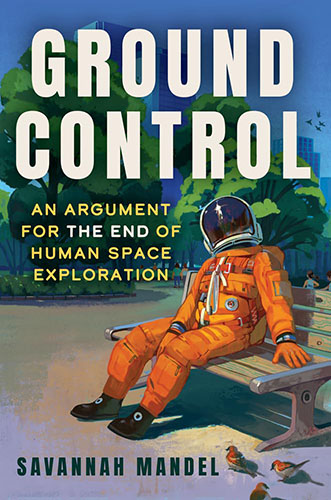
Category: Nonfiction(?)
Reviewed by: Dale Skran (from Ad Astra Winter 2025)
Title: Ground Control: An Argument for the End of Human Space Exploration
Author: Savannah Mandel
Format: Hardcover/Kindle
Pages: 224
Publisher: Chicago Review Press
Date: July 2024
Retail Price: $28.99/$14.99
ISBN: 978-1641609920
Find this book
Ground Control collects a series of essays documenting Mandel’s journey from being a space anthropologist studying Spaceport America in New Mexico, to writing a book calling for the end of space exploration, development, and settlement. It is as though Margaret Mead returned from her field studies in Samoa calling for the destruction of Samoa and the re-education of the indigenous peoples in Western ways. At minimum, it is hard to imagine Mandel continuing her studies as a “space anthropologist” after writing a book attacking her subjects of study as exploitative colonialist capitalists whose work should not be funded or pursued for the foreseeable future.
Because Ground Control is light on scholarship and lacking in political, economic, or philosophical thinking, it is hard to know exactly what to respond to in writing this review. At least Deudney in Dark Skies and the Weinersmiths in A City Mars (see extensive review) demonstrate extensive study of the thinking and arguments of space advocates before labeling space settlement supporters as existential menaces. In contrast, although Mandel constantly asserts her life-long interest in space and science fiction, she appears significantly ill-informed about her subject matter. For example, Gerard K. O’Neill and The High Frontier are never mentioned in the text, nor do they appear in the notes or index. For Mandel, the first people to think seriously about settling space are apparently named Musk and Bezos.
Her training as an anthropologist appears to have better prepared her to be a political ideologue rather than an objective scholar. Her experiences with Virgin Galactic and as an intern with the Commercial Spaceflight Federation (CSF) soured her on the dream of developing and settling space. It is indeed unfortunate that her experience was with a company that is not exactly moving humanity into space at a rapid pace, and one wonders what book she would have written if she did her research with Rocket Lab or Planet.
She recounts a conversation with the Executive Director of the CSF, where she asks, “Why do space companies … [and] the government … hate China and Russia so much? Why does it matter if they get to space first? Would it really be so bad?” The CSF Executive Director comes back with “xenophobia with a weighty dash of colonial intent.” Of course, I don’t know exactly what the ED said, but I am just gobsmacked by the naiveté and ignorance behind her question.
Another factor causing Mandel to take a dim view of commercial space lies in her experience with sexual harassment. She recounts various stories that sadly have the ring of truth. As space advocates, we must work tirelessly to welcome everyone sincerely interested in space, and a big part of that lies in ensuring that all people are free from harassment of any kind.
One of Mandel’s points has the virtue of being true—with the rapid growth of artificial intelligence, the long-term future of human space exploration appears grim. Expensive and risky “flags and footprints” human space exploration just isn’t needed. In my vision, programs like NASA’s Commercial LEO Destinations should be the focus of space spending, but the text reveals Mandel is more concerned with preventing the short-term fun the rich may have as space tourists as opposed to enabling the long-term benefits of space resources for everyone on Earth.
Mandel’s writing style leans heavily on rhetorical flash but is pleasing to read. She concludes with “The Caretaker’s Demand,” asking us to “wait, to care, to repair, and to conserve … A recognition that humans are not ready to settle outer space … before we settle outer space, planet Earth … must reach a point of stability.”
Read Ground Control only for gaining insight into the thinking of anti-space settlement activists. The book also usefully reminds us that the “Caretakers Demand” Mandel advocates for threatens not just our future in space, but the future of all our freedoms. The quest to explore, develop, and settle space is not a “demand” space advocates place on their fellow human beings. All we ask is the freedom to head for the stars. Mandel’s “Caretakers Demand” requires that all of us must be chained to the oars on Earth until utopia is achieved.
© 2025 Dale Skran












1 thought on “Book Review: Ground Control: An Argument for the End of Human Space Exploration”
The assumption behind this “Caretaker’s Demand” seems to be that humans can become ready to do something without doing it. This is contrary to all experience! And is it the path of wisdom to suppose that the solutions to our problems on Earth can all be found on Earth? I think not — indeed, it is very unlikely, in my view, that we can learn everything we need to know, in terms of stewardship both of human society and the Earth’s biosphere, without the experience we will gain in small enclosed environments off–Earth.
The rejection of space travel and settlement on the grounds that “first we need to make things better on Earth” seems to me to reflect, more than anything, a kind of aesthetic nihilism which finds so much fault with everything that really exists, that it finally takes refuge in negation and seeks non–existence.