Category: Nonfiction
Reviewed by: Casey Suire
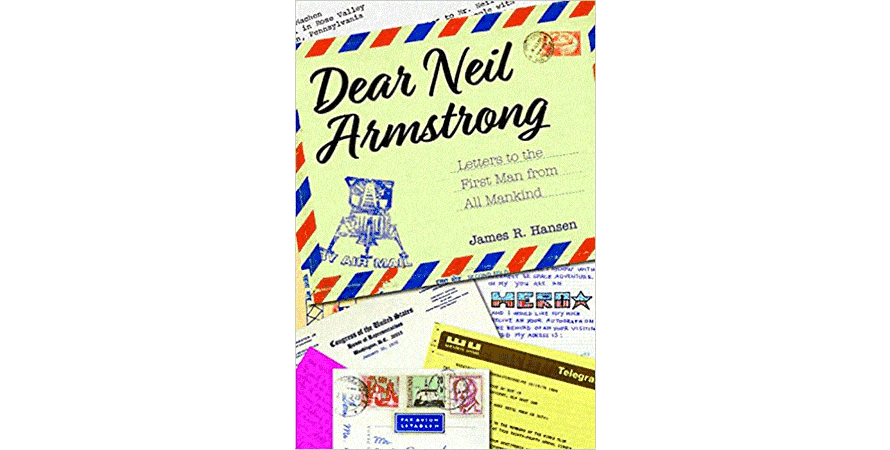
Title: Dear Neil Armstrong: Letters to the First Man from All Mankind
Author: James R. Hansen
NSS Amazon link for this book
Format: Hardcover/Kindle
Pages: 400
Publisher: Purdue University Press
Date: October, 2019
Retail Price: $34.99/$33.24
ISBN: 978-1557538741
Dear Neil Armstrong: Letters to the First Man from All Mankind is a must-have book for all space enthusiasts. This collection of letters, cards, telegrams, and e-mails gives readers an idea how fame affected Neil Armstrong’s life following Apollo 11. Society’s treatment, both good and bad, of heroes is demonstrated throughout this work.
In the weeks following his return from the Moon, Armstrong was bombarded with 10,000 pieces of mail per day. Kids are one thing, but many adults seemed to believe that Armstrong had time to miraculously answer all this mail. To many, Armstrong was almost some sort of superhero. To paraphrase many letters: “You must be special. Why else did you get picked to be the first man to walk on the Moon? Of course, you have the solution to my problem. Can I have an autograph…Are you there? Why haven’t you answered my letter yet?” Many letter writers even acknowledged that Armstrong was a very busy man, but they asked for things anyway.
The truth was much different. As referenced in a 2005 interview on 60 Minutes, Armstrong was not selected as the first man on the Moon. Rather, he was selected as the commander of Apollo 11 before it was known that it would be the first Moon landing mission. Had circumstances played out differently, another Apollo commander would have received all the hero worship instead. Nonetheless, he was first. A letter from June 1970 correctly foreshadowed that in fifty years, history books will focus more on Neil Armstrong than any other space hero.
The chapter on the Soviets contained some very interesting correspondence. Unlike many countries, the Soviet Union didn’t send any goodwill messages to Apollo 11. On television, news of the moonwalk only briefly interrupted a Russian volleyball match. Despite their government’s lukewarm reaction, many Soviets, as with the rest of the world, showered Armstrong with admiration and respect. He, along with his crewmates, received a congratulatory note from every living Soviet cosmonaut. Autograph requests from behind the Iron Curtain were not in short supply. One Soviet scientist even wrote a letter about naming a new mineral “Armstrongite.” Neil wrote back with approval.
Also noteworthy is how Armstrong interacted with children. Most young fans realized the significance of Armstrong’s “one small step.” Many kids expressed the opinion, even in the early seventies, that he was one of history’s most important figures. They often mailed gifts and asked for his advice and insight on various matters. Multiple youngsters even invited Armstrong to dine with their families! Thanks to the huge volume of mail, Armstrong rarely gave children what they desired. He did, however, send many kids autographed photos.
On the subject of autographs, several letters highlight issues with this process. In one case, an upset man claimed his autograph was done by an autopen and therefore not actually signed by Armstrong. Another example is how a fan asked for and successfully received a total of nine signed photos over a one-year period. Finally, on the next letter, Armstrong wrote a note to his secretary stating, “NO MORE AUTOGRAPHS.” Furthermore, sales of fake Neil Armstrong autographs began to occur. Even though he believed most requests were legitimate and not for profit, Armstrong decided to stop signing autographs in 1994.
The autograph debacle reveals a much larger problem with his celebrity. Many wanted to enrich themselves at the expense of the First Man and his precious time. For most letters, Armstrong turned down such demands with class and modesty. Sometimes, as with the autograph ban, he grew tired and took action.
Despite this, not all letters to Armstrong were pushy and rude. A few were especially heartwarming, thoughtful, and refreshing to read. Such letters were justified and very respectful of Armstrong. These are best part about the book and make it worth purchasing.
Due to the large quantity of correspondence Armstrong received over his lifetime, James Hansen had no shortage of material to work with. He admits that his original plan for publication would have resulted in one really long book. For this reason, favorable letters were divided into two shorter books. A second book of Armstrong letters, titled A Reluctant Icon: Letters to Neil Armstrong, was published in May 2020.
Dear Neil Armstrong is somewhat of a cautionary tale on how people should look at their heroes. People risk their lives all the time in order to improve the lives of others. For Neil Armstrong, this wasn’t enough, and people asked favors from him the rest of his life. Society should give back to heroes, not the other way around. Isn’t giving humanity the Moon enough?
© 2020 Casey Suire
Please use the NSS Amazon Link for all your book and other purchases. It helps NSS and does not cost you a cent! Bookmark this link for ALL your Amazon shopping!