Category: Nonfiction
Reviewed by: Casey Suire
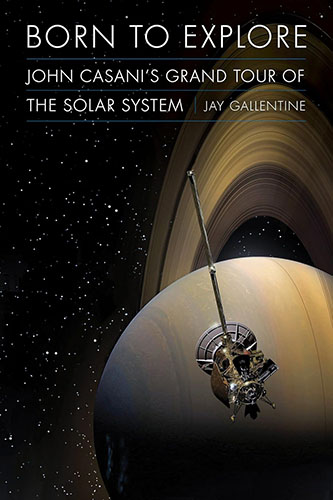
Title: Born to Explore: John Casani’s Grand Tour of the Solar System
Author: Jay Gallentine
Format: Hardcover/Kindle
Pages: 400
Publisher: University of Nebraska Press
Date: December 2025
Retail price: $39.95/$37.95
ISBN: 978-1496206657
Find this book
In November 2026, Voyager 1 will become the first human-made object to travel one light-day from Earth. Signals from NASA’s Deep Space Network (DSN) will take 24 hours to reach the spacecraft. Famously, both Voyager probes were equipped with a gold-plated copper phonograph record. If any extraterrestrials discover the Voyager Golden Record, they would have access to various spoken greetings, images, natural sounds, and music from our planet. The idea of a cosmic message to extraterrestrials was suggested to legendary scientist Carl Sagan by Voyager’s project manager, John R. Casani. With Born to Explore, Casani’s story is told for the very first time.
Initially, veteran space author Jay Gallentine planned to write a history book about robotic exploration of the outer planets and the Mars rovers. He first met Casani in 2007 and wanted to speak with him again before writing this latest book. In 2021, a planned twenty-minute interview became a fascinating four-hour conversation between the two men. After this productive meeting ended, Gallentine thought it was unusual that no book had ever been written about Casani’s long career at the Jet Propulsion Lab (JPL). Thus, John Casani became the central figure in Born to Explore.
The finished product is a meticulously researched and historically accurate book. It will be obvious to readers that Gallentine has the utmost respect for Casani. The story often shifts back and forth between the past and a 2016 dinner with Casani at an Italian restaurant. While enjoying a basket of bread, glasses of red wine, and bread pudding with ice cream, Casani recounts several important events in his life. What a brilliant setting to conduct research for a space history book.
While Casani served as a project manager for the Voyager, Galileo, and Cassini missions, the book is principally about Galileo. Other individuals in the book include James Van Allen, Bruce Murray, Lew Allen, Roger Diehl, Don Gurnett, Mary Reaves, and Hugh von Delden.
But why John Casani? Why not another project manager that guided other JPL missions? What inspired Gallentine to transform this book into a semi-biography of Casani? Readers will learn why his career was so exceptional. According to Casani, the Voyager Golden Record was “the most important accomplishment in his whole entire JPL career.” Additionally, his legacy was living “in a world with no corners.” No problem was too challenging or unsolvable. Casani always led his team to success despite some very tough circumstances. This was especially true during his tenure as Galileo project manager. The spacecraft endured many major design changes and delayed launch windows.
Interestingly, many of Galileo’s headaches were caused by the vehicle that delivered the spacecraft to low earth orbit (LEO): the space shuttle. A recurring theme of Born to Explore is the relationship between robotic and human space exploration. These two distinct camps don’t always agree on everything. Even today, dozens of NASA science missions face potential termination; crewed missions are a much higher priority.
In the book, NASA’s enthusiasm for the new shuttle wasn’t shared by many planetary scientists. As JPL director Bruce Murray explained in 1976, “Budgets are in flux. Less money for planets. Shuttle costs are killing all of us. JPL must diversify.” On another occasion, a NASA public affairs officer said, “It’s much easier to get in the paper talking about the Shuttle than it is about some unmanned spacecraft.” Confidence in the space shuttle was shattered when Challenger exploded. John Casani witnessed the tragedy from KSC’s Operations and Checkout Building. The Galileo mission was redesigned again and launched on shuttle Atlantis in 1989.
For all his success at JPL, Casani never considered himself a good manager. Instead, he thought of himself as a great leader. By his own admission, he was “very undisciplined, unorganized, and not very structured in terms of what a good management practice would anticipate.” Casani also believed that bad communication was “the root cause of all problems.” As a result, he championed an open-door policy. Anyone at JPL could walk into his office and speak to him. Furthermore, Casani largely considered his work complete once a spacecraft left Earth. Unlike other JPL personnel, he never got emotional when a mission ended. To Casani, each spacecraft “was just a machine.”
How he got hired at JPL is a heck of a story. As a young man, John Casani never dreamed of conquering the solar system. He earned a bachelor’s degree in electrical engineering from the University of Pennsylvania. Following an unfulfilling first job after college, Casani and a friend took a road trip to California. While sitting in the student union at the University of Southern California (USC), the aimless young Casani searched for employment. Despite his lack of a graduate degree, he was granted an interview with the Jet Propulsion Lab in Pasadena. Luckily for him, the original recruiter went on vacation. Instead, Casani was interviewed by another recruiter that shared his fun personality. As Casani later reflected, “I was kinda loose, you know, and I was more oriented to havin’ fun.” The interview went well, and John Casani began his long and storied career at JPL. Starting pay was $395/month. Quite a substantial salary for 1956.
For a book about very expensive and complex interplanetary spacecraft, Born to Explore is sometimes oriented for fun too. One example is a massive New Year’s party that attracted both drunken teenagers and policemen to the Casani residence. Another time, John Casani wore 16th-century attire for Galileo Galilei’s 421st birthday. There even was a cake. Other funny stories won’t be mentioned here. You’ll have to read the book to get them.
Additionally, Gallentine’s writing is often humorous. For instance, Lew Allen should have enjoyed his retirement instead of becoming JPL director in 1982. Gallentine jokes that Allen missed out on films like Star Trek II: The Wrath of Khan and Mad Max 2: The Road Warrior. When discussing an exchange between physicist Don Gurnett and a newspaper reporter, Gallentine notes an advertisement for “whole chicken fryers on sale that week for 39 cents a pound, FYI.” If you enjoy this style of writing, Born to Explore is for you.
The book also contains an ample supply of photographs. Perhaps the most powerful picture is one from March 1959. A young, bespectacled Casani, flanked by Wernher von Braun and James Van Allen, is holding the Pioneer 4 spacecraft. The college graduate that previously had no direction or ambitions was now standing in between two space legends. The photo also illustrates how robotic spacecraft became larger and more sophisticated over the next few decades. In more ways than one, this picture foreshadowed Casani’s future.
Sadly, John Casani never lived to see the publication of Born to Explore. He died June 19, 2025, at age 92. Thanks to Jay Gallentine and the University of Nebraska Press for another superb entry in the Outward Odyssey series. An outstanding account of an enviable life and NASA career. Truly, an untold story that every space enthusiast must read.
My favorite book this year.
© 2025 Casey Suire