Category: Nonfiction
Reviewed by: Douglas G. Adler
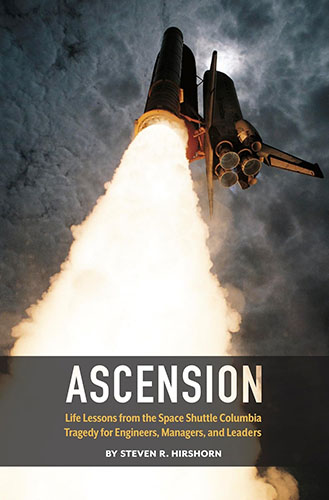
Title: Ascension: Life Lessons from the Space Shuttle Columbia Tragedy for Engineers, Managers, and Leaders
Author: Steven Hirshorn
Format: PDF/Kindle
Pages: 342
Publisher: NASA
Date: September 2025
Retail price: $0/$1.99
ISBN: 978-1626830875
Get free PDF of this book
The Columbia disaster in 2003, when the crew and vehicle succumbed to a catastrophic failure during reentry after the orbiter was fatally wounded by a foam strike that occurred during liftoff 15 days earlier, forever changed NASA and how the safety of crewed spaceflight was viewed. Many volumes have been written about the tragic events, covering the lead up to the launch, the events on orbit, the reentry, and the recovery operations that took place in the aftermath. Comm Check by Michael Cabbage and William Harwood, Bringing Columbia Home by Michael Leinbach and Jonathan Ward, and other books have recounted the events and tried to provide readers with lessons on life and leadership from the crisis. Most notably, the Columbia Accident Investigation Board (CAIB) report, which is available free online, did the deepest dive on all aspects of the final flight of America’s first Space Shuttle.
Into this fray enters Steven Hirshorn’s, Ascension: Life Lessons from the Space Shuttle Columbia Tragedy for Engineers, Managers, and Leaders. The book, published by NASA itself and is also available free online, retells the story as viewed through the eyes of a Flight Controller who had extensive experience working in Mission Control. The book recounts the events of the flight, the disaster, and the investigation. The book is long and very detail oriented and gives the reader a real sense of the culture inside of NASA before, during, and after the Columbia Disaster. Parallels are drawn to the trials that NASA went through after the Apollo 1 pad fire (which claimed the lives of astronauts Gus Grissom, Ed White, and Roger Chaffee) and the loss of the Challenger with all hands in 1986. After each one of those terrible events, NASA was forced to take a hard look at itself in the mirror and make changes to reduce the risk of those events ever happening again, and the loss of the Columbia spurred similar efforts (to varying degrees of success).
Much of the information here is not new. As someone who read the entire CAIB report and other books on the loss of Columbia, I did not learn much about the disaster and the subsequent investigation that I did not know before. What is different about this book is that it is written by someone who lived and worked at NASA and had firsthand knowledge of the events as they took place in real time. Hirshorn has held many posts within NASA, and cares deeply about its history and its future. Few other works on Columbia have been written by someone with this level of internal knowledge of the agency, giving it additional perspective and relevance.
Make no mistake – this is not light reading. Those looking for a casual overview of the events leading up to the loss of Columbia might want to look elsewhere. The author has produced a highly detailed recounting of all of the events of import and has not skimped on technical and engineering details as well as information about the management culture at NASA at the time of the accident. As someone who prefers more information than less, I found the book to be highly readable and very interesting.
Spaceflight, by its very nature, will always be a hazardous undertaking. The loss of Columbia both taught us new lessons and reaffirmed old ones about high-risk decision making in the workplace, and especially in professional spaceflight. Hirshorn’s book gives the reader much food for thought about these issues and is well worth a read.
© 2025 Douglas Graham Adler