Category: Fiction
Reviewed by Peter Spasov
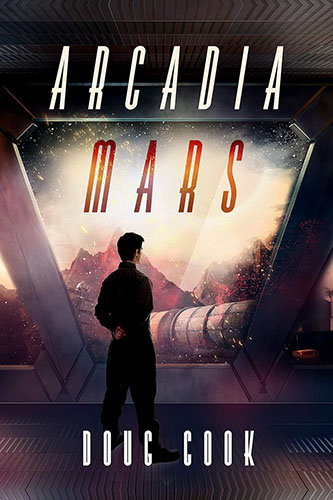
Title: Arcadia Mars
Author: Doug Cook
NSS Amazon link for this book
Format: Paperback, Kindle
Pages: 402
Publisher: AquilaMission.space
Date: April 2019
Retail Price: $14.95/$3.95
ISBN: 978-1095895115
A potential Earth-destroying disaster looms, so humanity must establish a colony on Mars soon. This is the premise driving Arcadia Mars. Though fiction, this story portrays a thoroughly detailed and plausible program for settlement based on a realistic extrapolation of technology into the near future.
Author Doug Cook is a retired petroleum geophysicist with experience in deep-water submersible studies, with assorted publications in the field. He has a lifelong passion for astrogeology and space exploration. This is his second work of fiction, being a sequel to The Aquila Mission, a mission by four astronauts to study an asteroid and comet as preparation for a subsequent mission to Mars.
In Arcadia Mars, we learn humanity has since detected a Kuiper-belt object on an Earth-destroying collision course several decades in the future. Although a program is underway to deflect the object, dubbed with the name Shiva, the imperative is to accelerate the settlement of Mars as a backup plan.
Now the same four astronauts from the first book, as two married couples now with two sons and a daughter among them, spearhead a new mission. All share an ambitious goal: colonize Mars as soon as possible. The first chapter begins with a chronology of pre-launch events including infrastructure, mission planning, and events (some catastrophic) on Earth.
The author details crew selection in the form of introspections, many written from the point of view of the person selected. We also learn of people who will later initiate settlements based on the mostly-religious beliefs of their respective sponsoring organizations. A software designer describes AI entities, which to a degree have their own personalities. A fictitious interview includes photos of actual (nonfiction) robots in development. This is one example of Cook blending fiction with real-life nonfiction, among others in the book. The reader also learns more about sample analysis from the previous Aquila mission, complete with an educational primer on DNA biochemistry.
Although the geopolitical situation on Earth intensifies as some applaud the program and others attempt to jeopardize it, an Earth consortium initiates a preliminary mission to pave the way for colonization to follow. This first crewed mission to Mars climaxes with a successful landing. The expedition sets up Arcadia Base, completing work begun by the robotic ships which arrived earlier. A fatal accident occurs and they bury Mars’ first casualty. The crew returns back to Earth as planned.
Then the actual colonization mission is underway. There’s a glitch and two of the onboard teenagers come up with a clever solution. Here we learn more about the ship and outbound operations, including transfer orbit. There is a stinky incident with the waste disposal unit, giving us an idea of a particular issue potentially facing space travelers. The ship lands successfully, albeit foreshadowing a developing personality conflict.
Twenty one colonists make up this expedition to initially set up operations including a greenhouse and aquaponics. They celebrate Christmas, endure a dust storm, have two births, perform explorations, and find evidence of previous life on the planet complete with some scientific explanation as to why it is so. Then additional colonists arrive. There is a rescue incident with clever problem solving. One issue is combating monotony, and several romances develop. Radiation exposure compromises a newborn, yet future gene therapy potentially offers a solution.
Then sabotage kills one colonist and Coby, the expedition leader, nearly dies. After his tenuous recovery, the story reveals motive and delves into the issues of setting up legal processes for the colony. But the plot seems contrived when the villain too conveniently confesses during the investigation. There is a trial and verdict. After the colonists figure out how to set up a jail, the murderer commits suicide by breaking out without a suit.
This novel is a blend of fiction plus nonfiction. The author provides a history of Mars in culture and scientific exploration, including SpaceX plans and the author’s concept involving fuel depots, propellant requirements, energy budget, choice of landing site and more. There are 77 footnotes throughout the book.
The fiction portion closes with an epilogue concerning the future of the colony written mainly as Coby’s personal log. Settlers set up a trading system to become economically self sustaining.
Aficionados of space travel will most probably devour this book for its mission concepts. The author emphasizes the dangers of space and how to overcome them. Although a layperson could certainly appreciate the stakes involved, character motivations and more, one may yearn for more emotional drama. With the exception of one obviously flawed psychopath, the characters are near flawlessly heroic with few complicating foibles. Many of the interactions have the feel of nostalgic television sitcoms where the same ideals and motivations drive everyone, the psychopath excepted.
Although interpersonal relationships often seem too perfect, this remains a compelling story about humanity’s future in space.
© 2020 Peter Spasov
Please use the NSS Amazon Link for all your book and other purchases. It helps NSS and does not cost you a cent! Bookmark this link for ALL your Amazon shopping!