
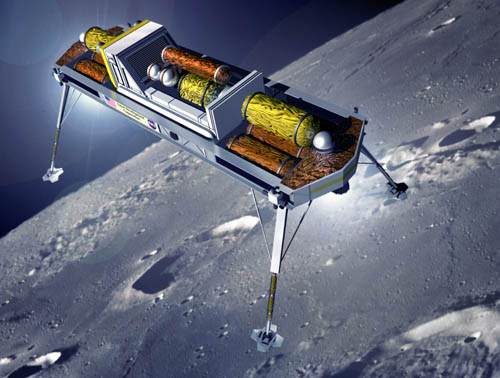
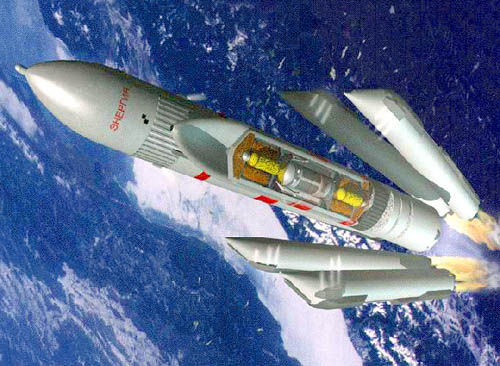
 Energia cargo launch
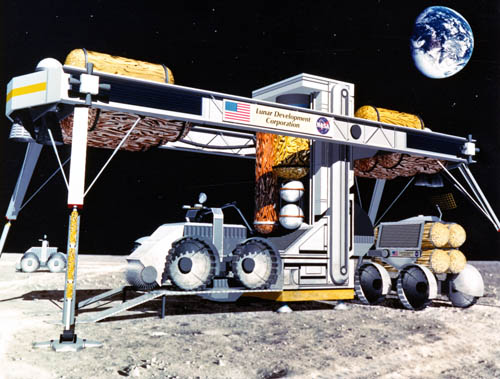 A second unmanned lander delivers six small robotic lunar vehicles, after the LUNOX plant+reactor has been deployed. Two “Loader” bulldozers collect and sort ~500kg/hour of ilmenite-rich lunar soil, which is fed into the LUNOX plant and processed into liquid oxygen propellant. The process is based on H2 reduction of lunar regolith in a fluidized-bed reactor, solid-state high-temperature electrolysis and Stirling-cycle O2 liquefaction and refrigeration. Two “Tankers” transport the liquid oxygen from the LUNOX factory to other users on the lunar surface (the annual production capability is 24,000kg, assuming an extraction efficiency of 4% after benefication). Finally, two “Haulers” are available for moving heavy equipment across short distances. All rovers use regenerable power sources which are recharged from the nuclear reactor surface power supply.
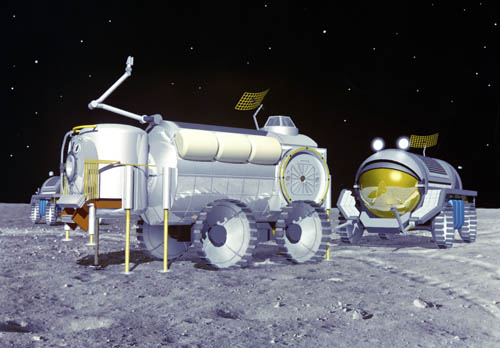
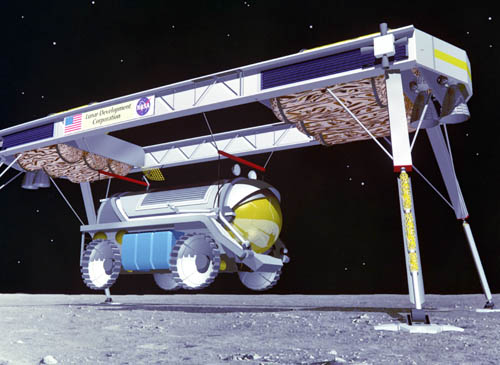 Deployment of pressurized lunar rovers
 Airlock/node support module
| FLIGHT | ITEM | MASS (KG) |
| 1 | LUNOX PLANT | 7269 |
| 1 | NUCLEAR REACTOR (40-60KWe) | 5110 |
| 2 | TANKER #1 | 1471 |
| 2 | TANKER #2 | 1471 |
| 2 | LOADER #1 | 1728 |
| 2 | LOADER #2 | 1728 |
| 2 | HAULER #1 | 962 |
| 2 | HAULER #2 | 962 |
| 3 | PRESSURIZED ROVER #1 | 5150 |
| 4 | PRESSURIZED ROVER #2 | 5150 |
| 3 | MOBILE POWER UNIT #1 | 1544 |
| 4 | MOBILE POWER UNIT #2 | 1544 |
| 3, 4 | SCIENCE PAYLOAD | 2000 |
| 5 | AIRLOCK/NODE SUPPORT VEHICLE | 11010 |
| 6 | LOGISTICS & SPARES | 12454 |
| TOTAL: | 59553 |
TABLE 2 — Lunar Outpost Elements
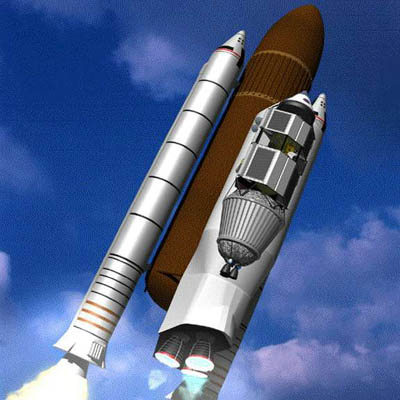 “Phoenix” manned lunar spacecraft launch
| DRY MASS (KG) | PROPELLANT (KG) | |
| APOLLO TYPE CREW MODULE | 5935 | 199 |
| +CREW AND SUPPORT | 609 | |
| “PHOENIX” MANNED LANDER (4 x 31 150KN thrust engines) | 5505 | 16944 |
| +CARGO | 2000 | |
| +LIQUID HYDROGEN FUEL FOR RETURN TRIP | 2492 | |
| TRANSLUNAR INJECTION STAGE (3 x RL-10-A4 engines) | 6130 | 43930 |
| TOTAL MASS IN LOW EARTH ORBIT | 83744 | |
| LUNAR OXYGEN REQUIRED: | 10165 |
TABLE 3 —”Phoenix” weight summary
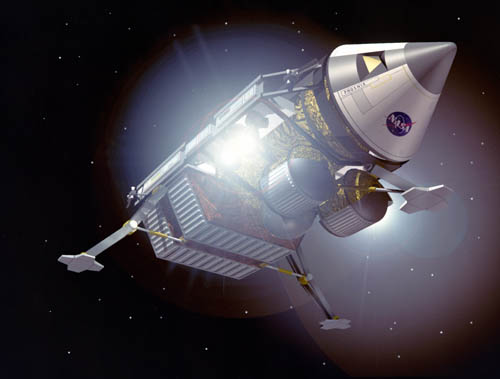 “Phoenix” lands on the Moon
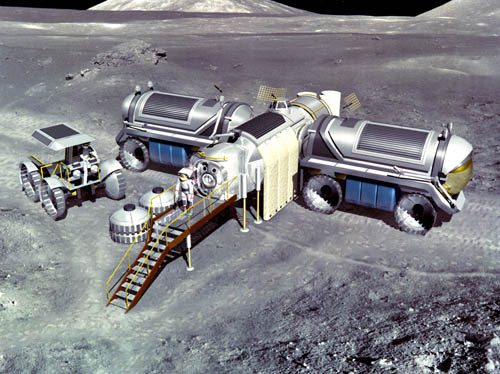 LUNOX lunar outpost
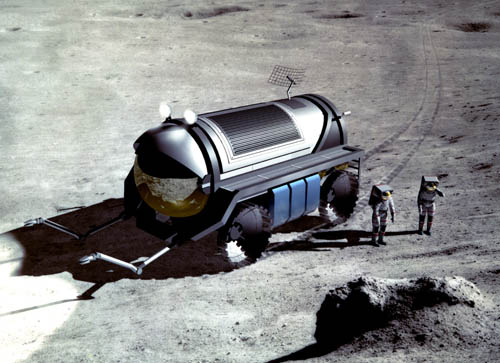 When not attached to the lunar outpost, the rovers could venture hundreds of kilometers from the landing site, enabling a comprehensive survey of the lunar surface. One rover could house all four astronauts in an emergency as a safeguard against catastrophic failure. The Mobile Power Unit-less configuration depicted here would be capable of 2-3 day missions.
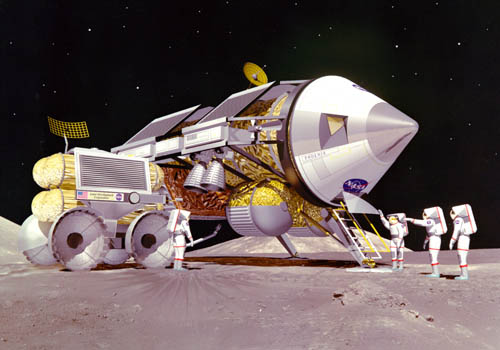 “Phoenix” refueling on the lunar surface
| COST ($B,1999) | |
| LUNOX SYSTEMS | $3.9 |
| LUNAR SURFACE SYSTEMS | $4.6 |
| SCIENCE PAYLOADS | $0.9 |
| MANNED “PHOENIX” DEVELOPMENT | $3.5 |
| CARGO SPACECRAFT DEVELOPMENT | $0.0 |
| LAUNCH VEHICLE DEVELOPMENT | $1.2 |
| TOTAL DEVELOPMENT COST | $14.1 |
| LAUNCH VEHICLE PRODUCTION (x7) | $4.0 |
| MANNED “PHOENIX” PRODUCTION (x1) | $1.2 |
| CARGO SPACECRAFT PRODUCTION (x6) | $3.2 |
| TOTAL PRODUCTION COST | $8.4 |
LUNOX cost summary
This plan assumed a first manned landing in 2005. The total cost was estimated at $19.6 billion in FY 1993 dollars — $22.5B at 1999 economic conditions. The cost of developing lunar oxygen mining equipment would be relatively high, but the required technologies — automation, robotics, lunar surface vehicles, in-situ resource utilization — could have considerable relevance to the American commercial sector. The Shuttle-derived heavy lift vehicle and “Phoenix” lander would be less costly to develop thanks to the LUNOX infrastructure. Each manned lunar landing would cost $1.7 billion (including $550 million for the launcher) and the unmanned landings would cost $1 billion each. In comparison, the 1992 First Lunar Outpost baseline launch vehicle+spacecraft would have cost $4.6 billion and $3.7 billion, respectively. LUNOX would have some built-in redundancy even if the cost-reducing elements of the plan (Energia, lunar oxygen mining) proved unworkable. All cargo elements could be launched on U.S. rockets in case the Russians pull out of the project. Oxygen for the return trip could also be brought from Earth in an emergency, although doing so would increase the launch cost by 50%. The LUNOX proposal was overshadowed by the International Space Station and NASA’s future Mars exploration plans (“Mars Semi-Direct”). But it did put an end to NASA’s brief obsession (1992-93) with extremely large launch vehicles; future plans would again be based on smaller and more affordable Shuttle-derived heavy-lift launch vehicles. In-situ resource utilization and nuclear power would also be a key part of the agency’s future human exploration plans throughout the 1990s.SOURCES
“Early Lunar Resource Utilization: A Key To Human Exploration” by Kent Joosten & Lisa Guerra (AIAA 93-4784), 1993 “INTERNATIONAL LUNAR RESOURCES EXPLORATION CONCEPT” by Kent Joosten, NASA/Johnson Space Center briefing, May 7, 1993Lunar Base Studies in the 1990s 1992: FLO 1993: LUNOX 1993: ELA 1994: LANTR 1996: HLR