
By Burt Dicht
NSS Space Coasts Correspondent
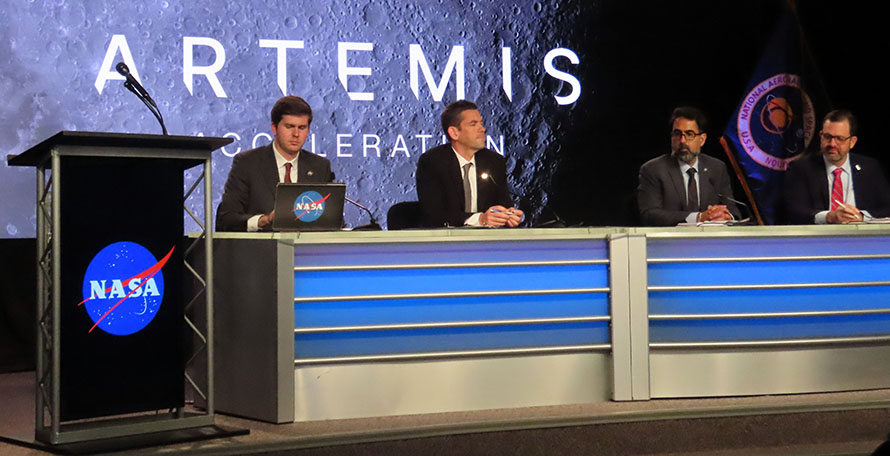
NASA Administrator Jared Isaacman opened the October 23 Artemis Acceleration press conference with a reminder of what the agency accomplished during the Apollo program. (Pictured in above image, from left to right: NASA Deputy Press Secretary George Alderman; NASA Administrator Jared Isaacman; NASA Associate Administrator Amit Kshatriya; NASA Artemis program manager Jeremy Parsons.)
The day before marked 58 years since Apollo 7 splashed down in the Atlantic Ocean on October 22, 1968, completing NASA’s first crewed Apollo mission. Over the next nine months, NASA launched Apollo 8, Apollo 9, and Apollo 10, culminating in the historic Apollo 11 Moon landing in July 1969.
It was a remarkable demonstration of what the United States could accomplish when its national resources, technical capabilities, and workforce were focused on a common goal. The urgency was driven in large part by the space race with the Soviet Union.
Now, nearly six decades later, NASA faces another challenge as the United States works to return astronauts to the Moon amid growing competition from China.
That was the backdrop for the briefing, during which Isaacman and NASA Associate Administrator Amit Kshatriya outlined the changes NASA is making to accelerate the Artemis program. Artemis Program Manager Jeremy Parsons followed with an extensive presentation detailing the mission plans, technical challenges, and preparations for Artemis III, currently targeted for summer 2027, and Artemis IV, which is intended to return astronauts to the lunar surface in 2028.
Restoring Urgency and Accountability
Isaacman’s message was that NASA must change how it approaches its missions if it hopes to meet its goals.
He acknowledged that institutional inertia and misplaced priorities have contributed to the delays that have affected Artemis. He also challenged the notion that more time, more money, and fewer launches necessarily make a program safer or more achievable.
Isaacman called for greater intensity, discipline, and engineering ownership throughout NASA and its contractors. He emphasized that confronting shortcomings and taking action to correct them is essential to changing an organization’s culture.
Enthusiasm alone won’t change the laws of physics, and Isaacman didn’t pretend otherwise. NASA must still solve difficult technical problems, demonstrate that its systems work, and ensure the safety of its astronauts. He described the revised plan as an achievable pathway, while cautioning that the road ahead would not be easy.
Changing How NASA Works
Kshatriya expanded on the management and cultural changes NASA is pursuing, starting with extreme ownership: NASA taking responsibility for its decisions, mistakes, and failures rather than allowing problems to persist.
The rest of his agenda follows from that. NASA wants to redefine what it means to work for the agency, attracting talented people and giving them meaningful challenges. It must make choices; it cannot do everything, but it must keep pursuing difficult missions that push technological boundaries. And it must organize its people, resources, and engineering efforts around clearly defined missions.
Kshatriya emphasized the capabilities of NASA’s workforce and described an agency energized by the opportunity to take greater ownership of its programs. NASA is also bringing more technical and engineering responsibilities in-house to strengthen its ability to oversee and execute missions.
Artemis III: Testing Two Lunar Landers in Earth Orbit
Parsons provided a detailed look at the plans for Artemis III, which NASA reshaped earlier this year into a test mission in low Earth orbit rather than a lunar landing.

The approximately 14-day mission will carry NASA astronauts Randy Bresnik, Frank Rubio, and Andre Douglas, along with European Space Agency astronaut Luca Parmitano, aboard Orion.
Parsons described it as “likely the most complicated launch campaign ever undertaken.” The mission involves three launches and will test Orion’s ability to rendezvous and dock with two different commercial lunar landers.
Blue Origin’s Blue Moon Mark 2 test vehicle will launch first aboard New Glenn from Cape Canaveral Space Force Station. The lander will enter a circular orbit approximately 237 nautical miles (439 km) above Earth, where it can remain for up to 30 days awaiting Orion, although NASA wants to keep that time as short as possible.

Following launch aboard NASA’s Space Launch System (SLS) rocket, Orion will initially enter an elliptical Earth orbit. Its service module will then perform a series of maneuvers to place the spacecraft into a circular orbit approximately 300 nautical miles (556 km) above Earth for thermal stabilization. During the first two days, the crew will check Orion’s systems and prepare for rendezvous with Blue Moon. Docking is planned for the third day of the mission, followed by approximately two days of evaluations aboard the lander, including its cabin environment, controls, and life-support systems.
Later in the mission, SpaceX will launch a Starship Version 3 test vehicle from Kennedy Space Center’s Launch Complex 39A. Orion will undock from Blue Moon, adjust its orbit, and dock with Starship approximately 206 nautical miles (381 km) above Earth.
Unlike the Blue Moon test, the Starship docking will last up to two hours, and the astronauts will not enter the vehicle.
The mission will also provide opportunities to evaluate Orion’s crew suits, docking sensors, and other systems. Thermal management is a particular concern. Orion was designed as a deep-space vehicle, and the thermal environment in low Earth orbit is more demanding. Additional activities include testing procedures for handling lunar samples and conducting scientific experiments.
Following completion of the planned tests, Orion will return to Earth, with splashdown in the Pacific Ocean off the coast of California.
The objective is to test critical systems and operating procedures with both commercial lunar landers, reducing risks before astronauts attempt to land on the Moon.
Preparing the Hardware and Launch Facilities
Parsons also provided an update on preparations for Artemis III.
The SLS solid rocket boosters have been stacked, and all four RS-25 engines have been installed on the core stage. Work continues on a spacer being manufactured at NASA’s Marshall Space Flight Center that will replace the Interim Cryogenic Propulsion Stage used on Artemis I and II. Because Artemis III stays in Earth orbit, it does not require the upper stage’s translunar injection burn. Orion’s service module will provide the additional maneuvering capability needed for the mission.
NASA is targeting a short-stack tanking test before the end of 2026. The test will involve rolling the SLS core stage and solid rocket boosters to Launch Pad 39B without Orion or the upper spacer. Engineers will load propellants to evaluate the redesigned hydrogen quick-disconnect system and verify fueling procedures. The Artemis III crew will also conduct a launch-day rehearsal and practice emergency evacuation procedures at the pad.
Both commercial lander providers face considerable work. SpaceX is preparing Launch Complex 39A for Starship operations, while Blue Origin is working to restore Launch Complex 36 following the explosion during a static fire test in May.
Parsons acknowledged that supply-chain problems have contributed to schedule delays for both test vehicles. NASA has placed personnel within the companies to help identify and resolve issues more quickly.
NASA leadership believes closer coordination and greater engineering involvement will improve the program’s ability to maintain its schedule, although significant work remains.
Artemis IV: Returning Astronauts to the Moon
While Artemis III will focus on testing lunar landing systems in Earth orbit, Artemis IV is intended to return astronauts to the lunar surface in 2028, the first crewed landing since Apollo 17 in 1972.

NASA plans to maintain competition between SpaceX and Blue Origin, delaying the final selection of the Artemis IV lander to allow both companies additional time to demonstrate their capabilities.
Both companies are also working on revised lunar mission architectures. SpaceX is developing an approach that would use Starship to provide propulsion for Orion’s journey toward the Moon, while Blue Origin is pursuing a configuration involving three transfer stages. These concepts remain under development, and NASA has not yet committed to a specific lander for Artemis IV.
Preparations for a longer-term human presence on the Moon are also moving forward.
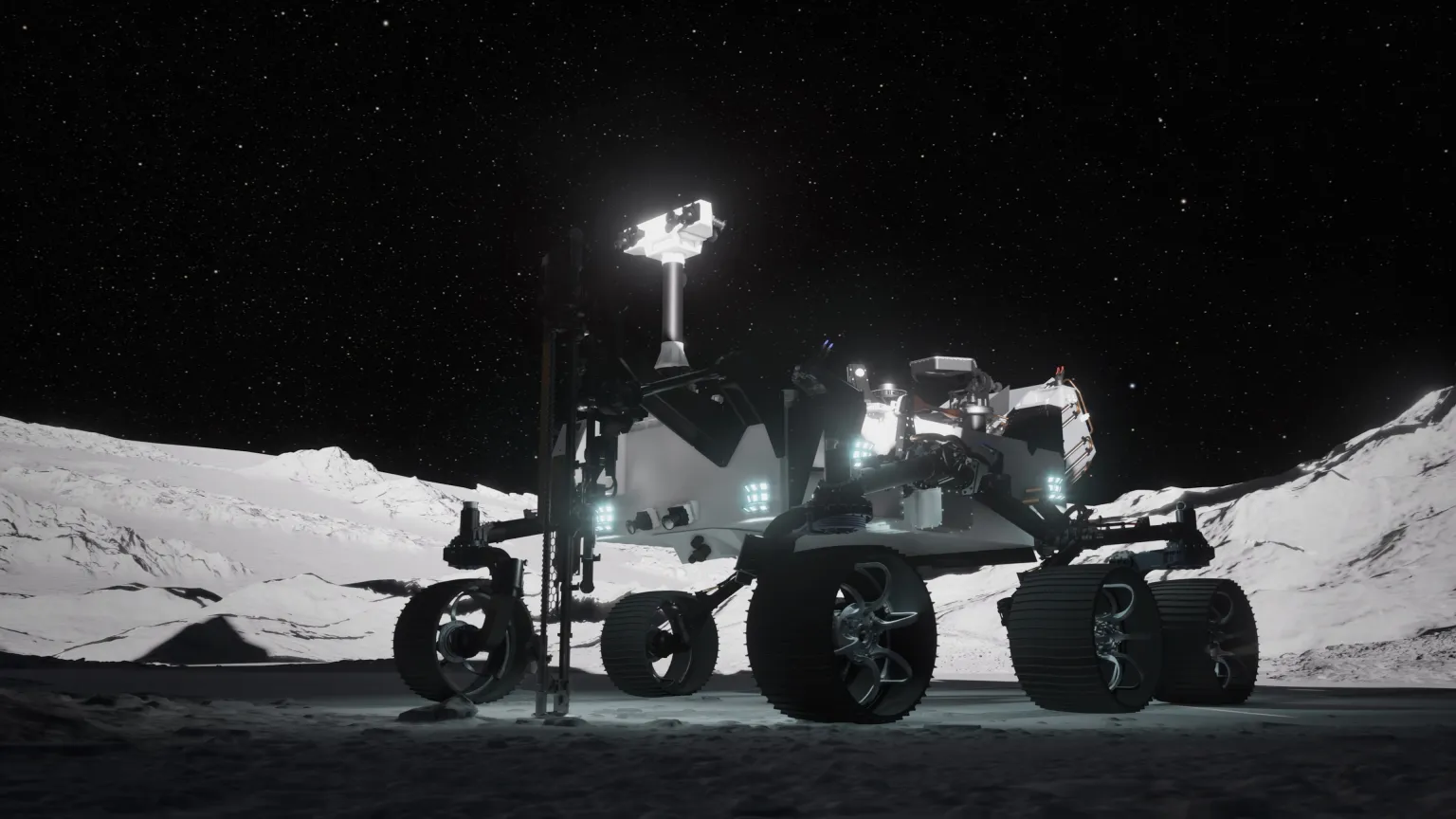
NASA intends to begin delivering equipment to the lunar south pole before astronauts arrive, using a series of robotic landers, rovers, and other spacecraft. The goal is to have essential equipment and transportation capabilities in place to support future crews.
The agency is also pursuing a lighter, simplified version of Axiom Space’s lunar spacesuit, known as the sortie suit, for initial surface operations. Axiom plans to test its suit aboard the International Space Station in 2027.
These activities are intended to support more than a single return to the Moon. NASA’s broader objective is to establish the infrastructure and operational experience needed for a sustained human presence on the lunar surface.
The Path Forward
Throughout the briefing, NASA leadership returned to the importance of execution. The revised Artemis approach is intended to increase the pace of missions, strengthen accountability, and provide more opportunities to test systems before astronauts depend on them during a lunar landing.
The comparison with Apollo is compelling, but there are important differences. Apollo was a national effort organized around a single overriding objective. Artemis involves a more complex combination of government programs, commercial partners, international participants, and long-term exploration goals.
What came across during the briefing was a commitment from NASA’s leadership, its workforce, and its industry partners to meet these challenges. That commitment includes confronting problems directly, taking greater ownership of engineering and technical work, bringing more capabilities in-house, and making the difficult decisions needed to keep the program moving forward.
As Isaacman acknowledged at the beginning of the briefing, enthusiasm cannot change the laws of physics. The engineering challenges remain, and there is much work ahead. But NASA’s renewed emphasis on accountability, engineering discipline, and mission execution reflects a determination to overcome those challenges.
The goal remains clear: return American astronauts to the Moon, establish the foundation for a sustained human presence, and, above all, bring the crews home safely.









2 thoughts on “NASA Sets a New Course for Artemis”
As a non-technical, long time amateur proponent of our space program, who wants to live long enough to see us back on the Moon to stay, I salute the apparent determination of those working toward that goal. I worry about the technical and political challenges that could derail them/us but pray they/we will press on. God’s speed!!
Good synopsis, Burt. -Dr. Sammy