
Category: Nonfiction?
Reviewed by: Dale Skran
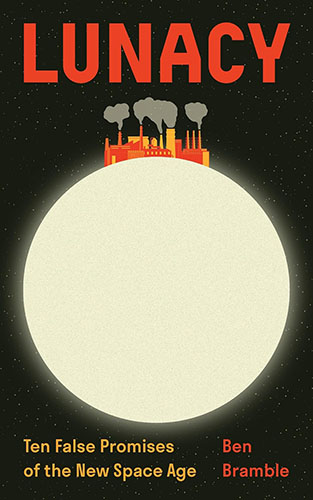
Title: Lunacy: Ten False Promises of the New Space Age
Author: Ben Bramble
Format: Paperback/Kindle/Audio
Pages: 200
Publisher: Princeton University Press
Date: July 2026
Retail price: $18.95/$9.99/$15.75
Print length: 200 pages
ISBN: 978-0691281285
Find this Book
Editor’s note: This long essay defends the National Space Society Vision against those who, like the author of the book being reviewed, think “we shouldn’t colonize Mars or the Moon, or even vacation there.”
Bramble, an Australian philosopher who teaches at Australian National University, has penned a YAASS (Yet Another Anti-Space-Settlement) book. These books are multiplying like flies, so space settlement advocates must be gaining ground to generate such an abundant response. Bramble assembles ten arguments for the “New Space Age” of development and settlement that he thinks are just plain wrong, and at length he explains why.
Speaking plainly, Bramble has written a terrible book. But even though Bramble is mostly wrong, a few chapters are mostly correct: “To Grow Humanity,” “To Meet Aliens,” and “To End War.”
Chapter 4: To Grow Humanity
This chapter contains some tortured logic, but the core point remains – merely having more total people living does not strongly justify space settlement. While it is true that to enable trillions of humans to live, the settlement of space is essential, this by itself does not mean that having those trillions exist must be a good thing. Speculatively, it might be a bad thing. No one really knows, and that is the problem with so-called “long-termism” logic. You can use this sort of argument to claim space settlement is a good idea, or that it is a terrible idea, but long-termist speculation cannot give us any real guidance.
Chapter 7: To Meet Aliens
Here Bramble takes the position that we should not signal our presence to aliens, as this may be a risky enterprise. He has a point, but as a life-long space advocate, I know of very few other advocates who believe that we should develop and settle space “to meet aliens” so the inclusion of the topic at all seems off. Also, efforts to settle space in and of itself will not signal our presence to aliens, or at least no more than electromagnetic signals leaking out from the Earth currently do.
Chapter 6: To End War
Bramble is surely correct that developing and settling space will not end war, although neither will it necessarily lead to the conflicts he fears. Regardless, let us concede that “To End War” is not a good argument for space settlement. We can acknowledge that an abundance of resources from space may reduce the risks of some conflicts, but most often wars are about much more than just access to resources.
We now come to three justifications for the “new space age” that are not as weak as Bramble believes: “To Do Science,” “To Excite and Inspire,” and “To Go on Holiday.” They are not the main reasons for space settlement and development, but they are solid reasons.
Chapter 8: To Do Science
Although “To Do Science” does not often appear in the writings of space settlement advocates as the primary justification for space development and settlement, Bramble starts by presenting at length a list of scientific space projects he finds exciting, including “an enormous telescope on the far side of the Moon.” He then asserts that “… these scientific activities have little to gain from the New Space Age.” He seems to understand that “new space” companies have developed larger and less expensive launch vehicles that might help in new scientific projects but then concludes “…governments pursuing science for science’s sake could simply buy the relevant help from these companies.” But in Bramble’s world, there would be no commercial space companies, because developing space is morally wrong and even dangerous. He appears to lack the wit to understand that space science depends on space technology, and that commercial space projects are rapidly driving forward a wide range of space technologies that can then be used off-the-shelf for scientific projects. But if we end the commercial space project, there will be no commercial companies to buy anything from, and NASA will be back to building everything itself at great cost. I doubt there are many scientists who want to ignore Starship/Superheavy or New Glenn and limit themselves to smaller rockets that lift much less and cost 10x more.
Bramble is at the core a Luddite who says, “There is plenty of science and technology where the costs and risks to humanity seem to clearly outweigh the possible benefits….” Weirdly, Bramble thinks all – or most – of the things we have done in space to date are great, but the projects associated with “new space” are worthless.
Bramble eventually gets around to the “dark skies” issue and here he is surely correct that in the long run, large scale space development will impede ground-based astronomy. Many space advocates believe that this should motivate us to move astronomy more completely into space where it is much more effective, while retaining the benefits of space development. This is a complex topic that is explored at length in an NSS position paper.
Bramble then attacks the idea of commercial LEO stations, saying “…is there any guarantee that these private agents will be doing science for the sake of science (or humanity), rather than to further their own interests?” In saying this, Bramble is misunderstanding how commercial LEO stations will operate. The idea is that NASA will continue to fund “public science” but will rent privately owned stations to conduct the work. Other parties, both commercial and non-profit, may also rent these stations. The commercial LEO stations are service providers, not scientific institutes. The promise is that commercial LEO stations will be less expensive to operate than the ISS and will in time offer a wider range of services, enabling more and better science. Any impact that the commercial LEO stations providers may have on the scientific agenda will be modest and similar to that which occurs on the Earth when scientists rent space in a commercially owned building.
Bramble concludes “When private interests set the scientific agenda, science itself will always be playing second fiddle to profits….” But this is now the case and has always been the case – that is why we have government funded research. There is nothing about the “new space age” that will intrinsically reduce government spending on space science. If this does happen, as some in the current Administration are indeed pushing for, this will be a political decision, not an inevitable consequence of space development. In fact, space development will lead directly to the creation of large-scale space infrastructure that will lower the cost of doing space science, enabling both a better future for everyone and more capability to do science in space.
Chapter 9: To Excite and Inspire
In Chapter 9 Bramble takes on the idea that we need to develop space to “Excite and Inspire.” He argues we don’t need humans in space to carry out most space science projects, and in the long run he is right. With powerful AI guiding improved robots, the needful role for human space exploration will diminish. However, as I have argued in The Space Review, although humans can usefully support space science, the only long-term reason for humans to be in space is space settlement. In the short to medium term, a case can be made that crewed bases on the Moon and Mars enable more and better science in the near term, while over time lowering the cost of doing high-value science in both locations. Right now, we must build and fly to Mars an elaborate and extremely expensive probe for everything we wish to do on Mars. Imagine how much less expensive, faster, and easier it would be to send an email to a crew member living at a Martian base, and ask them to get in a rover, go collect some samples, and use the equipment at the base to do an analysis of them. Even considering a high initial cost for the bases, as time goes on the operational cost of base oriented science will be less than a building a bespoke probe launched from Earth for every single thing we want to do on the surface of the Moon and Mars.
Bramble worries that if we send humans to explore, this puts them at unnecessary risk if robots can do the job. No doubt Bramble has a point, yet the fact remains that public excitement over Artemis 2 greatly exceeds interest in any robotic probe. There is something about going and doing something yourself that is different – and better – than sending any number of robots. Bramble doesn’t understand this visceral human drive, perhaps because it isn’t logical, but we are not creatures of logic alone.
But what really gets Bramble going is “…trying to inspire an interest in science in kids by getting them excited about people ‘living, working, and holidaying’ in space.” Setting aside his translation of the old L5 Society slogan that their goals are to “live, work, and play” in space to his native Australian, Bramble displays a painfully cramped vision of our future in space, saying:
“We shouldn’t want children becoming excited about space because they think they might one day get rich by mining asteroids, or be able one day to visit a space hotel on the Moon. Any interest they thereby acquire in science will be canceled out by damage done to their character from having them focus on the benefits for themselves, shallow benefits at that.”
There are lots of ways to get rich but mining an asteroid will diminish the environmental impact of mining on the Earth, which seems like supporting the common good to me. Visting a space hotel may seem frivolous, but space tourism, as I expand on below, promises many benefits. He doubles down, saying “I’m also not convinced that STEM fields are even the key areas right now that we need more bright kids getting into. Our technological capabilities are already immense and growing rapidly.” A similar logic is espoused by Bill McKibben in his notorious book Enough which argues for a halt to any science or technology related to GRIN – Genetics, Robotics, Information Technology, and Nanotechnology. There is something vastly privileged and heartless about this viewpoint in a world full of human suffering that could be addressed by targeted GRIN technologies. Just walk through any hospice and interact with some dying patients. There are hundreds of truly awful diseases and conditions we currently have no answer for. As Glenn Reynolds (NSS Board of Strategic Advisors) likes to say in his blog: “faster, please” for the technology to make our lives better!
Some might argue that I am correct, but we need more medical research, not space or GRIN research. This kind of narrow focus ignores how science and technology work. The best results are obtained by advancing science and technology on a wide front, and then allowing cross-fertilization between fields. If we ban any kind of work that might result in a product made in space or derived from space, this will inevitably stunt the entire enterprise of science and technology. Where would we be now if Bramble’s philosophy had been ascendant during the 1960s? If so, say goodbye to GPS, weather satellites, satellite radio, geosynchronous communications satellites, Earth resource satellites, and low-cost internet everywhere.
Next Bramble addresses the idea that we ought to land on Mars just to show we can do it (although no advocate of space settlement would argue that this is a good reason to land on Mars). Oddly, he thinks the Moon landing was inspiring, but landing on Mars will not be! His counter reveals his true colors “The attempt to go even further into space, to build bigger and more powerful things there, seems to me a sort of substitute for making changes that will actually benefit the world.” He has three false points here: (1) doing big things in space will not and cannot benefit the world, and (2) there is a mandatory choice between benefiting the world and doing big things in space, and (3) those doing big things in space are seeking a substitute for engaging seriously with the world’s problems.
Bramble continues “… progress on social and political problems is not incremental or inevitable” but that “We need wisdom, decency, and moral strength.” I do not wish to suggest that “doing big things in space” will solve ALL the world’s problems, only some of them. NSS has a great paper listing the many current and potential benefits of the “new space age” that Bramble thinks are worthless or morally degrading. My personal contribution to fighting climate change is to advocate for space solar power and space data centers. I believe that developing organic fully closed cycle agriculture for space settlements will have enormous benefits for people on the Earth. It is a fact that by putting data centers in space we reduce terrestrial grid demand and eliminate the operational use of water for cooling by the data centers located in space. If eventually space data centers are constructed using lunar materials as Musk envisions, their impact on the environment of the Earth will trend toward di minimis. However, even doing all the big things in space currently envisioned leaves plenty of resources for a vast array of non-space technical projects.
Working on asteroid mining or space solar power is not a substitute for working on Earthly problems – it is working on Earthly problems, Bramble notwithstanding. Many and possibly all impacts mining has on the environment of the Earth will be mitigated by asteroid mining.
Some will suggest that air pollution from launches related to asteroid mining will be a major issue, but even assuming this is true during an early period in which asteroid mining is established, over time it will become unnecessary as the industrial base for asteroid mining is increasingly located in space. Others may suggest that returning the mined materials to the Earth will intrinsically pollute the upper atmosphere due to the volatilization of heat shields, but this problem can be minimized by using a heat shield that mimics naturally occurring meteors containing iron, magnesium, and silicate, substances which are readily found on asteroids and with which we have substantial data with regard to their atmospheric impacts. Whereas the environmental impact of Earth-based mining is large and well understood, making a full evaluation of the environmental impact of Earth-based mining as compared to asteroid mining remains a research project. Bramble is right in the minor key that the ability to “land on the Moon” does not directly translate into the ability to solve social and political issues. This is partly because some “social” issues, e.g. addiction, have very complex underlying causes with the result that the science needed to ameliorate the issues are very challenging. Another problem is that many social/political issues derive from conflicting visions of the common good that are not simply fixable by canceling new space and focusing on those issues. Many of the issues that trouble us have been going on for millennia with little real progress, and all that canceling new space will do is cut off a wide array of useful benefits to humanity, without solving anything Bramble claims to care about.
Bramble then says “But I do not think we need to keep going into space, further and still further, to be yet further inspired. We know we are an incredible species.” Bramble’s egotistic self-confidence is disturbing. We do not know that we are in any way incredible. Most probably, we are ordinary and unexceptional in the universe, unless we are more or less the only intelligent life at all. And we will never figure out our place in the universe except by going further and further afield until we find the answers. Bramble would respond that we can do this with only robotic probes and telescopes, but this is just an assumption. At a minimum the large space telescopes and interstellar robotic probes needed to find the ground truth about life in the universe depend on the rapid advancement of “new space” projects, not a retreat to the ground. It is equally possible that the fundamental truth of our place in the universe can only be found by interstellar travel and exploration on a large scale, a project requiring extensive space development and settlement.
Bramble has a curious rhetorical technique that lacks logical coherency. First, he praises what has already been done – the Golden Gate Bridge, the Hoover Dam, etc. – and then he suggests that the activities of new space are worthless dross, comparing them to Jeff Bezos’s 10,000-year clock. The comparison of space solar power and asteroid mining to a 10,000-year clock which has no economic purposes has no logic beyond that Bramble does not like either. And the idea that technology in the past was good while future technology is all worthless cannot be viewed as a serious argument.
Bramble endorses Sagan’s view that exploring space will elevate our view of ourselves and the universe, but he insists that this can be completely accomplished remotely/robotically, and that all efforts to “humanize” space, including a recent proposal by NASA to establish time zones on the Moon, are wrongheaded and will reduce the ability of space to inspire us by making space less different from the Earth than it currently is. Alternatively, it can be argued that only when we are born, live, and die in space – in a myriad of different locations – will we truly gain the full benefit of what space has to offer in terms of expanding our consciousness.
Finally, Bramble rejects the idea that any “new space” figure, and especially Elon Musk, is truly “inspirational.” He insists that on the whole, Musk’s – and presumably all “new space” figures – efforts are not for the “betterment of humanity.” It is important to understand that the “new space” leaders probably all think they are making the world a better place, and Musk certainly thinks he is. But thinking you are making the world a better place is not sufficient. Bramble thinks he is making the world a better place by campaigning against space development and settlement. The difference is that the new space enterprise produces tangible benefits to millions of people, while Bramble does not. Bramble also claims that the “new space pioneers” are not “truly motivated by humanity’s interests.” If they were, he opines, “… they might be more interested in consulting with humanity about what we should be doing in space …”
Anti-space development and settlement folks often bring up this idea of “consultation” with humanity as through the idea of polling everyone made sense. We have a variety of political entities on the Earth, including political parties, non-profits, nations and the UN, that give expression to the views of humanity in an actionable way. Many of these entities are deeply involved in space in general, and many in the “new space” project. They have been consulted and are continuously being consulted. What I suspect Bramble really means is that he personally has not been consulted, nor are his academic friends being consulted. Regardless, anti-space development books are flowing off the presses, and the mainstream press puts out a vast array of critical articles on various space matters. Magazines like Scientific American publish articles with titles like “Humans will Never Settle Space.” If anything, pro-space settlement views are infrequently mentioned and often misrepresented.
Chapter 10: To Go on Holiday
In this chapter Bramble takes on space tourism, framing VAST’s Haven-1 as a “luxury resort” with a “state-of-the-art gym” and “sleek wood veneer accents.” This hyperbolic text greatly exaggerates Haven-1, which is best compared to one ISS or one MIR module, hardly a “luxury hotel.” It is more like one room in an average hotel. The “state of the art gym” is more like a compact universal machine. And so on. But of course, advocates for space tourism would love to see large hotels in orbit that really were luxury resorts.
Bramble does not like space tourism. He opines about rocket pollution and space debris, but his real concern is “character.” He suggests that those who engage in space tourism exhibit the “willingness to indulge in … space tourism, which … reflects the absence of human traits that we admire and regard morally important.” Bramble cannot see how any moral tourist can fly to space “to play basketball in zero gravity while so many on Earth are suffering.” By this logic no expensive or large-scale amusements should be allowed, only those that meet Bramble’s standard of being “low-cost and truly life-enhancing.” Disney World must go. Jets to Paris must go. 5-star hotels must be closed. All the yachts beached. No American should visit Australia. And so on.
In the long run the costs of orbital space tourism will verge toward the cost to fly to Australia, since the energy costs are similar. Of course, flying to space in a rocket will probably always cost more than an airline ticket to Australia, but at the same time this point suggests that the price has a long way to drop before it hits a floor. Should trips to see kangaroos be banned? What of all those working in the tourism industry and the yacht building industry who will lose their jobs?
The important point here is that ending all the big fun people have and forcing them to engage in “low-cost and truly life-enhancing” entertainments will not fix the problems Bramble is concerned about since fixing those problems is not mainly about a lack of money. My suggestion is that Bramble might find it useful to talk to someone actually doing non-profit work in Africa to help him understand just how useless some “aid” efforts are in practice, and why that might be the case. For certain, banning fun will destroy the lives of millions who work in various tourist industries, including the nascent space tourism industry, but it will with high probability not result in any material change in the life of the average African. It may well make their lives worse by reducing tourism to Africa, clearly an expensive luxury that must go, consistent with Bramble’s philosophy.
Bramble worries that space tourism will “foster resentment” and “deeply depress … people who are trapped in poverty.” There is so much visible wealth on the Earth, now brought to your phone via the Internet, that a few space tourist flights, however excessive, are a mere drop in the bucket of all this excess. What Bramble misses is that for every disillusioned youth, there will be another thinking, “If I got an engineering degree, maybe I could work in a hotel on the Moon. That would be cool.”
Bramble falls for the trap of believing that “The existence of such extravagant spending makes it … clear that the resources to address poverty exist …” as though shutting down all tourism would eliminate poverty. Eliminating poverty requires much more than just spreading money around, and there are profound differences of opinion on just what is required.
Bramble never seriously engages with the space advocate’s case for space tourism, and he may not even be aware that it exists. Space tourism is one of a very few space activities that are price elastic. What this means is that the market is very small if it costs $100M per person to fly into space. If it costs $10M per person, the market will be larger. If it costs $1M per person, it would be much larger. If it costs $100K per person, it would be very much larger. If it costs $10K, it would be on the same level as flying to Australia from the U.S.
Space advocates hope that as space tourism grows, costs will drop, and they will eventually reach something in the $10K to $100K range. At this point, space tourism will still be only available to the more well-off, but it will be a true mass market on par with other adventure travel destinations. The current cost to climb Mt. Everest is in the range of $50K to $80K. This is a lot of money, but shutting down the Everest climbing industry will simply force a lot of sherpas into poverty and do nothing to eliminate world hunger.
But what will have been gained from space tourism becoming a true mass-market adventure tourism destination? It has the potential to reduce, via a virtuous circle of more traffic leading to more competition to better technology to lower costs to more traffic …. the cost of getting into space by a large increment. But since Bramble thinks that all new space projects are morally wrong and won’t benefit humanity anyway, he would be alarmed if space tourism greatly lowered the cost of access to space.
Chapter 1: To Back Up Humanity
This brings us to the remaining four chapters, which cover some of the stronger arguments for an expansive future in space. Chapter 1, “To Back Up Humanity,” suffers from narrowing this project to building a city on Mars, and generally misunderstanding what is needed to “back up humanity.” Brambles takes the “glass half full” approach when he says “…we could not have such a colony there for at least a hundred years or so.” He thinks the whole effort is pointless since this is such a long time it won’t be useful in backing up humanity. While Bramble is certainly correct that some existential threats need to be at least survived in the near term, the project of backing up humanity via space settlement remains a long-term effort comparable to the diaspora out of Africa, the work of centuries if not more. This does not make the project pointless; it makes it more urgent we begin now. Next Bramble argues that life on the Martian settlement will be so miserable that it would not be morally acceptable to even try. He envisions a teeming population scraping by in cramped, dark caves, as if the cleverness and adaptability that enabled humans to spread over the entire Earth has vanished from our nature. Things will be challenging in any early colony, just as has been the case on Earth (Jamestown, anyone?), but this will be on Mars, as on Earth, a temporary condition.
Bramble continues with a tortured argument that starting now to settle space is a bad idea since “we would need major breakthroughs” … and likens building a space settlement with today’s technology to building a toothpick tower using only toothpicks. He ignores that fact that we develop technology we are motivated to create, and if we are not focused on settling space, it is not likely we will develop what is needed by random chance. He also ignores the risk of a nuclear war, for example, setting back the march of science to such a degree that 500 years from now we are much less able to settle space than we are now.
This is followed by a reprise of Deudney’s argument that future space settlements will be very successful and pose a threat to the Earth, which I have refuted at length in the NSS Space Settlement Journal.
Bramble concludes with the nonsensical argument that in the future we won’t need Mars as a backup because things will be so great on Earth. It is true that we are going to have to figure out a way to adapt to climate change, manage AI, and avoid a large-scale nuclear war over the next few centuries if we are to break out into space on a large scale. But these are not the only threats, and some are like playing Russian Roulette. We may avoid nuclear war this century as we did last century, but what about the next, and the next, and the next?
One howler, which is sadly typical of Bramble’s confused and ill-informed thinking is, “If we develop the technology that is needed to survive radiation on Mars, we would almost certainly have the technology needed to survive a nuclear war on the Earth.” Note to Bramble: (1) we already have the technology to survive radiation while living in a settlement on, or actually below, the Martian surface, and (2) no speculative magnetic or electrostatic radiation shield is going to protect against a nuclear blast. Fundamentally, living on a Martian surface environment and surviving a nuclear war are completely different hazards, and Bramble has erred in comparing them.
He then argues that the distance to Mars will no longer protect a settlement there from Earthly dangers since advanced technology will make Mars “…more or less as vulnerable to destruction as Earth would be from any threats that the Earth might still face.” There is this little thing called the speed of light limit that Bramble seems unaware of. Of course, it is always possible for the Earth to attack Mars, but it is a great deal harder due to the vast distances involved than attacking a country on the Earth. He concludes that “… starting now to try to colonize Mars will not help to accelerate interstellar travel.” Since only a solar-system wide civilization (or at least a civilization that has large-scale access to space resources) is likely to be able to afford interstellar travel, he is probably wrong, but we may also need centuries of testing of large-scale closed-cycle ecological life support systems before we head into the big dark, and starting now gets the clock ticking.
Chapter 2: To Save Earth
In “To Save Earth” Bramble goes after Bezos and O’Neill directly. He starts with a more or less fair description of what is proposed – using the resources of space to avoid strip-mining the Earth. He re-uses his “Timeframe” argument from Chapter 1, saying “There is simply no time to wait decades for us to be able to do the sort of things in space that Bezos and O’Neill propose as solutions.” This argument ignores a few things: (1) it will also take many decades to massively switch to renewable energy on the Earth, (2) with Starlink SpaceX has demonstrated as a working reality the ability to build things on a much larger scale and at lower cost than any previous space project (11,000 Starlink satellites totaling 12x the mass of the ISS), and (3) SpaceX is betting their entire company that they can build a much larger number of data centers with much greater total mass in space within a few years. Although the expected mass of the StarMind system is necessarily speculative at this point, a back-of-the envelope calculation suggests something in the range of 5 billion metric tons, or about 13 million times the mass of the ISS. This is certainly in the range of projects envisioned by O’Neill, even if the operational StarMind system falls well short of these numbers. Bramble also very lightly skips over the complex and expensive reality of the storage and transmission infrastructure needed to truly replace coal, oil, and gas for baseload electricity with renewables.
An even more significant point lies in the (prior to the recent interest in space data centers) tiny resources being applied to space solar power and asteroid/lunar mining compared to the vast sums being spent on renewables. You can’t starve a runner and then claim they are a poor athlete. It should be noted that none of the current NASA budget directly supports utility-scale SSP research (some money was spent in the distant past), and only tiny sums are spent by NASA on technology for mining asteroids and the Moon. On page 29, with no justification, we are told “Technology alone is unable to save Earth here.” This is followed by a lecture on flying less and taking shorter showers. There are certainly issues such as soil erosion that cannot be solved by SSP or asteroid mining, but Bramble simply ignores the well-established potential of Space Solar Power to be part of our future energy sources. Unlike fusion, which has yet to provide anything like an operating power plant, the scientific and engineering aspects of SSP have been substantially demonstrated. On page 31 he oddly concludes that “when our renewable technologies become advanced enough, most of these sacrifices can be lifted or reversed anyway.” This is a bold assertion that requires significant proof to be taken seriously. A more likely outcome is that at best global average consumption will be dramatically lower than the current U.S. norm on a permanent basis. And Bramble just dismisses the concern that these drastic reductions in consumption will require authoritarian government to come to full fruition with another lecture on democracy, as though democracies are good at voting for mass economic decline.
Next Bramble takes on the idea that space resources are needed to sustain the future growth of humanity. He seems very confident that current population growth will peak, and then decline, such that “Far from it becoming harder to live with Earth’s finite resources, it will become easier to do so.” In saying this, he sidesteps the fundamental issue – if you want more population growth, the Earth has some finite limit, and further growth is only possible by expanding into space. Without any examination or discussion in this chapter, Bramble just ignores this idea. We will return to his thinking on this topic later.
Bramble also fails to grasp that the issue is not just growing population, it is the desire of the poor of the world to live the lives the internet blasts at them every minute they are awake. A back of the envelope calculation suggests an additional 100,000 TWh/year above the current global electricity usage of about 30,000 TWh/year is needed to support a global population of 10B at current U.S. levels of electricity consumption. And this calculation assumes zero growth in per-capita electricity consumption, something which is at best speculative. And those poor people also want things which require more mines, etc. So maybe we do need the resources of space!
Bramble then suggests that Bezos is wrong in arguing that advancing civilization requires larger per capita consumption of energy. Here Bramble has a point that the correlation between increased living standards and increased energy consumption, although historically real, may not always be true. At the moment, we are seeing large-scale political conflict over the energy needed for AI data centers. This would seem to support Bezos’ argument, but over time biology-based technology may replace significant parts of current energy use. Or it may not. The real issue is all those impoverished humans who wish to live like Americans. We need a better solution than Bramble opining on taking shorter showers.
The idea is trotted out that at some point with perfect recycling (and a fixed population) we will no longer need to mine anything. This is more or less true in theory, but such perfect recycling requires more energy, which Bramble does not account for. It is also worth noting that this level of recycling technology is a high-probability outcome of space settlement research. Regardless, this means permanently accepting a wide variety of limits on consumption, something which Bramble advocates but which may be less popular in the minds of others. Finally, Bramble goes after the idea that increased longevity might drive us into space and dismisses it by arguing that longer lives have no real benefit, and by suggesting that such advances are a long way off in the future. Many surely disagree that longer, healthier lives have no material benefits, and the notion that in an age of burgeoning artificial intelligence we can rest easily that longevity breakthroughs lie far in the future is a bet I would not make. The idea that being immortal might make long space voyages more practical is not part of Bramble’s research, apparently.
At the core of Bramble’s thinking lies a deeply pessimistic view of human flourishing. He does not appear to believe that the existence of human beings, longer lives, or higher living standards are inherently good. To the extent that space development and settlement advance these goals, he argues they should be opposed.
Not satisfied with the above arguments, Bramble adds: (1) brilliant minds will spend time working on the visions of O’Neill/Bezos/Musk rather than on what Bramble thinks is important, (2) more rocket launches will result in increased air pollution, (3) increased space debris inevitably create a “Kessler Syndrome” disaster, and (4) asteroid mining/deflection technology will be used to attack the Earth ala Deudney. He even argues that we should not seek to develop asteroid deflection technology to protect the human race due to the risk that asteroids may be used as weapons. Both Bramble and Deudney seriously exaggerate the value of asteroids as weapons. They are hard to move, take a very long time to arrive at the target, are fairly easy to find even if stealthed, and are not very precise as weapons. Our imaginary space terrorists would be better off sticking to nuclear missiles.
This is followed by a section where Bramble dismisses the value of the Overview Effect in saving the Earth. While I tend to agree with him that the prospect of the Overview Effect saving the Earth is not by itself a strong rationale for space development and settlement, the poor quality of Bramble’s research is exemplified by the fact that he does not mention either Frank White or the Overview Effect by name. He also does not seem to grasp that being in space is a much more powerful experience than looking at a picture.
In the final section of this chapter, Bramble argues that Bezos and O’Neill are avoiding a moral issue by advocating for the usage of space resources. He quotes Wendell Berry on O’Neill, arguing that a lack of energy is not the issue, the problem is that humans are unwilling to make modest sacrifices for the common good. Even the briefest examination shows how wrong Berry and Bramble are. During World War II, millions of Americans made immense sacrifices for the common good ranging from paying extremely high taxes to sacrificing their lives in combat to enduring food rationing. The problem is that it is much less clear today than during WWII that we need to sacrifice for the common good in the way Bramble and Berry imagine we should. Rather than giving up travel and taking short showers, we might instead make the truly necessary sacrifices, such as managing soil to avoid erosion and not polluting our environment with mercury, while enjoying abundant supplies of electricity and metals from space.
Chapter 3: To Achieve Abundance
In “To Achieve Abundance” Bramble takes on the idea that using the resources of space may be the only way to not just get by, but to be truly materially rich. Mining is his first target, and he trots out the old saw that no one will get rich mining the asteroids since it will, as one example, drive down the price of gold. The best counter is to consider the case of aluminum. At one point, aluminum was so costly kings had aluminum flatware. Later, we learned how to refine it inexpensively, and its use exploded. Although aluminum is quite inexpensive today, there is still a very large industry that mines it and forms it into a vast array of products. This may also be the case for gold (which has many uses Bramble does not seem to be aware of) and anything else we bring back cheaply from asteroids or the Moon. At a minimum, the example of aluminum suggests Bramble does not have a strong argument that asteroid mining will certainly fail.
The author worries about a future cartel of space gold miners getting rich by restricting supply, but such an outcome is only possible if Earthly gold mining is banned via fiat or banned de facto by environmental regulations. For asteroid mining to happen at all, it has to produce product for less than the costs on the Earth, so it is hard to see how these “space cartels” would operate without providing good value to their customers. The real issue here is that Bramble seems concerned that space miners will become wealthy while offering gold for a lower price than it is currently available. From the space advocate’s viewpoint, the potential gains by space miners are an essential part of building a long-term future in space that is not dependent on pubic outlays as is currently the case. Bramble follows on with a reprise of his “it will take a long time” argument as though it will not also take a long time to set up a massive recycling enterprise on the Earth. And mining the asteroids would take a lot less time if we actively pursued the task rather than debating the topic.
Next Bramble takes on “spinoffs.” This is a weak argument for space, except, I would argue, for the life support and agriculture needed to support space settlements, which has great potential for re-use on the Earth. His first point is that all the spinoffs from space we enjoy today came from scientific efforts in space, not commercial ones. He then argues that we don’t need commercial space to have more spin-offs. Bramble ignores the fact that until very recently, commercial space was extremely modest, so the comparison is hardly fair. Also, if commercial space efforts failed to produce spin-offs, it might be because commercial activities focus on direct benefits to their customers, not spin-offs.
Bramble makes the usual anti-spin-off case, i.e. that if technology is needed, it will be developed on the Earth whether we use it in space or not. Via his choice of examples – cushioning tennis shoes and compact vacuum cleaners – Bramble seeks to diminish the value of space spin-offs. A far better and more impactful example would be the CMOS active-pixel sensor/camera-on-a-chip which is now ubiquitous and was directly developed by a JPL team for NASA. In spite of my counterexample, his argument seems fairly strong. However, my experience is that technology does not magically roll out of a chute. It is created by human desire and energy, and absent large scale space development and settlement, those water recycling technologies that could be developed on the Earth may never actually be developed since they don’t seem as important on Earth as in space.
What Bramble completely and utterly ignores are the numerous direct current benefits of commercial space activities, as well as the extremely promising products that lie on the near-term horizon, such as ZBLAN fiber optic cables made in space and retinas printed in zero gravity.
Next Bramble takes on O’Neill’s increased living space argument. I give him some credit for at least trying to engage in this discussion, as the ability to manufacture new lands in space is a benefit of space settlement that obviously cannot be duplicated on Earth. Bramble makes the argument that we would need to build many thousands of rotating space settlements to have any material impact, and this would take many centuries. Bramble is right but also missing the point. Those settlements will be far from the Earth – far from the menace of nuclear missiles – offering something that no plot of land on the Earth can. And that fact that creating a true spacefaring civilization is the work of centuries does not make it a bad idea, anymore that the fact that the African diaspora has been going on for millennia means we should have stayed in Olduvai Gorge. Bramble questions why anyone would want to live in space at all, even if they inhabited a larger, more customized environment than they could own on the Earth. The Weinersmiths (the authors of A City on Mars) suffer from the same blindness – people want to create their own best lives, free from the pressure they feel on the Earth to conform to the wishes of others. Given this fact, there will be no lack of volunteers to occupy the myriad O’Neill settlements we will eventually build.
The next fish in the barrel Bramble takes on is Bezos and his “thousand Mozarts.” Oddly, he focuses on music and argues we don’t need more great music. Although I am sure Bezos appreciates good music, it is the “thousand Einsteins” he is probably more interested in. And we need not just a thousand, but as many great scientists and technologists as we can find since we have a truly immense array of problems to solve. But the clever rejoinder is always – what about the “thousand Hitlers”?
And indeed, this is one of the weaker arguments for space settlement. A stronger formulation is not to focus on individuals, but on the cultural diversity that O’Neill envisioned filling those thousands of habitats, a diversity that is increasingly homogenized on the Earth.
But it is exactly this vision which Bramble really dislikes. He argues that more material goods, more energy use, more land, etc. will not make us happier, so we don’t need space resources or settlements. Part of the problem here is that in the view of Bramble – and others like McKibben – we have it pretty good right now, and we don’t need much more, at least in the developed countries. I’m not sure what kind of rose-colored glasses Bramble wears, but this is far from being true. And why shouldn’t we all live on a vast estate like Louis the fourteenth, or where Churchill grew up? But this is the weak side of the argument. Space advocates want more resources, more energy, and more technology for large scale projects like building space settlements, exploring the universe, and in time going interstellar. And we are way short of the wealth needed to achieve these things. If we stay on the Earth as Bramble wishes, we will never achieve any of them before extinction catches up with us. Bramble is free to give up technology and live with the Amish if he wishes – just don’t impose this vision on everyone else.
Bramble argues against a future like that depicted in Asimov’s Naked Sun in which individuals or families live in isolated O’Neill settlements and opines that this will not promote human flourishing. Although I don’t propose banning such living arrangements, I tend to agree with Bramble on this point. But the sense of connection he values will surely be a feature of most space settlements. It is very hard to maintain a self-sustaining community with just a few people, so the minimum settlement size will be perhaps 10,000, with many in the range from 10,000 to 100,000. These will be extremely rich social environments, but small enough to create a sense of mutual support and belonging as part of a vast tapestry of different ways of living.
Many, including Bramble and myself, are concerned about the negative impact of social media and AI on human relationships. Arguably, surviving these dangers is just another existential risk that we will have to manage regardless of whether we expand into space or not. But Bramble seems to miss the point that there is no direct relationship between developing and settling space and the harms of social media. Others might argue that the prospect of a hopeful human future in space is an excellent tonic for the grim elixir of social media.
Chapter 5: To Give Humanity an Amazing Future
Lastly, we come to “To Give Humanity an Amazing Future.” Numerous quotes from Musk, O’Neill, Zubrin, and Bezos buttress the notion that many space advocates believe that developing and settling space is foundational to having an “amazing” future. Bramble comes back saying they “lack imagination.” This debate lacks any common ground. Space advocates find the idea of exploring, developing, and settling space extremely exciting and engaging. Bramble thinks it is pointless and dangerous. For space advocates, enthusiasts, and professionals, any future without space is going to be “grim or dismal.” As Bramble often fails to grasp, conflicts arise from differing views of the desirable human condition. From the space advocate’s viewpoint, Bramble is a proto-totalitarian, standing athwart the path to the future with a stop sign, demanding they give up their hopes and dreams, while accusing them of being moral midgets. So much of Bramble’s argument relies on painting space advocates as morally and ethically suspect that it undermines his efforts since it violates one of the rules of constructive debate, which is to not assume the other side has evil motives.
Bramble next dumps on the reader another mass of quotes focused on far-out cosmological engineering and transhumanism. This is a bit of guilt by association. You can be a very strong advocate of space settlement and not be a transhumanist or an advocate of pushing the solar system around the galaxy with a “Caplan Engine.” By even bringing up these ideas, Bramble is trying to label space settlement advocates as extreme outliers.
As a contrast, the author advocates for “humility” – that we should have a “deep reverence” for the unspoiled vastness of space, such that we would not disturb them without an “extremely good” reason. Bramble then expends a very large amount of ink rhapsodizing about the beauty of the Moon and how it is wrong to mine it or alter it in any way, even if those alterations are not visible from the Earth. The root problem with Bramble’s attitude is his requirement for an “extremely important” reason for humans to do something in space. We don’t need such reasons to do things on the Earth – why should they be required in space? Much of what we do is for frivolous purposes – just for fun! But Bramble is anti-fun, and ultimately anti-human
This is not an argument to disassemble all the celestial bodies in the solar system and turn them into computronium or O’Neill cylinders, but instead that humanity has a place both on the Earth – and in space. Reasonable regulations are fine, but Bramble is an absolutist of the worst sort – he wants to keep humanity on the Earth and keep space “pure.” Arguing in the alternative, we do have an “extremely important” reason to develop and settle space. No matter how great things are for us on the Earth, it is subject to periodic waves of extinction. If we don’t spread out into space, we are doomed on a relatively short scale of time viewed geologically.
Bramble at least understands that there is a logical relationship between the diaspora out of Africa and the movement into space. He argues, however, “… it was never the expansion itself that was good.” What was good “… is that we humans have been slowly getting better at … building a society where everyone can flourish.” He further argues that “The growth we have had so far … has been … at least a necessary condition of it (our social progress). But further growth is simply not needed for us to keep on making social or moral progress.” Here the author asserts a belief without any substantial basis. The story of human history is growth leading to new discoveries and new adventures in new lands. The idea that we can make continued progress locked in a jail cell called Earth is at best just a hypothesis, and a dubious one at that. If we are truly limited to the Earth forever, this means permanent caps on population, wealth, the size and cost of scientific experiments, the amount of energy we have available for major projects, and many other things. No doubt scientific progress will continue in the Earth-jail, but a stunted form of science with vast areas closed off to investigation. And the potential will exist for endless conflict between those who want to push limits and Bramble’s supporters. Is this the utopia we want?
The full extent of Bramble’s apparent nihilism appears in a section titled “What about Eventually?” Here he argues that if we can achieve a utopian civilization on our Earth-jail, there is no need for the human race to expand into space since “Simply enlarging or duplicating our utopia … would seem an idle or pointless task.” The scenario by which he defines his utopia is quite strained as well, since he seems to believe we can explore all possible scientific and cultural possibilities confined to our Earthly jail. The best I can say is that he lacks imagination, and the most likely outcome of Bramble’s lack of imagination is the demise of the human race.
The final arrow toward the space advocates comes as a claim that they are religious cultists who wish to distract from current problems by advocating for a heaven in space in the distant future. Far from it, they sincerely believe that space development and settlement is essential to solving Earth’s issues in the current moment, as has been discussed above.
There is only one real answer to Bramble and the entire anti-space settlement crowd. It is, as the great H.G. Wells wrote Cabal’s lines in the final scene of Things to Come – “All the universe or nothing. Which shall it be?”
© 2026 Dale Skran






1 thought on “Lunacy: A Book Review Essay”
Thank you Dale for helping to defend the robust, expansive, and abundant human future we are seeking against this type of lunacy.