By Dave Dressler
At our last International Space Development Conference, I had the good fortune to meet Bill Diamond, CEO of the SETI Institute. Bill was the Sunday night keynote speaker, thanks to conference chair Pascal Lee, who is himself a researcher with the Institute and also the NSS Vice President for Planetary Development.
Bill Diamond is also the featured guest on the next Space Forum with Burt Dicht, this Thursday, September 17, 2026. Register at this link or watch for our archived presentation on the NSS YouTube Forum channel.
The SETI Institute has fascinated me for years. Its work reaches well beyond the search for extraterrestrial intelligence, spanning astrobiology, planetary science, and Mars exploration, all aimed at bringing rigorous, factual insight to how we understand the universe. I was curious: What does an organization born from the vision of Carl Sagan and Frank Drake become next, and who leads an institution like that into its future?
During ISDC, Bill Diamond said, “I like to describe my role as the having the coolest and least-lucrative CEO position in all of Silicon Valley.” Proof, if any were needed, that there are more important things in life than money.
The SETI Institute is fertile ground for thinking about what lies ahead as we push outward from Earth. Bill shared some of what he believes we should be preparing for as we return to places like the lunar surface. Among them: the possibility that evidence of extraterrestrial intelligence is already sitting on untouched moons and asteroids, waiting to be found.
Consider what might become of a Dyson Sphere if its star died. Fragments of that technology could scatter across the galaxy, and airless surfaces with no weather, no erosion, and no plate tectonics are close to perfect long-term storage. Anything that landed there could still be waiting, essentially as it fell. There are myriad other possibilities too, some at the very limits of our imagining.
Twenty Minutes Away
As chance would have it, my travels took me to Menlo Park, about twenty minutes from the SETI Institute. Bill was in Europe at the time, but arranged for Grace Chong and Simon Steel to provide a tour of the Institute’s offices in Mountain View.
I was welcomed warmly, handed a cup of coffee, and left to explore. The place operates something like a working museum: timelines tracing the history of the search, models, artifacts, and a collection of fossils donated by benefactor Franklin Antonio, all threaded through the offices where the actual work happens.
Earth as a Rehearsal for Mars
I was introduced to several researchers, among them Dr. Nathalie Cabrol, who directs the Institute’s Carl Sagan Center and its roughly 120 researchers.
Cabrol is an astrobiologist. Since 2002 her fieldwork has centered on terrestrial analogs — places on Earth harsh enough to stand in for other worlds. That has taken her to volcanic lakes above 20,000 feet in the Central Andes and into the hyper-arid Atacama, environments where the combination of extreme UV, thin air, and near-total absence of water pushes life to its limits. What survives in those conditions, and what traces it leaves behind, help to shape the protocols we’ll use to look for microbial life on Mars and on the icy moons of Jupiter and Saturn.

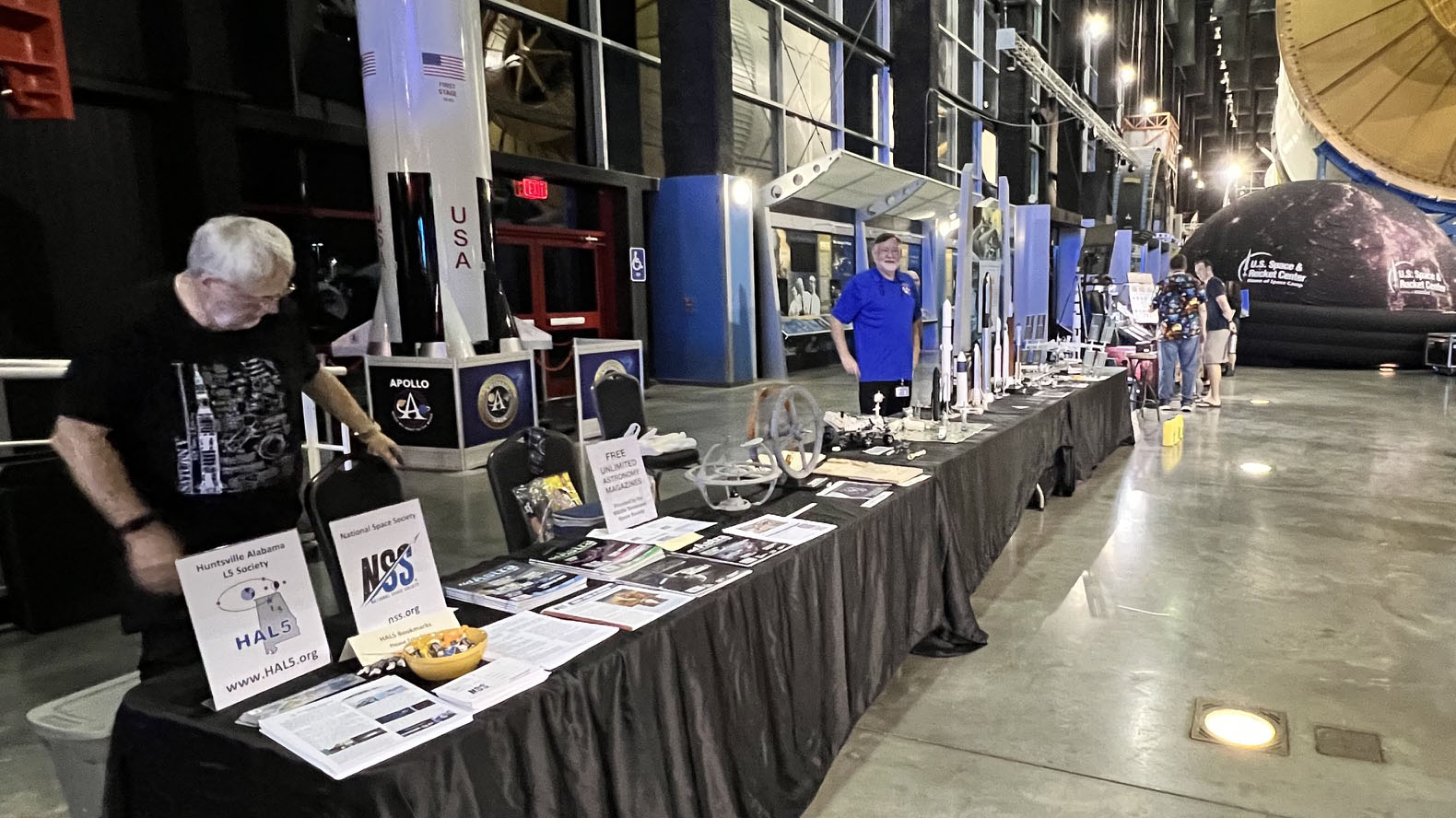
Fellow visitors at the SETI Institute. Photo by Dave Dressler.
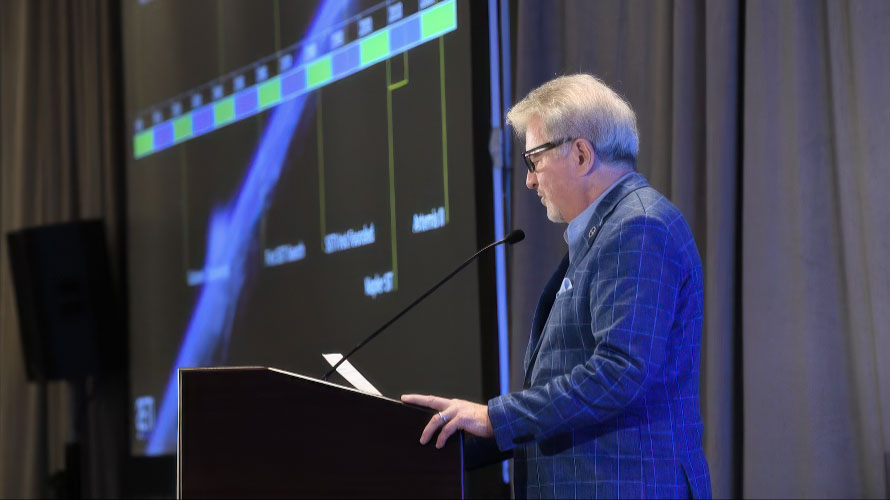
Top photo of Bill Diamond speaking at ISDC. Photo by Travis Wicks.