By Burt Dicht
NSS Space Coast Correspondent
A large anvil cloud hanging over Florida’s Space Coast added some uncertainty to the final hours of the countdown, but it cleared in time for NASA’s SpaceX Crew-13 mission to lift off on schedule at 11:10 a.m. EDT on Oct. 1.
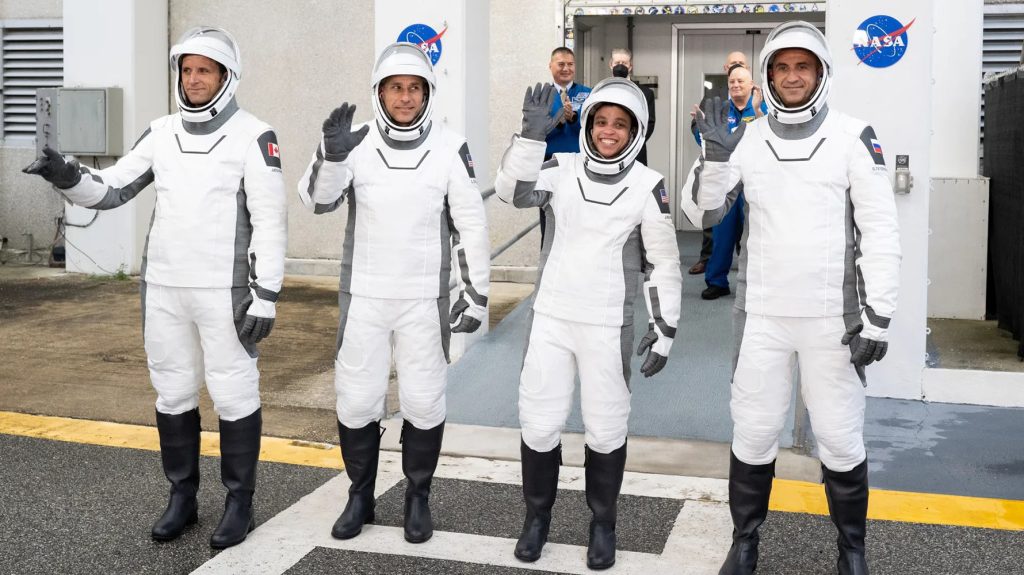
A SpaceX Falcon 9 launched from Space Launch Complex 40 at Cape Canaveral Space Force Station carrying Canadian Space Agency astronaut Joshua Kutryk, NASA astronauts Luke Delaney and Jessica Watkins, and Roscosmos cosmonaut Sergey Teteryatnikov, shown in photo from left to right as they prepare to depart the Neil A. Armstrong Operations and Checkout Building (image credit: NASA/Joel Kowsky). The four are now on their way to the International Space Station, where they will join the Expedition 75 crew.
The launch included several milestones. Watkins, the Crew-13 commander, became the first NASA astronaut to launch aboard a SpaceX Dragon spacecraft twice. She previously spent 170 days aboard the ISS as a member of Crew-4 in 2022. Kutryk, making his first spaceflight, became the first Canadian Space Agency astronaut to fly as part of NASA’s Commercial Crew Program. Delaney and Teteryatnikov are also making their first spaceflights.
Crew-13 is flying aboard the SpaceX Dragon spacecraft Grace, which made its first trip to the ISS on Axiom Mission 4 in 2025.
For Crew-13, getting to launch day required a little extra patience. The mission had originally been targeting Sept. 12, but NASA and SpaceX delayed the flight after an oxidizer leak was detected in Dragon’s propulsion system during standard prelaunch processing. The team subsequently replaced an oxidizer valve and completed the testing and reviews necessary to clear the spacecraft for flight.
The result was a delay of less than three weeks from the original launch date.


Making Human Spaceflight Look Routine
Following the launch, NASA Administrator Jared Isaacman reflected on how missions such as Crew-13 can sometimes make human spaceflight appear routine. He emphasized that it is anything but routine and credited the expertise and competence of the NASA-industry workforce that makes these missions possible, praising NASA employees, SpaceX and NASA’s other commercial partners.
By the time of the post-launch news conference, Dragon Grace was safely in orbit, separated from the Falcon 9 second stage and operating normally as the crew prepared for its rendezvous with the space station.

Julianna Scheiman, SpaceX director of NASA Science and Dragon Programs, noted another measure of how far the program has come. Crew-13 is the 21st crewed Dragon mission and the 53rd Dragon mission to the International Space Station.
A Fast Trip to the Space Station
If the rendezvous proceeds according to plan, Grace will dock with the forward port of the station’s Harmony module at approximately 7 p.m. EDT, just 7 hours and 50 minutes after launch. That would make Crew-13 the fastest launch-to-docking by a U.S. spacecraft in the history of the International Space Station.
The previous Crew Dragon record was 14 hours and 43 minutes, set by Crew-11 in August 2025. Russian Soyuz spacecraft have flown even faster rendezvous profiles, making the distinction of U.S. spacecraft important.
The shorter trip is possible because of favorable orbital geometry. When the ISS is properly positioned relative to the launch site, Dragon requires fewer orbits and phasing maneuvers to catch up with the station. The tradeoff is an essentially instantaneous launch window. Missing the planned launch time means waiting for another opportunity with a different rendezvous profile.
Six Months of Science
Once Crew-13 arrives, the new crew will begin a brief handover with Crew-12, which is scheduled to begin its return to Earth aboard the SpaceX Dragon spacecraft Freedom no earlier than Oct. 5.
Crew-13 will spend approximately six months aboard the ISS conducting research, technology demonstrations and station operations. Among the planned investigations are studies using human stem cell-derived tissues to improve disease modeling and pharmaceutical testing for conditions including heart disease and Parkinson’s disease. The crew will also study crop production for long-duration missions, blood-flow abnormalities in microgravity and new medical diagnostic equipment for monitoring astronaut health.
Kutryk will participate in an extensive Canadian research program focused in large part on understanding how humans adapt to long-duration spaceflight.
Among the experiments are AstroFit, which will study ways to improve astronaut exercise routines and reduce the physical effects of microgravity; C-STARS, examining stress, coping strategies and mental well-being during long-duration missions; and HomeBase, which looks at how astronauts maintain their sense of location and orientation without gravity.
Other Canadian investigations will examine vision changes, anemia, cardiovascular and respiratory health, bone loss and astronaut vital signs. The research will contribute to our understanding of how humans can live and work in space for longer periods as missions move beyond low Earth orbit.
It is a connection the Crew-13 members emphasized when they arrived at Kennedy Space Center on Saturday. After a year of training, Watkins, Delaney, Kutryk and Teteryatnikov are beginning the mission they have been preparing for, one that will contribute to the research needed for longer-duration human spaceflight and future missions to the Moon and Mars.