Category: Nonfiction
Reviewed by: Clifford R. McMurray
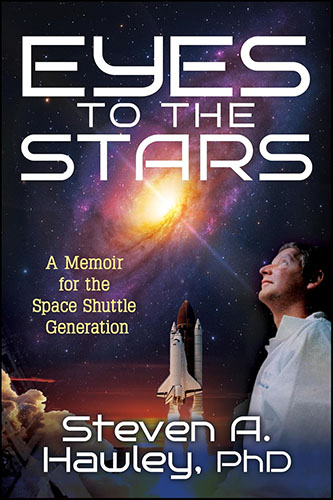
Title: Eyes to the Stars: A Memoir for the Space Shuttle Generation
Author: Steven A. Hawley, PhD
Format: Hardcover/Kindle
Pages: 464
Publisher: Bookpress Publishing
Date: July 2026
Retail Price: $39.95/$13.95
ISBN: 978-1960259578
Find this book
When he joined the NASA astronaut corps in 1978, Steven Hawley was the youngest person ever selected for that elite group. As a member of NASA’s Astronaut Group 8, he was one of the TFNGs (“Thirty-Five New Guys”), the first group of astronauts specifically selected to fly the Space Shuttle. He wasn’t a pilot; he was a freshly minted PhD astronomer with a degree in astrophysics from the University of California, Santa Barbara. With Shuttle about to fly, NASA wanted scientist astronauts as well as pilots.
As a boy, Hawley loved the stars and read about the idea that telescopes orbiting in space above Earth’s atmosphere would give much clearer views than any telescope on Earth. He dreamed about being an astronomer working in space on one of those telescopes. As it turned out, space telescopes could be operated remotely and didn’t need an on-site operator. But as an astronaut, Hawley was a crewmember on the shuttle flight that launched the Hubble Space Telescope, and he helped upgrade Hubble on the second servicing mission to that telescope. His last spaceflight was the mission that deployed the Chandra X-Ray Observatory, another of NASA’s “Great Observatories.”
Among Hawley’s classmates in Group 8 were NASA’s first six female astronauts, one of whom, Sally Ride, was just a few months older than him. She and Hawley were married in 1982, a year before she became America’s first woman in space. The marriage wasn’t destined to last. Ride divorced Hawley in 1987, for reasons he thought at the time were career-related. He remarried a few years later. These events take just a few pages of the book; as with most astronauts who write autobiographies, Hawley is clearly more interested in telling the story of the history he was helping to make than in his personal life.
From the beginning of his time at NASA, he decided he wanted to make his career there. He was somewhere near the center of the action throughout the next 30 years, almost to the end of the shuttle program. He flew in space five times, participated in the investigations of the Challenger and Columbia accidents, and held several management positions in the NASA bureaucracy, including Deputy Chief of the Astronaut Office (the first non-pilot to hold that position), Deputy Director of NASA Ames Research Center, Deputy Director of Flight Crew Operations, and, finally, Director of Flight Crew Operations. In that last role, he represented the astronauts in the shuttle launch decision meetings on many flights. His administrative work spanned the years of the Shuttle missions to the Russian Mir space station and the first flights to assemble the International Space Station. He was the last of the TFNGs to fly on the Shuttle.
Whether a young person wants to be an astronaut or not, this book has a lot to teach about how to think about and manage a career and accomplish consequential goals. Hawley always gave his best, a lesson he learned early and well from a high school teacher who gave him a choice between an A or an F, with nothing in between, when he tried to coast through a class. Whenever his fellow astronauts speak of Hawley, in private as well as in their own books, it’s always with deep respect. He made his mark in a life worth reading about.
© 2026 Clifford R. McMurray